José L. Balcázar – författare
Visar alla böcker från författaren José L. Balcázar. Handla med fri frakt och snabb leverans.
13 produkter
13 produkter
Häftad, Engelska, 2006
566 kr
Skickas inom 10-15 vardagar
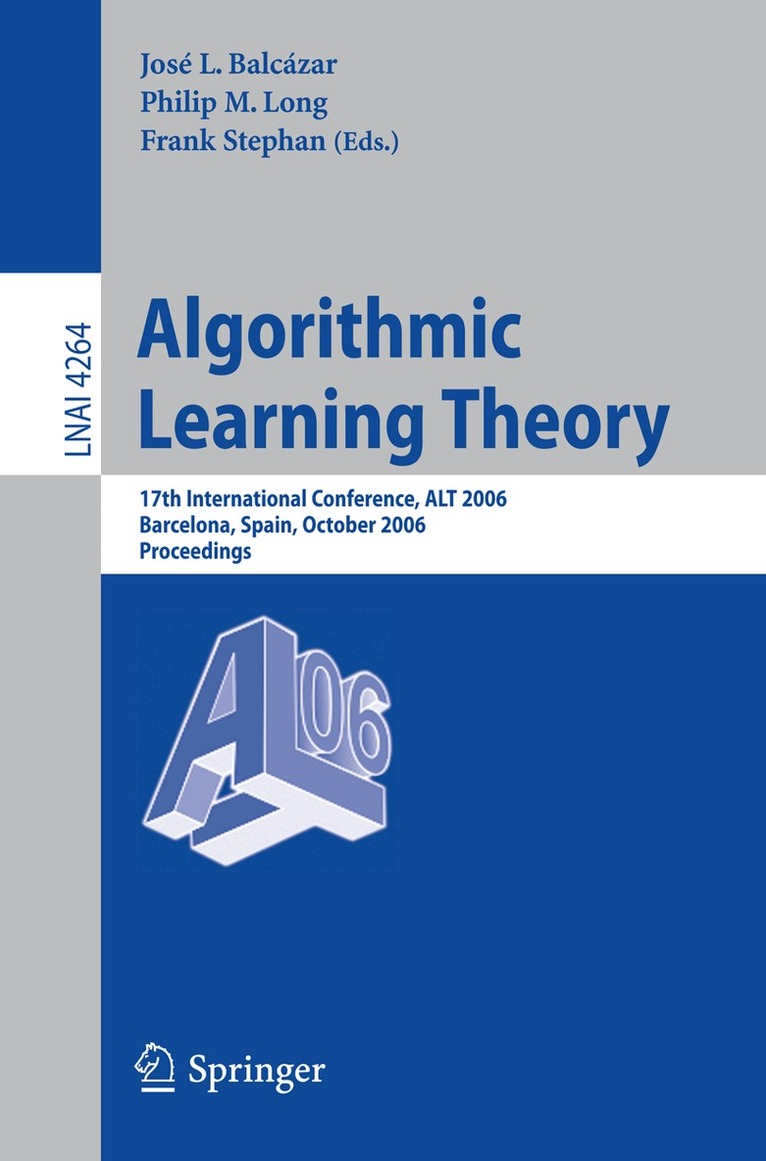
This book constitutes the refereed proceedings of the 17th International Conference on Algorithmic Learning Theory, ALT 2006, held in Barcelona, Spain in October 2006, colocated with the 9th International Conference on Discovery Science, DS 2006. The 24 revised full papers presented together with the abstracts of five invited papers were carefully reviewed and selected from 53 submissions. The papers are dedicated to the theoretical foundations of machine learning.
E-bok
PDF, Engelska, 2006734 kr
Läs direkt efter köp
Häftad, Engelska, 2010
1 125 kr
Skickas inom 10-15 vardagar
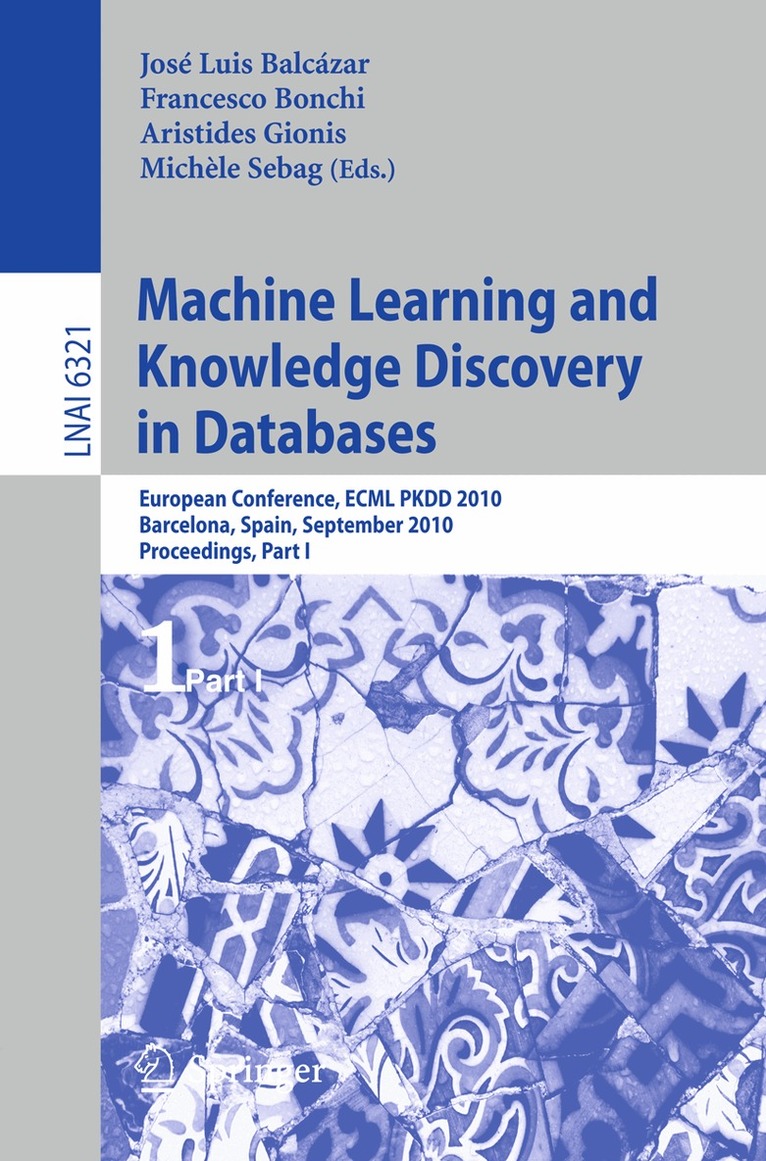
The European Conference on Machine Learning and Principles and Practice of Knowledge Discovery in Databases, ECML PKDD 2010, was held in Barcelona, September 20-24, 2010, consolidating the long junction between the European Conference on Machine Learning (of which the ?rst instance as European wo- shop dates back to 1986) and Principles and Practice of Knowledge Discovery in Data Bases (of which the ?rst instance dates back to 1997). Since the two conferences were ?rst collocated in 2001, both machine learning and data m- ing communities have realized how each discipline bene?ts from the advances, and participates to de?ning the challenges, of the sister discipline. Accordingly, a single ECML PKDD Steering Committee gathering senior members of both communities was appointed in 2008. In 2010, as in previous years, ECML PKDD lasted from Monday to F- day. It involved six plenary invited talks, by Christos Faloutsos, Jiawei Han, Hod Lipson, Leslie Pack Kaelbling, Tomaso Poggio, and Jur .. gen Schmidhuber, respectively. Monday and Friday were devoted to workshops and tutorials, or- nized and selected by Colin de la Higuera and Gemma Garriga.Continuing from ECML PKDD 2009, an industrial session managed by Taneli Mielikainen and Hugo Zaragoza welcomed distinguished speakers from the ML and DM ind- try: Rakesh Agrawal, Mayank Bawa, Ignasi Belda, Michael Berthold, Jos'eLuis Fl' orez,ThoreGraepel,andAlejandroJaimes.Theconferencealsofeaturedad- coverychallenge,organizedbyAndr' asBenczur ' ,CarlosCastillo,Zolt' anGyon .. gyi, and Julien Masan' es.
E-bok
PDF, Engelska, 20101 408 kr
Läs direkt efter köp
Häftad, Engelska, 2010
566 kr
Skickas inom 10-15 vardagar
The European Conference on Machine Learning and Principles and Practice of Knowledge Discovery in Databases, ECML PKDD 2010, was held in Barcelona, September 20-24, 2010, consolidating the long junction between the European Conference on Machine Learning (of which the ?rst instance as European wo- shop dates back to 1986) and Principles and Practice of Knowledge Discovery in Data Bases (of which the ?rst instance dates back to 1997). Since the two conferences were ?rst collocated in 2001, both machine learning and data m- ing communities have realized how each discipline bene?ts from the advances, and participates to de?ning the challenges, of the sister discipline. Accordingly, a single ECML PKDD Steering Committee gathering senior members of both communities was appointed in 2008. In 2010, as in previous years, ECML PKDD lasted from Monday to F- day. It involved six plenary invited talks, by Christos Faloutsos, Jiawei Han, Hod Lipson, Leslie Pack Kaelbling, Tomaso Poggio, and Jur .. gen Schmidhuber, respectively. Monday and Friday were devoted to workshops and tutorials, or- nized and selected by Colin de la Higuera and Gemma Garriga.Continuing from ECML PKDD 2009, an industrial session managed by Taneli Mielikainen and Hugo Zaragoza welcomed distinguished speakers from the ML and DM ind- try: Rakesh Agrawal, Mayank Bawa, Ignasi Belda, Michael Berthold, Jos'eLuis Fl' orez,ThoreGraepel,andAlejandroJaimes.Theconferencealsofeaturedad- coverychallenge,organizedbyAndr' asBenczur ' ,CarlosCastillo,Zolt' anGyon .. gyi, and Julien Masan' es.
E-bok
PDF, Engelska, 2010708 kr
Läs direkt efter köp
Häftad, Engelska, 2010
1 125 kr
Skickas inom 10-15 vardagar
The European Conference on Machine Learning and Principles and Practice of Knowledge Discovery in Databases, ECML PKDD 2010, was held in Barcelona, September 20-24, 2010, consolidating the long junction between the European Conference on Machine Learning (of which the ?rst instance as European wo- shop dates back to 1986) and Principles and Practice of Knowledge Discovery in Data Bases (of which the ?rst instance dates back to 1997). Since the two conferences were ?rst collocated in 2001, both machine learning and data m- ing communities have realized how each discipline bene?ts from the advances, and participates to de?ning the challenges, of the sister discipline. Accordingly, a single ECML PKDD Steering Committee gathering senior members of both communities was appointed in 2008. In 2010, as in previous years, ECML PKDD lasted from Monday to F- day. It involved six plenary invited talks, by Christos Faloutsos, Jiawei Han, Hod Lipson, Leslie Pack Kaelbling, Tomaso Poggio, and Jur .. gen Schmidhuber, respectively. Monday and Friday were devoted to workshops and tutorials, or- nized and selected by Colin de la Higuera and Gemma Garriga.Continuing from ECML PKDD 2009, an industrial session managed by Taneli Mielikainen and Hugo Zaragoza welcomed distinguished speakers from the ML and DM ind- try: Rakesh Agrawal, Mayank Bawa, Ignasi Belda, Michael Berthold, Jos'eLuis Fl' orez,ThoreGraepel,andAlejandroJaimes.Theconferencealsofeaturedad- coverychallenge,organizedbyAndr' asBenczur ' ,CarlosCastillo,Zolt' anGyon .. gyi, and Julien Masan' es.
E-bok
PDF, Engelska, 20101 459 kr
Läs direkt efter köp
E-bok
PDF, Engelska, 20121 519 kr
Läs direkt efter köp
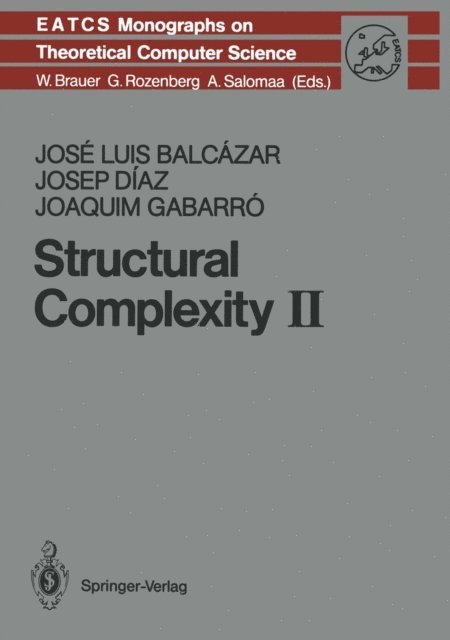
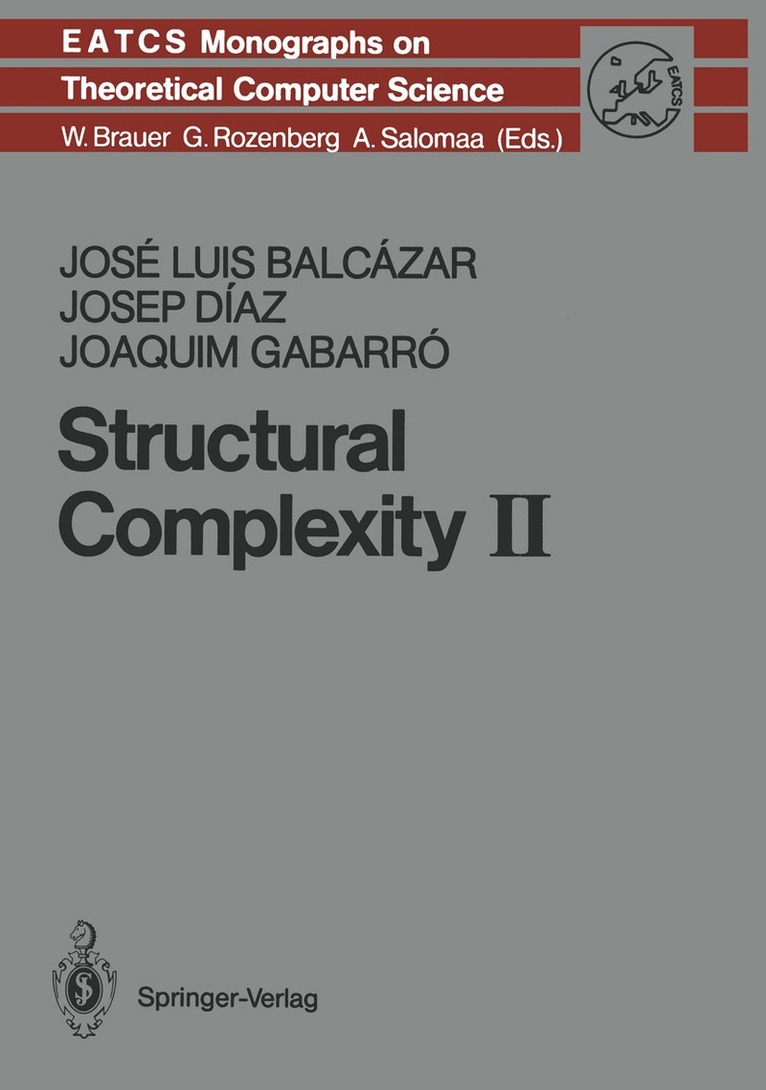
This is the second volume of a two volume collection on Structural Complexity. This volume assumes as a prerequisite knowledge about the topics treated in Volume I, but the present volume itself is nearly self-contained. As in Volume I, each chapter of this book ends with a section entitled "Bibliographical Remarks", in which the relevant references for the chapter are briefly commented upon. These sections might also be of interest to those wanting an overview of the evolution of the field, as well as relevant related results which are not included in the text. Each chapter includes a section of exercises. The reader is encouraged to spend some time on them. Some results presented as exercises are occasionally used later in the text. A reference is provided for the most interesting and for the most useful exercises. Some exercises are marked with a • to indicate that, to the best knowledge of the authors, the solution has a certain degree of difficulty. Many topics from the field of Structural Complexity are not treated in depth, or not treated at all. The authors bear all responsibility for the choice of topics, which has been made based on the interest of the authors on each topic. Many friends and colleagues have made suggestions or corrections. In partic ular we would like to express our gratitude to Richard Beigel, Ron Book, Rafael Casas, Jozef Gruska, Uwe Schoning, Pekka Orponen, and Osamu Watanabe.
Häftad, Engelska, 2011
1 201 kr
Skickas inom 10-15 vardagar
This is the second volume of a two volume collection on Structural Complexity. This volume assumes as a prerequisite knowledge about the topics treated in Volume I, but the present volume itself is nearly self-contained. As in Volume I, each chapter of this book ends with a section entitled "Bibliographical Remarks", in which the relevant references for the chapter are briefly commented upon. These sections might also be of interest to those wanting an overview of the evolution of the field, as well as relevant related results which are not included in the text. Each chapter includes a section of exercises. The reader is encouraged to spend some time on them. Some results presented as exercises are occasionally used later in the text. A reference is provided for the most interesting and for the most useful exercises. Some exercises are marked with a • to indicate that, to the best knowledge of the authors, the solution has a certain degree of difficulty. Many topics from the field of Structural Complexity are not treated in depth, or not treated at all. The authors bear all responsibility for the choice of topics, which has been made based on the interest of the authors on each topic. Many friends and colleagues have made suggestions or corrections. In partic ular we would like to express our gratitude to Richard Beigel, Ron Book, Rafael Casas, Jozef Gruska, Uwe Schoning, Pekka Orponen, and Osamu Watanabe.
E-bok
PDF, Engelska, 2012687 kr
Läs direkt efter köp
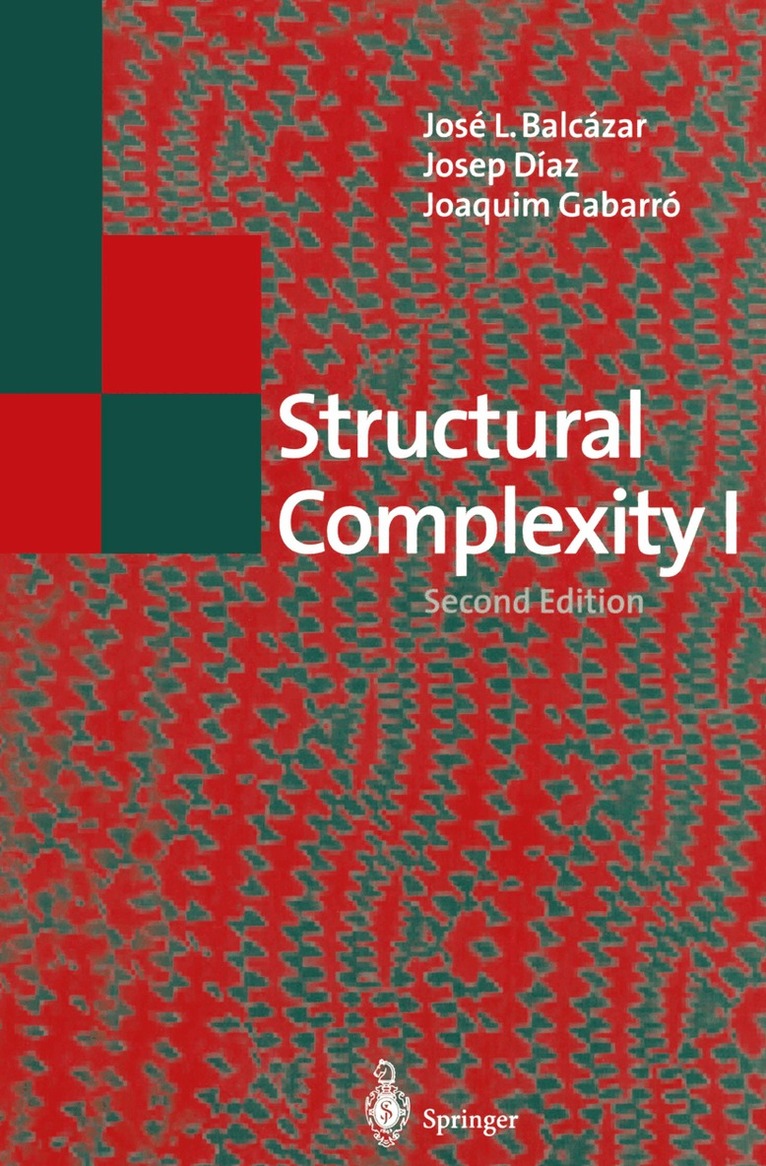
In the six years since the first edition of this book was published, the field of Structural Complexity has grown quite a bit. However, we are keeping this volume at the same basic level that it had in the first edition, and the only new result incorporated as an appendix is the closure under complementation of nondeterministic space classes, which in the previous edition was posed as an open problem. This result was already included in our Volume II, but we feel that due to the basic nature of the result, it belongs to this volume. There are of course other important results obtained during these last six years. However, as they belong to new areas opened in the field they are outside the scope of this fundamental volume. Other changes in this second edition are the update of some Bibliograph ical Remarks and references, correction of many mistakes and typos, and a renumbering of the definitions and results. Experience has shown us that this new numbering is a lot more friendly, and several readers have confirmed this opinion. For the sake of the reader of Volume II, where all references to Volume I follow the old numbering, we have included here a table indicating the new number corresponding to each of the old ones.
Häftad, Engelska, 2011
550 kr
Skickas inom 10-15 vardagar
In the six years since the first edition of this book was published, the field of Structural Complexity has grown quite a bit. However, we are keeping this volume at the same basic level that it had in the first edition, and the only new result incorporated as an appendix is the closure under complementation of nondeterministic space classes, which in the previous edition was posed as an open problem. This result was already included in our Volume II, but we feel that due to the basic nature of the result, it belongs to this volume. There are of course other important results obtained during these last six years. However, as they belong to new areas opened in the field they are outside the scope of this fundamental volume. Other changes in this second edition are the update of some Bibliograph ical Remarks and references, correction of many mistakes and typos, and a renumbering of the definitions and results. Experience has shown us that this new numbering is a lot more friendly, and several readers have confirmed this opinion. For the sake of the reader of Volume II, where all references to Volume I follow the old numbering, we have included here a table indicating the new number corresponding to each of the old ones.
E-bok
PDF, Engelska, 20121 140 kr
Läs direkt efter köp
Since the achievement of a fonnal definition of the concept of "algorithm", the Mathematical Theory of Computation has developed into a broad and rich discipline. The notion of "complexity of an algorithm" yields an important area of research, known as Complexity Theory, that can be approached from several points of view. Some of these are briefly discussed in the Introduction and, in particular, our view of the "Structural" approach is outlined there. We feel the subject is mature enough to permit collecting and interrelating many of the results in book fonn. Let us point out that a substantial part of the knowledge in Structural Complexity Theory can be found only in specialized journals, symposia proceedings, and monographs like doctoral dissertations or similar texts, mostly unpublished. We believe that a task to be done soon is a systematization of the interconnections between all the research lines; this is a serious and long task. We hope that the two volumes of this book can serve as a starting point for this systematization process.