Josef Chytry - Böcker
Visar alla böcker från författaren Josef Chytry. Handla med fri frakt och snabb leverans.
9 produkter
9 produkter
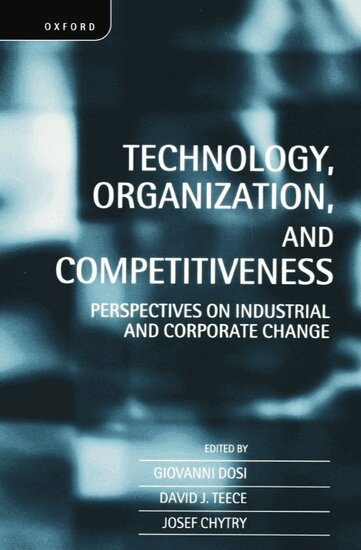
Technology, Organization, and Competitiveness
Perspectives on Industrial and Corporate Change
Häftad, Engelska, 1998
1 487 kr
Skickas inom 5-8 vardagar
This book brings together the work of leading international thinkers working in the overlapping areas of economics, organization studies, business history, corporate strategy, and innovation. There is a growing awareness that the perspectives of a single discipline are unable to capture and explain the complexities and dynamics of firm behaviour, organizational structure, and corporate strategy. All the chapters in this book are drawn from the pioneering journal Industrial and Corporate Change opening up the inter-disciplinary coverage of the journal to a wider readership. Here readers will find extensive and original contributions from economists Oliver Williamson, Richard Nelson, and Martin Fransman; sociology and organization theorists Mark Granovetter and Gary Hamilton; business historians William Lazonick and Jonathan West; innovation scholars Parimal Patel, Keith Pavitt, and Giovanni Dosi; and business strategists David Teece and Gary Pisano. This book will be vital reading for all those who want to get to grips with the best of current international thinking on the dynamic interplay of technology, organization, and competition.
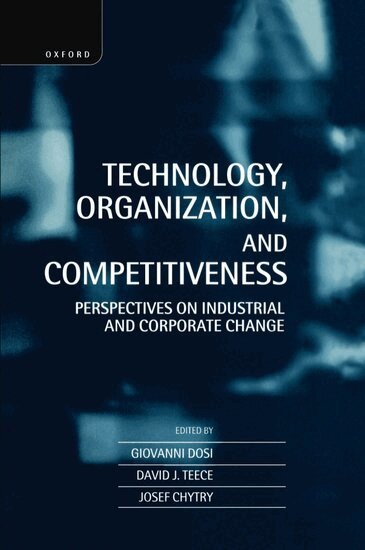
Technology, Organization, and Competitiveness
Perspectives on Industrial and Corporate Change
Inbunden, Engelska, 1998
3 425 kr
Skickas inom 5-8 vardagar
This book brings together the work of leading international thinkers working in the overlapping areas of economics, organization studies, business history, corporate strategy, and innovation. There is a growing awareness that the perspectives of a single discipline are unable to capture and explain the complexities and dynamics of firm behaviour, organizational structure, and corporate strategy. All the chapters in this book are drawn from the pioneering journal Industrial and Corporate Change opening up the inter-disciplinary coverage of the journal to a wider readership. Here readers will find extensive and original contributions from economists Oliver Williamson, Richard Nelson, and Martin Fransman; sociology and organization theorists Mark Granovetter and Gary Hamilton; business historians William Lazonick and Jonathan West; innovation scholars Parimal Patel, Keith Pavitt, and Giovanni Dosi; and business strategists David Teece and Gary Pisano. This book will be vital reading for all those who want to get to grips with the best of current international thinking on the dynamic interplay of technology, organization, and competition.
900 kr
Skickas inom 3-6 vardagar
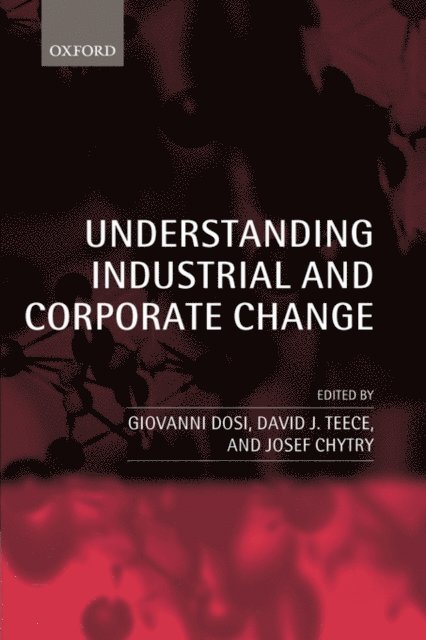
Understanding Industrial and Corporate Change contains pioneering work on technological, organizational, and institutional change from leading theorists and practitioners such as Joseph Stiglitz, Oliver Williamson, Masahiko Aoki, Alfred D. Chandler Jr., and Sidney Winter. Trans-disciplinary in its approach, the book explores three distinct themes: Markets and Organizations; Evolutionary Theory and Technological Change; and Strategy, Capabilities, and Knowledge Management. The chapters are drawn from the journal Industrial and Corporate Change, reflecting the diverse contributions it has published since 1992 in such areas as business history, industrial organization, strategic management, organizational theory, innovation studies, organizational behavior, economics, political science, social psychology, and sociology.Understanding Industrial and Corporate Change provides an accessible account of recent research and theory on technological, organizational, and institutional change for academics and advanced students of Business and Management, Organization Theory, Technology and Innovation Studies, and Industrial Economics.
835 kr
Skickas inom 3-6 vardagar
Shortly after the middle of the eighteenth century a number of thinkers from the German-speaking lands began to create a paradigm drawn from their impressions of a distant historical reality, ancient Athens; added to it a new mode of thought, modern dialectics; and at times even paid homage to the ancient Greek deity Dionysos, to materialize their longing for an ideal. The influence of these forces came to permeate modern German consciousness, deifying the concept and activity of art, reviving the Platonic (and Sanskrit) vision of the cosmos as play and aesthetic creation, and projecting a way of life and labor that would honor not the commodity but the aesthetic product. With rigorous commitment to primary sources and an unflagging critical engagement with the ideas and concrete situations they raise, Josef Chytry provides a comprehensive and extensive study of this central motif in German thought from Winckelmann to Marcuse. Chytry takes "aesthetic state" to signify the concentrated modern intellectual movement to revitalize the radical Hellenic tradition of the polis as the site of a beautiful or good life. The movement begins with the classicism of Winckelmann, Wiemar aesthetic humanism (Wieland, Herder, Goethe), and Schiller's formal theory of the aesthetic state and continues through the idealism of the Swabian dialecticians Holderlin, Hegel, and Schelling and the realism of Marx, Wagner, and Nietzsche. It culminates in the postrealism of Heiddegger, Marcuse, and the aesthetic modernist artist Walter Spies, who initiated a dialogue with the non-Western "theatre state" of the isle of Bali. Josef Chytry concludes that the future speculation on the ideal of an aesthetic state must come to terms with the postrealist themes of ontological anarchy, aesthetic ethos, and theatre state. In a bold effort to stimulate such speculation, Chytry indicates how proponents of the aesthetic state might join forces with Rawlsian political theory to promote further the organon of persuasion that, in his view, serves as the common fount for the ancient, dialectical, and contractarian quests for the polis. This title is part of UC Press's Voices Revived program, which commemorates University of California Press’s mission to seek out and cultivate the brightest minds and give them voice, reach, and impact. Drawing on a backlist dating to 1893, Voices Revived makes high-quality, peer-reviewed scholarship accessible once again using print-on-demand technology. This title was originally published in 1989.
1 513 kr
Skickas inom 3-6 vardagar
Shortly after the middle of the eighteenth century a number of thinkers from the German-speaking lands began to create a paradigm drawn from their impressions of a distant historical reality, ancient Athens; added to it a new mode of thought, modern dialectics; and at times even paid homage to the ancient Greek deity Dionysos, to materialize their longing for an ideal. The influence of these forces came to permeate modern German consciousness, deifying the concept and activity of art, reviving the Platonic (and Sanskrit) vision of the cosmos as play and aesthetic creation, and projecting a way of life and labor that would honor not the commodity but the aesthetic product. With rigorous commitment to primary sources and an unflagging critical engagement with the ideas and concrete situations they raise, Josef Chytry provides a comprehensive and extensive study of this central motif in German thought from Winckelmann to Marcuse. Chytry takes "aesthetic state" to signify the concentrated modern intellectual movement to revitalize the radical Hellenic tradition of the polis as the site of a beautiful or good life. The movement begins with the classicism of Winckelmann, Wiemar aesthetic humanism (Wieland, Herder, Goethe), and Schiller's formal theory of the aesthetic state and continues through the idealism of the Swabian dialecticians Holderlin, Hegel, and Schelling and the realism of Marx, Wagner, and Nietzsche. It culminates in the postrealism of Heiddegger, Marcuse, and the aesthetic modernist artist Walter Spies, who initiated a dialogue with the non-Western "theatre state" of the isle of Bali. Josef Chytry concludes that the future speculation on the ideal of an aesthetic state must come to terms with the postrealist themes of ontological anarchy, aesthetic ethos, and theatre state. In a bold effort to stimulate such speculation, Chytry indicates how proponents of the aesthetic state might join forces with Rawlsian political theory to promote further the organon of persuasion that, in his view, serves as the common fount for the ancient, dialectical, and contractarian quests for the polis. This title is part of UC Press's Voices Revived program, which commemorates University of California Press’s mission to seek out and cultivate the brightest minds and give them voice, reach, and impact. Drawing on a backlist dating to 1893, Voices Revived makes high-quality, peer-reviewed scholarship accessible once again using print-on-demand technology. This title was originally published in 1989.
Unis vers Cythère
Aesthetic-Political Investigations in Polis Thought and the Artful Firm
Inbunden, Engelska, 2009
756 kr
Tillfälligt slut
Unis vers Cythère forms a continuation of the ongoing project to disseminate a new faculty of thought called cytherics, which is defined as the sighting and siting of aphrodisian – aesthetic-erotic – environments. The first part of the book proposes «polis thought» as a subdivision within political theory that would encourage attention to the polis element – the openness furnished by the classical polis/city for disputation, rhetoric, performance, ceremony, and the carnivalesque – for political theory and history. The second part develops the concept of the «artful firm», derived from contemporary firm and management theories on «the art firm» and «artful making», to argue for further convergences in related areas of aesthetics and management. Unis vers Cythère begins and ends with essays on the ancient Hellenic twin concepts of «thalassocracy» and «theatrocracy» in their relations to orthodox contemporary theories of political democracy.
Del 69 - American University Studies
Mountain of Paradise
Reflections on the Emergence of Greater California as a World Civilization
Inbunden, Engelska, 2013
952 kr
Skickas inom 5-8 vardagar
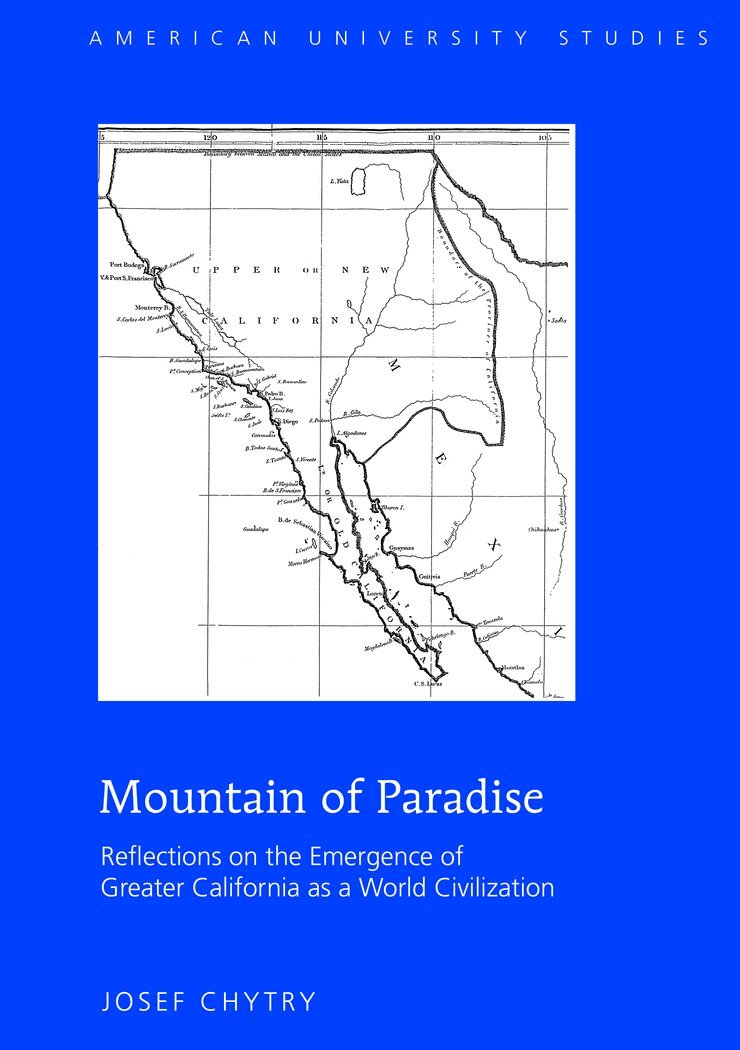
Mountain of Paradise challenges conventional taxonomies of world civilizations by introducing a new and formidable candidate: the civilization of Greater California presently incubating as the evolution of California into a veritable «nation-state» or «world commonwealth» according to contemporary commentators and scholars. Through a series of reflective essays it clarifies the momentous implications of this claim by a thorough account of the genealogical origins of «California», permutation into its speculative moment of self-identity thanks to prolonged creative interchange with European thought and philosophy, advancement to status of a socio-economic powerhouse by the 1950s and 1960s, invention of distinctly Californian variants of political economy by the 1970s and 1980s, and present domination over regions formerly classified as «Greater California». In its range and originality Mountain of Paradise constitutes a robust contribution to current political, social, economic and global thematics.
1 303 kr
Skickas inom 5-8 vardagar
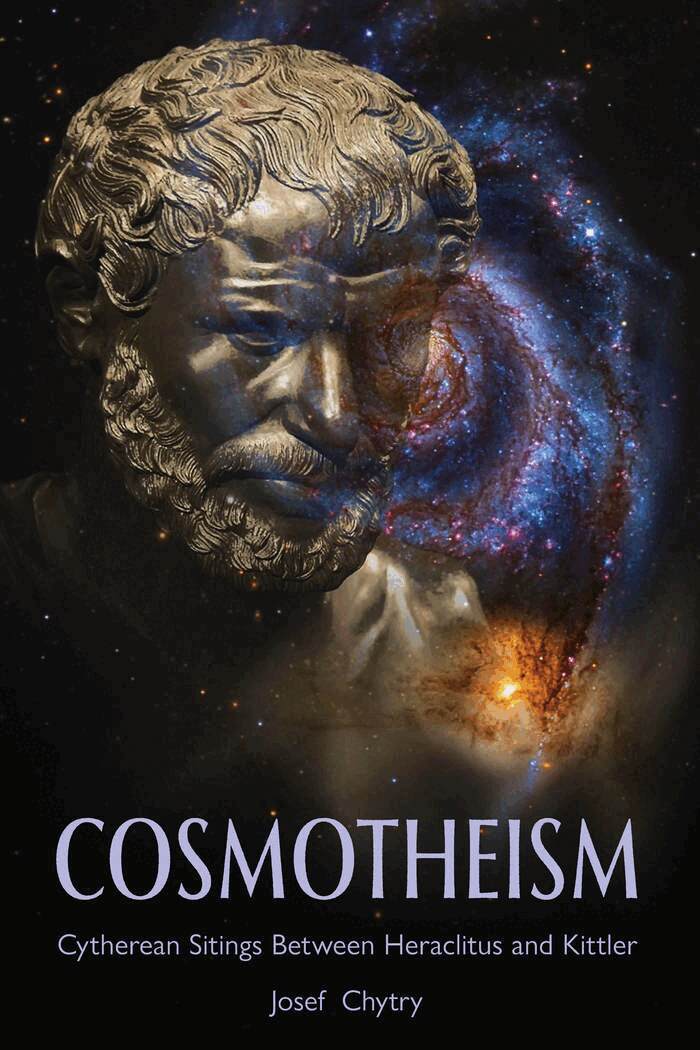
Cosmotheism retrieves the importance of a cosmic approach to reality through its revival of the heliocentric creed championed by Copernicus, Bruno and Kepler, through its critiques of historical patterns of politics and technology, and through its sponsorship of emancipatory thinkers, artists, "psychonauts," and cosmologists.
Mountain of Paradise
Reflections on the Emergence of Greater California as a World Civilization
Häftad, Engelska, 2025
434 kr
Skickas inom 5-8 vardagar
Mountain of Paradise challenges conventional taxonomies of world civilizations by introducing a new and formidable candidate: the civilization of Greater California presently incubating as the evolution of California into a veritable «nation-state» or «world commonwealth» according to contemporary commentators and scholars. Through a series of reflective essays it clarifies the momentous implications of this claim by a thorough account of the genealogical origins of «California», permutation into its speculative moment of self-identity thanks to prolonged creative interchange with European thought and philosophy, advancement to status of a socio-economic powerhouse by the 1950s and 1960s, invention of distinctly Californian variants of political economy by the 1970s and 1980s, and present domination over regions formerly classified as «Greater California». In its range and originality Mountain of Paradise constitutes a robust contribution to current political, social, economic and global thematics.