Josef Muller-Brockmann - Böcker
Visar alla böcker från författaren Josef Muller-Brockmann. Handla med fri frakt och snabb leverans.
2 produkter
2 produkter
Passenger Information System
Design Manual for the Swiss Federal Railways by Josef Müller-Brockmann
Häftad, Engelska, 2025
607 kr
Kommande
In 1980, Josef Müller-Brockmann laid the cornerstone for a uniform visual identity for the Swiss Federal Railways (SBB) with his legendary Visual Information System at Train Stations and Stops. In view of Switzerland’s multilingualism, the manual proposed a signage system that largely did without language; with his functional typography, the pioneer of Swiss graphic design conceived an intuitively comprehensible signage system for use throughout the country to also guide passengers unfamiliar with the terrain to their destination with the help of pictograms. The visual concept was developed in dialogue with the SBB and still dominates the railways’ visual identity even today.Müller-Brockmann’s manual, greatly expanded in1992 and given the title Passenger Information System, is a prime example of a complex design project that succeeds through extreme rationality and consistency. It thus serves as a compass for designers worldwide in their daily work. This reprint with a complete English translation makes the manual accessible for the first time to a broader public. Andres Janser examines the project in the context of Müller-Brockmann’s conceptual work and the systematic international design for which railways everywhere were striving during the period.
426 kr
Skickas inom 7-10 vardagar
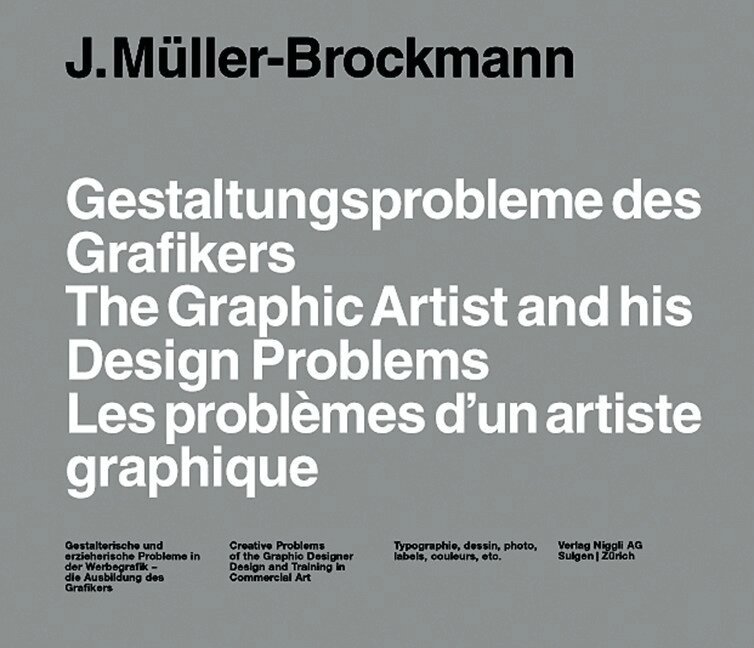
Müller-Brockmann’s book aimed to solve the graphic designer’s problem of finding the appropriate contemporary form. It became a standard work that still serves as a historic practical guide well beyond the boundaries of Switzerland. This edition is an unabbreviated reconstruction of the original edition of 1961, as a hardcover with jacket. It includes the additions made by Josef Müller-Brockmann himself for the paperback edition of 1983.In the first part, the path from illustrative to functional graphic design is traced, as well as the meaning of design elements, their use and effect in every area of advertising: business printed matter, advertisements, brochures, books, posters, and exhibitions. The middle section of the book contains fundamental thoughts concerning the work of the graphic designer. The chapter “Science and Visual Communication” covers the area of semiotics and communications research. In the last part, the systematic education of the graphic designer is presented by means of a comprehensive documentation. Thus, the book offers graphic designers a valuable survey of the fundamental tasks of design.