Joseph A. Wolf – författare
Visar alla böcker från författaren Joseph A. Wolf. Handla med fri frakt och snabb leverans.
8 produkter
8 produkter
Inbunden, Engelska, 2005
1 416 kr
Skickas inom 10-15 vardagar
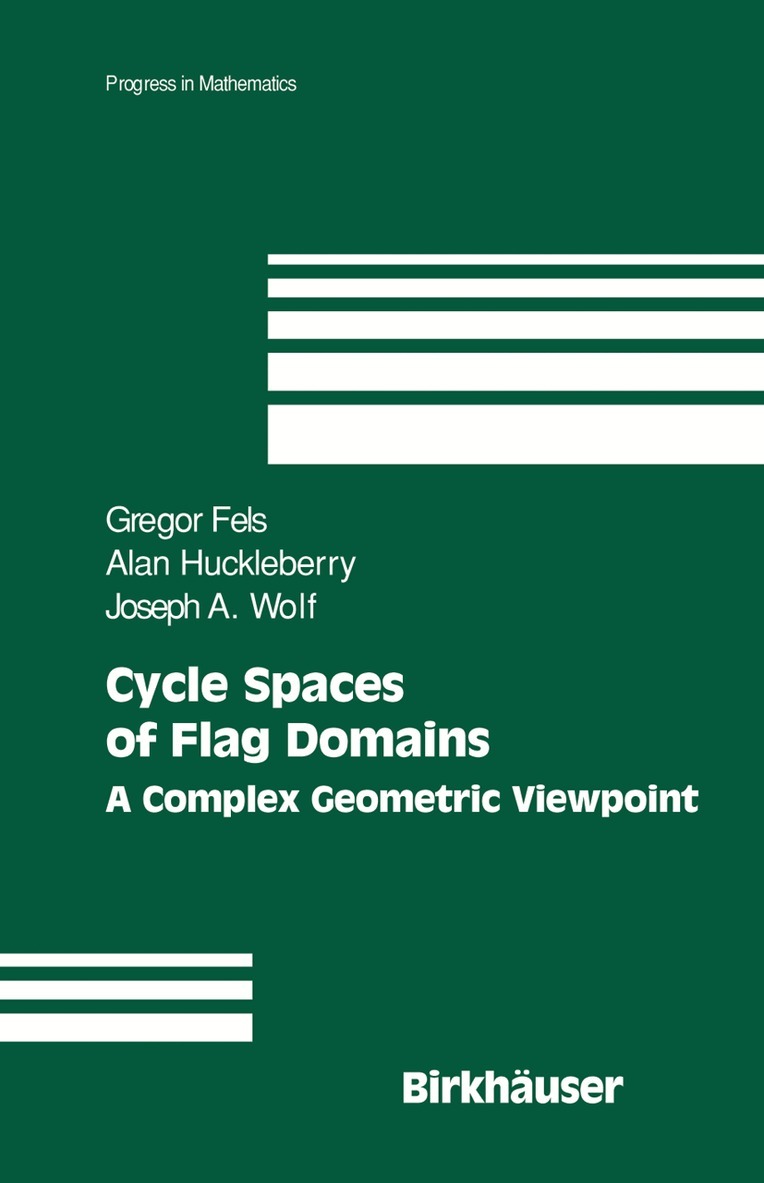
This research monograph is a systematic exposition of the background, methods, and recent results in the theory of cycle spaces of ?ag domains. Some of the methods are now standard, but many are new. The exposition is carried out from the viewpoint of complex algebraic and differential geometry. Except for certain foundational material,whichisreadilyavailablefromstandardtexts,itisessentiallyself-contained; at points where this is not the case we give extensive references. After developing the background material on complex ?ag manifolds and rep- sentationtheory, wegiveanexposition(withanumberofnewresults)ofthecomplex geometric methods that lead to our characterizations of (group theoretically de?ned) cyclespacesandtoanumberofconsequences. Thenwegiveabriefindicationofjust how those results are related to the representation theory of semisimple Lie groups through, for example, the theory of double ?bration transforms, and we indicate the connection to the variation of Hodge structure. Finally, we work out detailed local descriptions of the relevant full Barlet cycle spaces. Cycle space theory is a basic chapter in complex analysis. Since the 1960s its importance has been underlined by its role in the geometry of ?ag domains, and by applications in the representation theory of semisimple Lie groups. This developed veryslowlyuntilafewofyearsagowhenmethodsofcomplexgeometry,inparticular those involving Schubert slices, Schubert domains, Iwasawa domains and suppo- ing hypersurfaces, were introduced. In the late 1990s, and continuing through early 2002, we developed those methods and used them to give a precise description of cycle spaces for ?ag domains. This effectively enabled the use of double ?bration transforms in all ?ag domain situations.
E-bok
PDF, Engelska, 20061 733 kr
Läs direkt efter köp
This research monograph is a systematic exposition of the background, methods, and recent results in the theory of cycle spaces of ?ag domains. Some of the methods are now standard, but many are new. The exposition is carried out from the viewpoint of complex algebraic and differential geometry. Except for certain foundational material,whichisreadilyavailablefromstandardtexts,itisessentiallyself-contained; at points where this is not the case we give extensive references. After developing the background material on complex ?ag manifolds and rep- sentationtheory, wegiveanexposition(withanumberofnewresults)ofthecomplex geometric methods that lead to our characterizations of (group theoretically de?ned) cyclespacesandtoanumberofconsequences. Thenwegiveabriefindicationofjust how those results are related to the representation theory of semisimple Lie groups through, for example, the theory of double ?bration transforms, and we indicate the connection to the variation of Hodge structure. Finally, we work out detailed local descriptions of the relevant full Barlet cycle spaces. Cycle space theory is a basic chapter in complex analysis. Since the 1960s its importance has been underlined by its role in the geometry of ?ag domains, and by applications in the representation theory of semisimple Lie groups. This developed veryslowlyuntilafewofyearsagowhenmethodsofcomplexgeometry,inparticular those involving Schubert slices, Schubert domains, Iwasawa domains and suppo- ing hypersurfaces, were introduced. In the late 1990s, and continuing through early 2002, we developed those methods and used them to give a precise description of cycle spaces for ?ag domains. This effectively enabled the use of double ?bration transforms in all ?ag domain situations.
Häftad, Engelska, 2011
719 kr
Skickas inom 5-8 vardagar
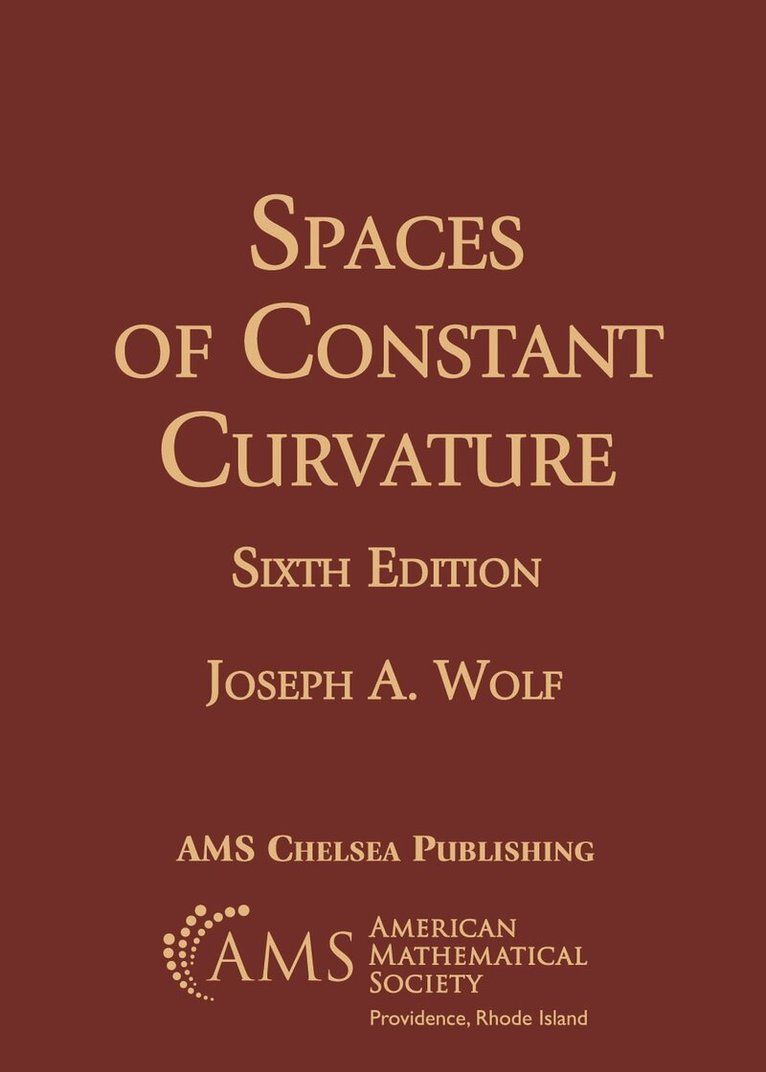
This book is the sixth edition of the classic Spaces of Constant Curvature, first published in 1967, with the previous (fifth) edition published in 1984. It illustrates the high degree of interplay between group theory and geometry. The reader will benefit from the very concise treatments of riemannian and pseudo-riemannian manifolds and their curvatures, of the representation theory of finite groups, and of indications of recent progress in discrete subgroups of Lie groups.Part I is a brief introduction to differentiable manifolds, covering spaces, and riemannian and pseudo-riemannian geometry. It also contains a certain amount of introductory material on symmetry groups and space forms, indicating the direction of the later chapters. Part II is an updated treatment of euclidean space form. Part III is Wolf's classic solution to the Clifford-Klein Spherical Space Form Problem. It starts with an exposition of the representation theory of finite groups. Part IV introduces riemannian symmetric spaces and extends considerations of spherical space forms to space forms of riemannian symmetric spaces. Finally, Part V examines space form problems on pseudo-riemannian symmetric spaces. At the end of Chapter 12 there is a new appendix describing some of the recent work on discrete subgroups of Lie groups with application to space forms of pseudo-riemannian symmetric spaces. Additional references have been added to this sixth edition as well.
Inbunden, Engelska, 2014
549 kr
Skickas inom 10-15 vardagar
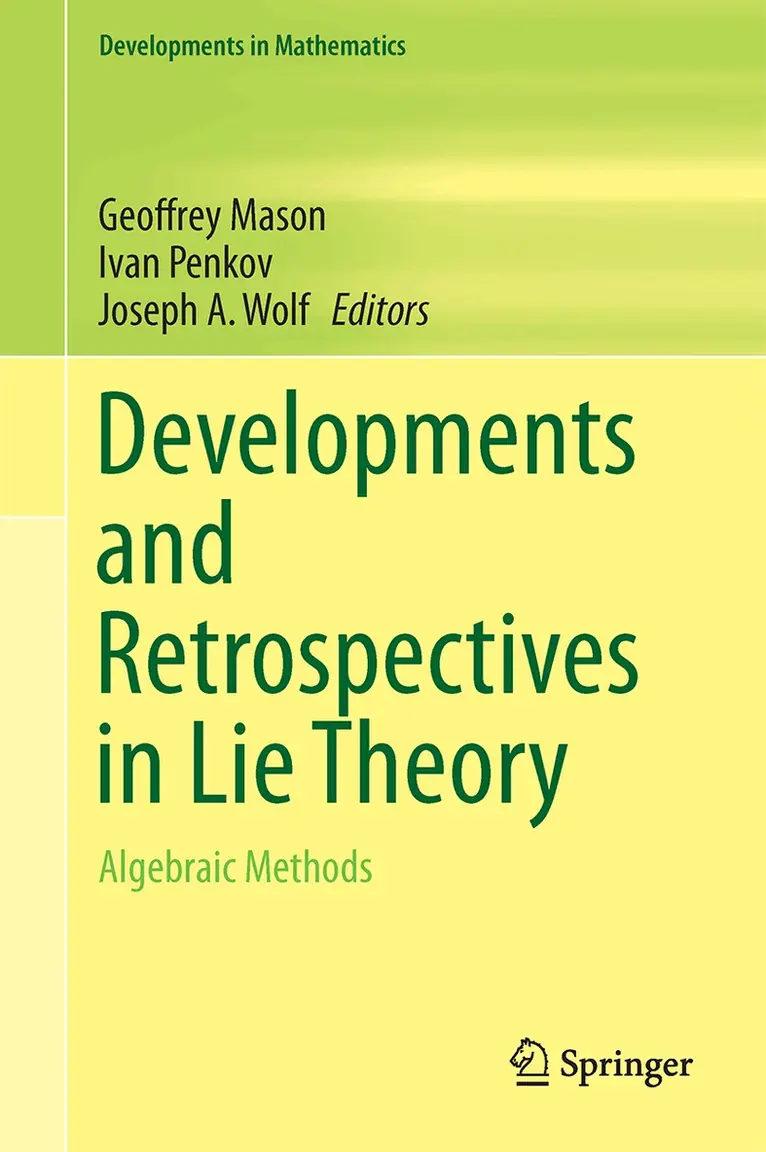
The Lie Theory Workshop, founded by Joe Wolf (UC, Berkeley), has been running for over two decades. These workshops have been sponsored by the NSF, noting the talks have been seminal in describing new perspectives in the field covering broad areas of current research. At the beginning, the top universities in California and Utah hosted the meetings which continue to run on a quarterly basis. Experts in representation theory/Lie theory from various parts of the US, Europe, Asia (China, Japan, Singapore, Russia), Canada, and South and Central America were routinely invited to give talks at these meetings. Nowadays, the workshops are also hosted at universities in Louisiana, Virginia, and Oklahoma. The contributors to this volume have all participated in these Lie theory workshops and include in this volume expository articles which cover representation theory from the algebraic, geometric, analytic, and topological perspectives with also important connections to math physics. These survey articles, review and update the prominent seminal series of workshops in representation/Lie theory mentioned-above, and reflects the widespread influence of those workshops in such areas as harmonic analysis, representation theory, differential geometry, algebraic geometry, number theory, and mathematical physics. Many of the contributors have had prominent roles in both the classical and modern developments of Lie theory and its applications.
E-bok
PDF, Engelska, 2014687 kr
Läs direkt efter köp
The Lie Theory Workshop, founded by Joe Wolf (UC, Berkeley), has been running for over two decades. These workshops have been sponsored by the NSF, noting the talks have been seminal in describing new perspectives in the field covering broad areas of current research. At the beginning, the top universities in California and Utah hosted the meetings which continue to run on a quarterly basis. Experts in representation theory/Lie theory from various parts of the US, Europe, Asia (China, Japan, Singapore, Russia), Canada, and South and Central America were routinely invited to give talks at these meetings. Nowadays, the workshops are also hosted at universities in Louisiana, Virginia, and Oklahoma. The contributors to this volume have all participated in these Lie theory workshops and include in this volume expository articles which cover representation theory from the algebraic, geometric, analytic, and topological perspectives with also important connections to math physics. These survey articles, review and update the prominent seminal series of workshops in representation/Lie theory mentioned-above, and reflects the widespread influence of those workshops in such areas as harmonic analysis, representation theory, differential geometry, algebraic geometry, number theory, and mathematical physics. Many of the contributors have had prominent roles in both the classical and modern developments of Lie theory and its applications.
Inbunden, Engelska, 2014
549 kr
Skickas inom 10-15 vardagar
The Lie Theory Workshop, founded by Joe Wolf (UC, Berkeley), has been running for over two decades. At the beginning, the top universities in California and Utah hosted the meetings, which continue to run on a quarterly basis. Experts in representation theory/Lie theory from various parts of the US, Europe, Asia (China, Japan, Singapore, Russia), Canada, and South and Central America were routinely invited to give talks at these meetings. Nowadays, the workshops are also hosted at universities in Louisiana, Virginia, and Oklahoma. These Lie theory workshops have been sponsored by the NSF, noting the talks have been seminal in describing new perspectives in the field covering broad areas of current research. The contributors have all participated in these Lie theory workshops and include in this volume expository articles which will cover representation theory from the algebraic, geometric, analytic, and topological perspectives with also important connections to math physics. These survey articles, review and update the prominent seminal series of workshops in representation/Lie theory mentioned above, and reflects the widespread influence of those workshops in such areas as harmonic analysis, representation theory, differential geometry, algebraic geometry, number theory, and mathematical physics. Many of the contributors have had prominent roles in both the classical and modern developments of Lie theory and its applications.
E-bok
PDF, Engelska, 2014712 kr
Läs direkt efter köp
The Lie Theory Workshop, founded by Joe Wolf (UC, Berkeley), has been running for over two decades. At the beginning, the top universities in California and Utah hosted the meetings, which continue to run on a quarterly basis. Experts in representation theory/Lie theory from various parts of the US, Europe, Asia (China, Japan, Singapore, Russia), Canada, and South and Central America were routinely invited to give talks at these meetings. Nowadays, the workshops are also hosted at universities in Louisiana, Virginia, and Oklahoma. These Lie theory workshops have been sponsored by the NSF, noting the talks have been seminal in describing new perspectives in the field covering broad areas of current research. The contributors have all participated in these Lie theory workshops and include in this volume expository articles which will cover representation theory from the algebraic, geometric, analytic, and topological perspectives with also important connections to math physics. These survey articles, review and update the prominent seminal series of workshops in representation/Lie theory mentioned above, and reflects the widespread influence of those workshops in such areas as harmonic analysis, representation theory, differential geometry, algebraic geometry, number theory, and mathematical physics. Many of the contributors have had prominent roles in both the classical and modern developments of Lie theory and its applications.
Häftad, Engelska, 2016
549 kr
Skickas inom 10-15 vardagar
The Lie Theory Workshop, founded by Joe Wolf (UC, Berkeley), has been running for over two decades. These workshops have been sponsored by the NSF, noting the talks have been seminal in describing new perspectives in the field covering broad areas of current research. At the beginning, the top universities in California and Utah hosted the meetings which continue to run on a quarterly basis. Experts in representation theory/Lie theory from various parts of the US, Europe, Asia (China, Japan, Singapore, Russia), Canada, and South and Central America were routinely invited to give talks at these meetings. Nowadays, the workshops are also hosted at universities in Louisiana, Virginia, and Oklahoma. The contributors to this volume have all participated in these Lie theory workshops and include in this volume expository articles which cover representation theory from the algebraic, geometric, analytic, and topological perspectives with also important connections to math physics. These survey articles, review and update the prominent seminal series of workshops in representation/Lie theory mentioned-above, and reflects the widespread influence of those workshops in such areas as harmonic analysis, representation theory, differential geometry, algebraic geometry, number theory, and mathematical physics. Many of the contributors have had prominent roles in both the classical and modern developments of Lie theory and its applications.