Joseph Campana - Böcker
Visar alla böcker från författaren Joseph Campana. Handla med fri frakt och snabb leverans.
9 produkter
9 produkter
904 kr
Skickas inom 7-10 vardagar
A study of Shakespeare’s child figures in relation to their own political moment, as well as our own.Politicians are fond of saying that “children are the future.” How did the child become a figure for our political hopes? Joseph Campana’s book locates the source of this idea in transformations of childhood and political sovereignty during the age of Shakespeare, changes spectacularly dramatized by the playwright himself. Shakespeare’s works feature far more child figures—and more politically entangled children—than other literary or theatrical works of the era. Campana delves into this rich corpus to show how children and childhood expose assumptions about the shape of an ideal polity, the nature of citizenship, the growing importance of population and demographics, and the question of what is or is not human. As our ability to imagine viable futures on our planet feels ever more limited, and as children take up legal proceedings to sue on behalf of the future, it behooves us to understand the way past child figures haunt our conversations about intergenerational justice. Shakespeare offers critical precedents for questions we still struggle to answer.
279 kr
Skickas inom 7-10 vardagar
A study of Shakespeare’s child figures in relation to their own political moment, as well as our own.Politicians are fond of saying that “children are the future.” How did the child become a figure for our political hopes? Joseph Campana’s book locates the source of this idea in transformations of childhood and political sovereignty during the age of Shakespeare, changes spectacularly dramatized by the playwright himself. Shakespeare’s works feature far more child figures—and more politically entangled children—than other literary or theatrical works of the era. Campana delves into this rich corpus to show how children and childhood expose assumptions about the shape of an ideal polity, the nature of citizenship, the growing importance of population and demographics, and the question of what is or is not human. As our ability to imagine viable futures on our planet feels ever more limited, and as children take up legal proceedings to sue on behalf of the future, it behooves us to understand the way past child figures haunt our conversations about intergenerational justice. Shakespeare offers critical precedents for questions we still struggle to answer.
Del 20 - Animalibus
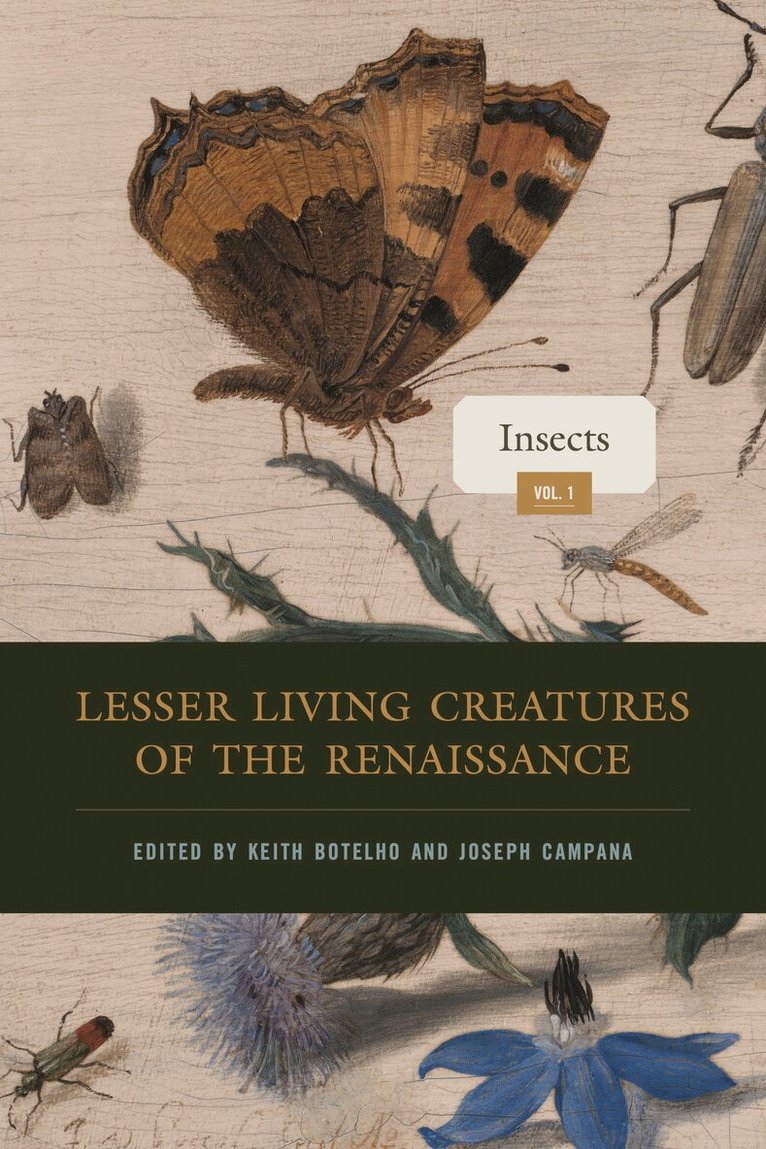
Lesser Living Creatures of the Renaissance
Volume 1, Insects
Inbunden, Engelska, 2023
1 195 kr
Skickas inom 7-10 vardagar
Lesser Living Creatures examines literary and cultural texts from early modern England in order to understand how people in that era thought about—and with—insect and arachnid life. Designed for the classroom, the book comprises two volumes—Insects and Concepts—that can be used together or independently. Each addresses the collaborative, multigenerational research that produced early modern natural history and provides new insights into the old question of what it means to be human in a world populated by beasts large and small.Volume 1, Insects, examines how insects burrowed into the literal and symbolic economies of the era. The contributors consider diminutive creatures—such as bees and beetles, flies and fleas, silkworms and spiders—and their depictions in plays, poetry, fables, natural histories, and more. In doing so, they illuminate how early modern science and literature worked as intersecting systems of knowledge production about the natural world and show definitively how insect life was, and remains, intimately entangled with human life.In addition to the editors, contributors to this volume include Chris Barrett, Roya Biggie, Bruce Boehrer, Gary Bouchard, Dan Brayton, Eric Brown, Mary Baine Campbell, Perry Guevara, Shannon Kelley, Emily King, Karen Raber, Kathryn Vomero Santos, Donovan Sherman, and Steven Swarbrick.
Del 20 - Animalibus
Lesser Living Creatures of the Renaissance
Volume 1, Insects
Häftad, Engelska, 2025
406 kr
Skickas inom 7-10 vardagar
Lesser Living Creatures examines literary and cultural texts from early modern England in order to understand how people in that era thought about—and with—insect and arachnid life. Designed for the classroom, the book comprises two volumes—Insects and Concepts—that can be used together or independently. Each addresses the collaborative, multigenerational research that produced early modern natural history and provides new insights into the old question of what it means to be human in a world populated by beasts large and small.Volume 1, Insects, examines how insects burrowed into the literal and symbolic economies of the era. The contributors consider diminutive creatures—such as bees and beetles, flies and fleas, silkworms and spiders—and their depictions in plays, poetry, fables, natural histories, and more. In doing so, they illuminate how early modern science and literature worked as intersecting systems of knowledge production about the natural world and show definitively how insect life was, and remains, intimately entangled with human life.In addition to the editors, contributors to this volume include Chris Barrett, Roya Biggie, Bruce Boehrer, Gary Bouchard, Dan Brayton, Eric Brown, Mary Baine Campbell, Perry Guevara, Shannon Kelley, Emily King, Karen Raber, Kathryn Vomero Santos, Donovan Sherman, and Steven Swarbrick.
Del 21 - Animalibus
Lesser Living Creatures of the Renaissance
Volume 2, Concepts
Inbunden, Engelska, 2023
1 087 kr
Skickas inom 7-10 vardagar
Lesser Living Creatures examines literary and cultural texts from early modern England in order to understand how people in that era thought about—and with—insect and arachnid life. The conversations in this two-volume set address the collaborative, multigenerational research that produced early modern natural history and provide new insights into the old question of what it means to be human in a world populated by beasts large and small.Volume 2, Concepts, explores ideas that cut across species, insect and otherwise, both building on and invigorating critical vocabularies developed over nearly two decades of early modern animal studies. The contributors explore topics such as the medical and culinary consumption of insects; extermination campaigns; the auditory and emotive effects of a swarm; insects and politics; and notions of infestation, stinging, and creeping. Throughout, they illuminate how early modern science and literature worked as intersecting systems of knowledge production about the natural world and show definitively how insect life was, and remains, intimately entangled with human life.In addition to the editors, contributors to this volume include Lucinda Cole, Frances E. Dolan, Lowell Duckert, Andrew Fleck, Rebecca Laroche, Jennifer Munroe, Amy L. Tigner, Jessica Lynn Wolfe, Derek Woods, and Julian Yates.
Del 21 - Animalibus
Lesser Living Creatures of the Renaissance
Volume 2, Concepts
Häftad, Engelska, 2025
385 kr
Skickas inom 7-10 vardagar
Lesser Living Creatures examines literary and cultural texts from early modern England in order to understand how people in that era thought about—and with—insect and arachnid life. The conversations in this two-volume set address the collaborative, multigenerational research that produced early modern natural history and provide new insights into the old question of what it means to be human in a world populated by beasts large and small.Volume 2, Concepts, explores ideas that cut across species, insect and otherwise, both building on and invigorating critical vocabularies developed over nearly two decades of early modern animal studies. The contributors explore topics such as the medical and culinary consumption of insects; extermination campaigns; the auditory and emotive effects of a swarm; insects and politics; and notions of infestation, stinging, and creeping. Throughout, they illuminate how early modern science and literature worked as intersecting systems of knowledge production about the natural world and show definitively how insect life was, and remains, intimately entangled with human life.In addition to the editors, contributors to this volume include Lucinda Cole, Frances E. Dolan, Lowell Duckert, Andrew Fleck, Rebecca Laroche, Jennifer Munroe, Amy L. Tigner, Jessica Lynn Wolfe, Derek Woods, and Julian Yates.
734 kr
Skickas inom 7-10 vardagar
The Pain of Reformation argues that Edmund Spenser's 1590 Faerie Queene represents an extended meditation on emerging notions of physical, social, and affective vulnerability in Renaissance England. Histories of violence, trauma, and injury have dominated literary studies, often obscuring vulnerability, or an openness to sensation, affect, and aesthetics that includes a wide range of pleasures and pains. This book approaches early modern sensations through the rubric of the vulnerable body, explores the emergence of notions of shared vulnerability, and illuminates a larger constellation of masculinity and ethics in post-Reformation England. Spenser's era grappled with England's precarious political position in a world tense with religious strife and fundamentally transformed by the doctrinal and cultural sea changes of the Reformation, which had serious implications for how masculinity, affect, and corporeality would be experienced and represented. Intimations of vulnerability often collided with the tropes of heroic poetry, producing a combination of defensiveness, anxiety, and shame. It has been easy to identify predictably violent formations of early modern masculinity but more difficult to see Renaissance literature as an exploration of vulnerability. The underside of representations of violence in Spenser's poetry was a contemplation of the precarious lives of subjects in post-Reformation England. Spenser's adoption of the allegory of Venus disarming Mars, understood in Renaissance Europe as an allegory of peace, indicates that The Faerie Queene is a heroic poem that militates against forms of violence and war that threatened to engulf Europe and devastate an England eager to militarize in response to perceived threats from within and without. In pursuing an analysis, disarmament, and redefinition of masculinity in response to a sense of shared vulnerability, Spenser's poem reveals itself to be a vital archive of the way gender, violence, pleasure, and pain were understood.
341 kr
Skickas inom 7-10 vardagar
The Pain of Reformation argues that Edmund Spenser's 1590 Faerie Queene represents an extended meditation on emerging notions of physical, social, and affective vulnerability in Renaissance England. Histories of violence, trauma, and injury have dominated literary studies, often obscuring vulnerability, or an openness to sensation, affect, and aesthetics that includes a wide range of pleasures and pains. This book approaches early modern sensations through the rubric of the vulnerable body, explores the emergence of notions of shared vulnerability, and illuminates a larger constellation of masculinity and ethics in post-Reformation England. Spenser's era grappled with England's precarious political position in a world tense with religious strife and fundamentally transformed by the doctrinal and cultural sea changes of the Reformation, which had serious implications for how masculinity, affect, and corporeality would be experienced and represented. Intimations of vulnerability often collided with the tropes of heroic poetry, producing a combination of defensiveness, anxiety, and shame. It has been easy to identify predictably violent formations of early modern masculinity but more difficult to see Renaissance literature as an exploration of vulnerability. The underside of representations of violence in Spenser's poetry was a contemplation of the precarious lives of subjects in post-Reformation England. Spenser's adoption of the allegory of Venus disarming Mars, understood in Renaissance Europe as an allegory of peace, indicates that The Faerie Queene is a heroic poem that militates against forms of violence and war that threatened to engulf Europe and devastate an England eager to militarize in response to perceived threats from within and without. In pursuing an analysis, disarmament, and redefinition of masculinity in response to a sense of shared vulnerability, Spenser's poem reveals itself to be a vital archive of the way gender, violence, pleasure, and pain were understood.
462 kr
Skickas inom 7-10 vardagar
Connecting Renaissance humanism to the variety of "critical posthumanisms" in twenty-first-century literary and cultural theory, Renaissance Posthumanism reconsiders traditional languages of humanism and the human, not by nostalgically enshrining or triumphantly superseding humanisms past but rather by revisiting and interrogating them. What if today's "critical posthumanisms," even as they distance themselves from the iconic representations of the Renaissance, are in fact moving ever closer to ideas in works from the fourteenth to the seventeenth century? What if "the human" is at once embedded and embodied in, evolving with, and de-centered amid a weird tangle of animals, environments, and vital materiality? Seeking those patterns of thought and practice, contributors to this collection focus on moments wherein Renaissance humanism looks retrospectively like an uncanny "contemporary"—and ally—of twenty-first-century critical posthumanism.