Joseph Galaskiewicz – författare
Visar alla böcker från författaren Joseph Galaskiewicz. Handla med fri frakt och snabb leverans.
2 produkter
2 produkter
Del 171 - SAGE Focus Editions
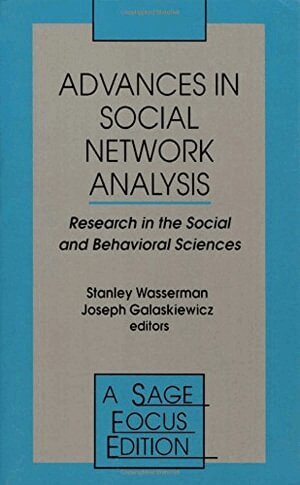
Advances in Social Network Analysis
Research in the Social and Behavioral Sciences
Häftad, Engelska, 1994
2 242 kr
Skickas inom 3-6 vardagar
Social network analysis, a method for analyzing relationships between social entities, has expanded over the last decade as new research has been done in this area. How can these new developments be applied effectively in the behavioral and social sciences disciplines? In Advances in Social Network Analysis, a team of leading methodologists in network analysis addresses this issue. They explore such topics as ways to specify the network contents to be studied, how to select the method for representing network structures, how social network analysis has been used to study interorganizational relations via the resource dependence model, how to use a contact matrix for studying the spread of disease in epidemiology, and how cohesion and structural equivalence network theories relate to studying social influence. It also offers statistical models for social support networks. Advances in Social Network Analysis is useful for researchers involved in general research methods and qualitative methods, and who are interested in psychology and sociology.
E-bok
PDF, Engelska, 2013763 kr
Läs direkt efter köp
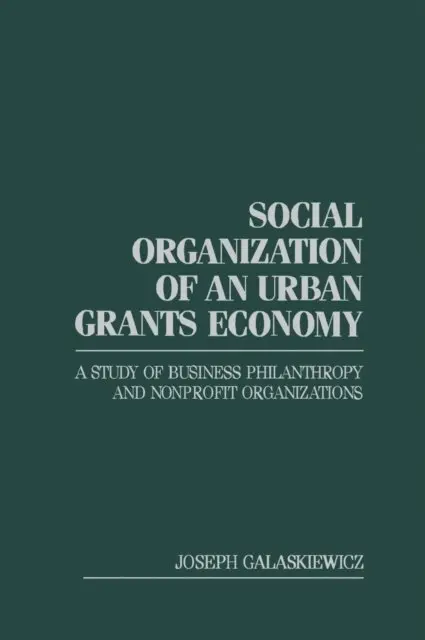
Social Organization of an Urban Grants Economy: A Study of Business Philanthropy and Nonprofit Organizations explains the elites, corporate wealth, and human service organizations as players in the urban grants economy. The focus of study is the Twin Cities of Minneapolis-St. Paul. The book discusses social institutions that support an economy of donative transfers, and how these institutions influence who gives, who gets, and who gives to whom. Emphasis is on the belief system that has influence over corporate contributions, boundary-spanning agency roles that have an active role in reducing transactional costs, and selective incentives that have been used to elicit participation. The text also analyzes the volume of corporate contributions in relation to the market position held by the firm and the social position of the executives in the community. Each firm has different rationalizations for its contributions. The role of the agencies has also developed to overcome some uncertainties present in the corporation''s contributing to nonprofits organizations. The text focuses on the production of collective goods, the peer-group which ensures participation in the collective enterprise, the institutionalization and socialization of values, as well as, the interaction of various agency roles. The book can prove valuable for social scientists, for heads of non-profit organizations, for officials of social and welfare departments of local governments, or for political scientists, economists, and historians.