Joseph W. Shaw – författare
Visar alla böcker från författaren Joseph W. Shaw. Handla med fri frakt och snabb leverans.
10 produkter
10 produkter
Häftad, Engelska, 2014
2 419 kr
Skickas inom 3-6 vardagar
Kommos, located on the south coast of Crete, is widely known for its important sanctuary of the Greek period. and for its earlier role as a major Minoan harbortown. Volumes II and III of this series on the results of the major excavations there have already been published. Now Part I of Volume I offers a general introduction to the site with chapters on the history and character of its excavation seen within the context of earlier archaeological exploration of the Mesara Plain and specifically in the Kommos area (Joseph W. Shaw) and studies on the geomorphology (John A. Gifford), the flora (C. Thomas Shay and Jennifer M. Shay, with Katherine A. Frego and Janusz Zwiazek) and the fauna (David S. Reese, with contributions by Mark J. Rose and Sebastian Payne) of the Kommos region, and ancient and modern land use (Michael Parsons, with John A. Gifford), A catalogue and analysis of finds from a foot survey in the Kommos area are included (Richard Hope Simpson, with Philip P. Betancourt, Peter J. Callaghan, Deborah K. Harlan, John W. Hayes, Joseph W. Shaw, Maria C. Shaw, and L. Vance Watrous). A final chapter by Harriet Blitzer treats Minoan implements and industries.This excavationwas conducted by the University of Toronto and the Royal Ontario Museum under the auspices of the American School of Classical Studies at Athens. Originally published in 1995. The Princeton Legacy Library uses the latest print-on-demand technology to again make available previously out-of-print books from the distinguished backlist of Princeton University Press. These editions preserve the original texts of these important books while presenting them in durable paperback and hardcover editions. The goal of the Princeton Legacy Library is to vastly increase access to the rich scholarly heritage found in the thousands of books published by Princeton University Press since its founding in 1905.
Inbunden, Engelska, 2016
5 784 kr
Skickas inom 3-6 vardagar
Kommos, located on the south coast of Crete, is widely known for its important sanctuary of the Greek period. and for its earlier role as a major Minoan harbortown. Volumes II and III of this series on the results of the major excavations there have already been published. Now Part I of Volume I offers a general introduction to the site with chapters on the history and character of its excavation seen within the context of earlier archaeological exploration of the Mesara Plain and specifically in the Kommos area (Joseph W. Shaw) and studies on the geomorphology (John A. Gifford), the flora (C. Thomas Shay and Jennifer M. Shay, with Katherine A. Frego and Janusz Zwiazek) and the fauna (David S. Reese, with contributions by Mark J. Rose and Sebastian Payne) of the Kommos region, and ancient and modern land use (Michael Parsons, with John A. Gifford), A catalogue and analysis of finds from a foot survey in the Kommos area are included (Richard Hope Simpson, with Philip P. Betancourt, Peter J. Callaghan, Deborah K. Harlan, John W. Hayes, Joseph W. Shaw, Maria C. Shaw, and L. Vance Watrous). A final chapter by Harriet Blitzer treats Minoan implements and industries.This excavationwas conducted by the University of Toronto and the Royal Ontario Museum under the auspices of the American School of Classical Studies at Athens. Originally published in 1995. The Princeton Legacy Library uses the latest print-on-demand technology to again make available previously out-of-print books from the distinguished backlist of Princeton University Press. These editions preserve the original texts of these important books while presenting them in durable paperback and hardcover editions. The goal of the Princeton Legacy Library is to vastly increase access to the rich scholarly heritage found in the thousands of books published by Princeton University Press since its founding in 1905.
Häftad, Engelska, 2019
2 516 kr
Skickas inom 3-6 vardagar
Kommos, located on the south coast of Crete, is widely known for its important sanctuary of the Greek period for its earlier role as a major Minoan harbortown. Volumes II and III in this series, dealing with the Minoan pottery, have already been published. Volume I, Part I (1995), offered a general introduction to the site, followed by chapters on the archaeological exploration of the area, its geology, fauna and flora, land use, as well as on the Minoan implements and indsutries. Now Volume I, Part II introduces the Kommos town (Joseph W. Shaw), and analyzes and interprets the houses on the hilltop (Maria C. Shaw and Lucia F. Nixon) and hillside (James C. Wright and John McEnroe). There is a catalog of miscellaneous finds from the houses (Mary K. Dabney, Katherine A. Schwab, Maria C. Shaw, John Bennet, Helene Whittaker, David Reese, and Olga Kryszowska), followed by synthetic chapters on town planning and domesetic architecture (Maria C. Shaw) and site development (Joseph W. Shaw). Combined, the interrelated Kommos volumes present an unusually thorough, interdisciplinary interpretation of a prehistoric site in Greece.An excavation by the University of Toronto and the Royal Ontario Museum under the auspices of the American School of Classical Studies in Athens.Originally published in 1996.The Princeton Legacy Library uses the latest print-on-demand technology to again make available previously out-of-print books from the distinguished backlist of Princeton University Press. These editions preserve the original texts of these important books while presenting them in durable paperback and hardcover editions. The goal of the Princeton Legacy Library is to vastly increase access to the rich scholarly heritage found in the thousands of books published by Princeton University Press since its founding in 1905.
Inbunden, Engelska, 2019
4 755 kr
Skickas inom 3-6 vardagar
Kommos, located on the south coast of Crete, is widely known for its important sanctuary of the Greek period for its earlier role as a major Minoan harbortown. Volumes II and III in this series, dealing with the Minoan pottery, have already been published. Volume I, Part I (1995), offered a general introduction to the site, followed by chapters on the archaeological exploration of the area, its geology, fauna and flora, land use, as well as on the Minoan implements and indsutries. Now Volume I, Part II introduces the Kommos town (Joseph W. Shaw), and analyzes and interprets the houses on the hilltop (Maria C. Shaw and Lucia F. Nixon) and hillside (James C. Wright and John McEnroe). There is a catalog of miscellaneous finds from the houses (Mary K. Dabney, Katherine A. Schwab, Maria C. Shaw, John Bennet, Helene Whittaker, David Reese, and Olga Kryszowska), followed by synthetic chapters on town planning and domesetic architecture (Maria C. Shaw) and site development (Joseph W. Shaw). Combined, the interrelated Kommos volumes present an unusually thorough, interdisciplinary interpretation of a prehistoric site in Greece.An excavation by the University of Toronto and the Royal Ontario Museum under the auspices of the American School of Classical Studies in Athens.Originally published in 1996.The Princeton Legacy Library uses the latest print-on-demand technology to again make available previously out-of-print books from the distinguished backlist of Princeton University Press. These editions preserve the original texts of these important books while presenting them in durable paperback and hardcover editions. The goal of the Princeton Legacy Library is to vastly increase access to the rich scholarly heritage found in the thousands of books published by Princeton University Press since its founding in 1905.
Del 30 - Hesperia Supplement
LM IA Ceramic Kiln in South-Central Crete
Function and Pottery Production
Häftad, Engelska, 2001
1 065 kr
Skickas inom 5-8 vardagar
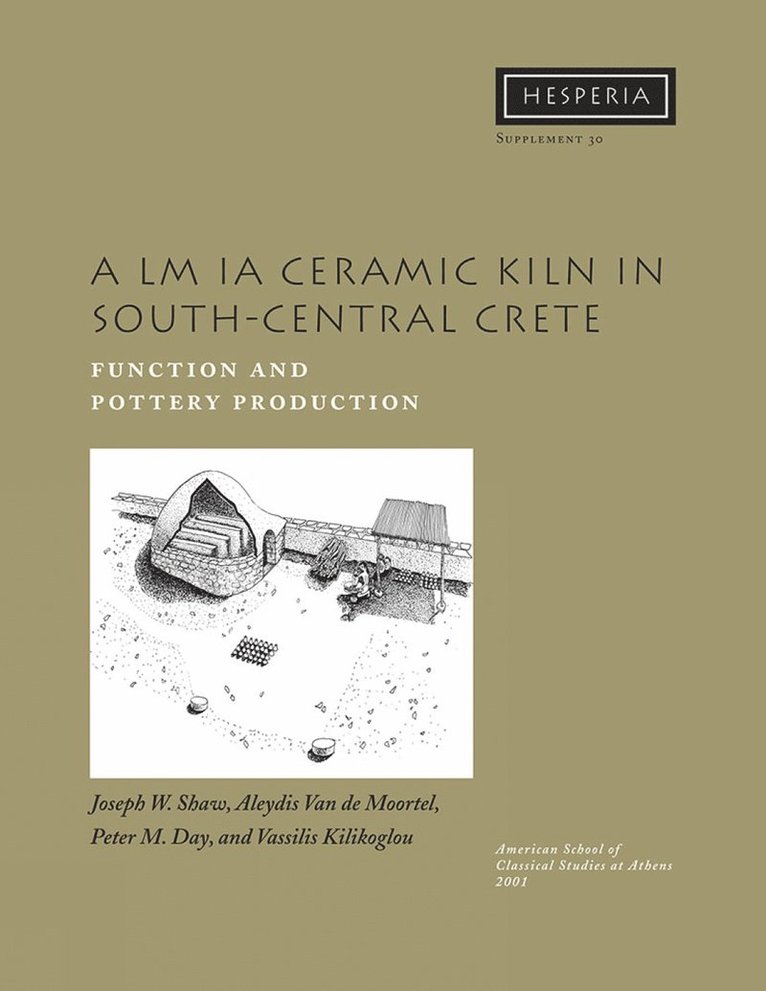
This volume presents an in-depth study of the Late Minoan IA cross-draft kiln found in excavations at Kommos, Crete. The kiln is of a type popular during the Neopalatial period, and its good state of preservation has allowed the authors to speculate about its original internal layout and use, as well as about the roof that covered it. Much of the large quantity of pottery found associated with the kiln is analyzed in detail, allowing for the first time the study of the shapes, decoration, and technical characteristics of vases known to have been fired in a specific LM IA kiln. The book presents an integrated program of analytical techniques used to illustrate the range of firing temperatures, the compositional similarities and differences in the clays used, and aspects of the firing process and the upper kiln structure. Offered here is a valuable contribution to our knowledge of the technology and organization of ceramic production at the beginning of the Late Minoan period, which will form a basis for studies of pottery provenience and exchange.
Inbunden, Engelska, 2006
645 kr
Skickas inom 5-8 vardagar
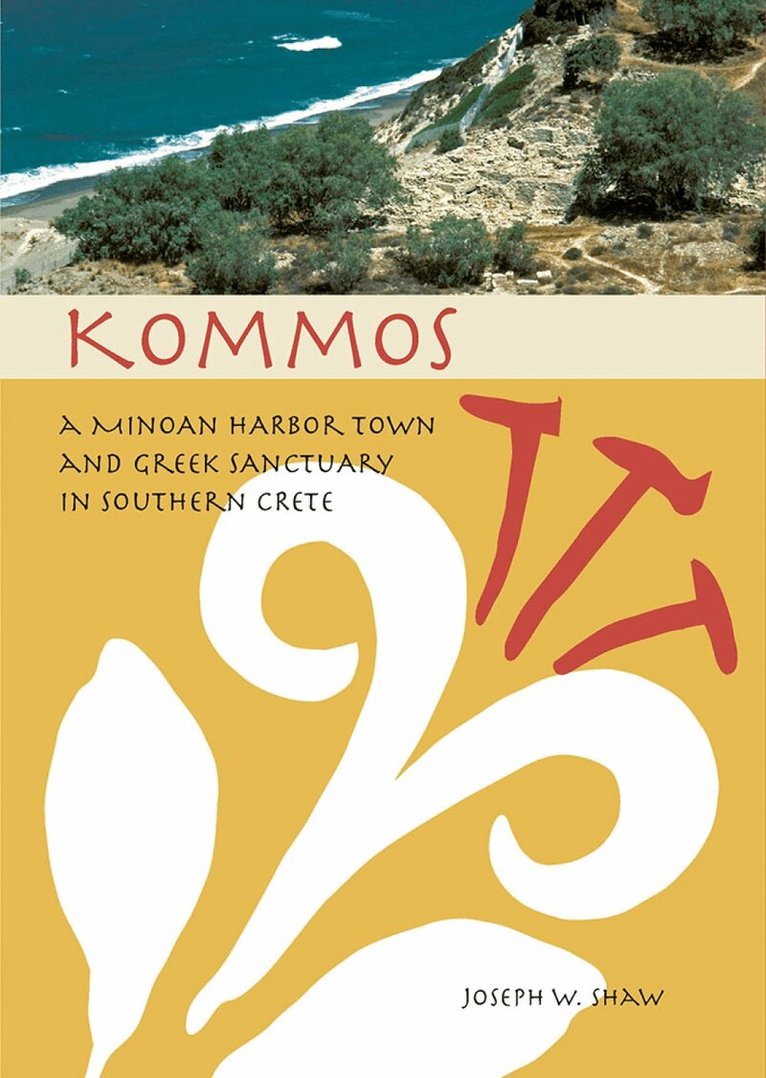
As well as being an archaeological guide, this beautifully illustrated volume tells the story of 30 years of fieldwork and study at one of the lesser known, but most intellectually fascinating, sites in Crete. In prehistory, Kommos was a busy harbor town with trading links extending to Egypt and Sardinia. The author traces the development of the settlement, its mysterious abandonment, and then resurrection as a religious site around 1000 B.C.
Del 49 - Prehistory Monographs
Elite Minoan Architecture
Its Development at Knossos, Phaistos, and Malia
Inbunden, Engelska, 2015
1 113 kr
Skickas inom 11-20 vardagar
The goal of this book is to trace the development of elite Minoan architectural forms that arose during the late Protopalatial (Middle Minoan II) and early Neopalatial periods (Middle Minoan III). The study of this architectual development concentrates on the older, larger sites of Knossos, Malia, and Phaistos where those very forms seem to have originated. Other Minoan towns and palaces in Crete are referenced when appropriate.
Del 57 - Prehistory Monographs
House X at Kommos: A Minoan Mansion Near the Sea Part 2
The Pottery
Inbunden, Engelska, 2017
1 502 kr
Skickas inom 5-8 vardagar
House X is by far the largest and best appointed of the Minoan houses excavated at Kommos in south-central Crete, a Minoan harbor and settlement that later became the site of a Greek sanctuary. Situated on the seacoast of the western Mesara Plain, Kommos faces west toward the Libyan Sea. House X stands on the southern edge of the Minoan town, separated by a large slab-paved road from the monumental civic buildings built and used between the Protopalatial and Postpalatial periods. The description of the stratigraphic excavation of this elite house is published with numerous architectural plans along with the cataloged small finds and tables of data on the floral and faunal materials. The excavated fresco fragments are also discussed and illustrated. This volume presents the Late Bronze Age pottery from in and around House X, a large Minoan house at Kommos situated not far from the sea in South-Central Crete. This volume is richly illustrated with drawings, photos, and tables of data. Rutter's contribution complements the publication of the architecture, stratigraphy, and small finds in Part 1 (Shaw and Shaw, eds., 2012). Together, this pair of volumes offers a conclusion to a series of monographs (volumes I-V) previously published about the site (Shaw and Shaw, eds., 1995-2006). The Kommos series is now completed by the two-volume publication on House X.
Inbunden, Engelska, 2006
3 108 kr
Tillfälligt slut
Kommos, an ancient site on the island of Crete, is known both for its important Greek sanctuary and for its earlier role as a major Minoan harbor town. This final book in the Princeton series focuses on the results of several decades of excavation at three of the site's monumental public buildings during the Minoan period. Of these, one has the characteristics of a "Minoan palace," a large central court surrounded by wings. Two stoas on either side of the court may have accommodated spectators watching formal events unfold within the court. Other rooms were used for storage. Vessels from the "palace," but also, and mainly, from two buildings that succeeded it in the fourteenth century BC, originate elsewhere in the Aegean and as far as Anatolia, Cyprus, Egypt, Syro-Palestine, and Sardinia, attesting to the site's major role in international trade. One of the later buildings is characterized by six huge rectangular spaces that were likely used to shelter ships during the nonsailing months. This kind of structure, from that period, has never before been found in Crete. Equally unique is the range of imported pottery.The results of the excavation are recorded in detail in chapters commenting on the architecture, on the "palace's" painted mural decoration, and on other finds representing a wide range of activities, including the likely production of purple dye, valued for trade amongst the elite. Well-stratified deposits provide a unique opportunity to establish local ceramic developments and to use them to date events that are being considered in terms of sociopolitical and economic perspectives encompassing the Mediterranean and the Near East. This book, which completes a survey of more than six hundred years of history, will prove especially useful to specialists in the Minoan era and to all students of the ancient world.
Del 35 - Prehistory Monographs
House X at Kommos: A Minoan Mansion Near the Sea Part 1
Architecture, Stratigraphy, and Selected Finds
Inbunden, Engelska, 2012
1 502 kr
Tillfälligt slut
House X is by far the largest and best appointed of the Minoan houses excavated at Kommos in south-central Crete, a Minoan harbor and settlement that later became the site of a Greek sanctuary. Situated on the seacoast of the western Mesara Plain, Kommos faces west toward the Libyan Sea. House X stands on the southern edge of the Minoan town, separated by a large slab-paved road from the monumental civic buildings built and used between the Protopalatial and Postpalatial periods. The description of the stratigraphic excavation of this elite house is published with numerous architectural plans along with the catalogued small finds and tables of data on the floral and faunal materials. The excavated fresco fragments are also discussed and illustrated.