Joseph W. Spatafora - Böcker
Visar alla böcker från författaren Joseph W. Spatafora. Handla med fri frakt och snabb leverans.
5 produkter
5 produkter
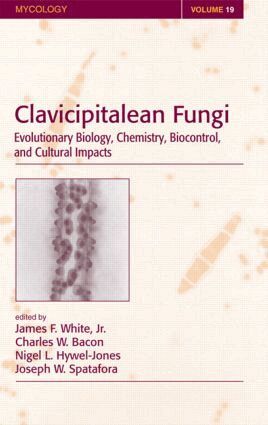
Clavicipitalean Fungi
Evolutionary Biology, Chemistry, Biocontrol And Cultural Impacts
Inbunden, Engelska, 2003
3 861 kr
Skickas inom 10-15 vardagar
This reference analyzes the ecology, evolution, genetics, physiology, and taxonomy of this diverse group of fungi for identification of common biological, biochemical, and genetic features and discovery of potential medical and agricultural applications. It traces and reconstruct the evolution of various host-endoparasite systems and studies recent taxonomic research and DNA sequence analyses on plant-infecting clavicipitaleans. Providing a holistic view of the entire clavicipitalean family, the book compares morphologic, geographic, and host variations among various clavicipitalean populations and examines key discoveries and compounds obtained in clavicipitalean studies.
1 593 kr
Skickas inom 10-15 vardagar
This volume includes treatments of systematics and related topics for both fungi and fungus-like organisms in four eukaryotic supergroups, as well as specialized chapters on nomenclature, techniques and evolution. These organisms are of great interest to mycologists, plant pathologists and others, including those interested in the animal parasitic Microsporidia. Our knowledge of the systematics and evolution of fungi has made great strides since the first edition of this volume, largely driven by molecular phylogenetic analyses. Consensus among mycologists has led to a stable systematic treatment that has since become widely adopted and is incorporated into this second edition, along with a great deal of new information on evolution and ecology. The systematic chapters cover occurrence, distribution, economic importance, morphology and ultrastructure, development of taxonomic theory, classification and maintenance and culture. Other chapters deal with nomenclatural changes necessitated by revisions of the International Code of Nomenclature for algae, fungi and plants, including the elimination of separate names for asexual states, as well as methods for preservation of cultures and specimens, character evolution and methods for ultrastructural study, the fungal fossil record and the impact of whole genomes on fungal studies.
1 593 kr
Skickas inom 10-15 vardagar
This volume includes treatments of systematics and related topics for both fungi and fungus-like organisms in four eukaryotic supergroups, as well as specialized chapters on nomenclature, techniques and evolution. These organisms are of great interest to mycologists, plant pathologists and others, including those interested in the animal parasitic Microsporidia. Our knowledge of the systematics and evolution of fungi has made great strides since the first edition of this volume, largely driven by molecular phylogenetic analyses. Consensus among mycologists has led to a stable systematic treatment that has since become widely adopted and is incorporated into this second edition, along with a great deal of new information on evolution and ecology. The systematic chapters cover occurrence, distribution, economic importance, morphology and ultrastructure, development of taxonomic theory, classification, and maintenance and culture. Other chapters deal with nomenclatural changes necessitated by revisions of the International Code of Nomenclature for algae, fungi and plants, including the elimination of separate names for asexual states, as well as methods for preservation of cultures and specimens, character evolution and methods for ultrastructural study, the fungal fossil record, and the impact of whole genomes on fungal studies.
1 593 kr
Skickas inom 10-15 vardagar
This volume includes treatments of systematics and related topics for both fungi and fungus-like organisms in four eukaryotic supergroups, as well as specialized chapters on nomenclature, techniques and evolution. These organisms are of great interest to mycologists, plant pathologists and others, including those interested in the animal parasitic Microsporidia. Our knowledge of the systematics and evolution of fungi has made great strides since the first edition of this volume, largely driven by molecular phylogenetic analyses. Consensus among mycologists has led to a stable systematic treatment that has since become widely adopted and is incorporated into this second edition, along with a great deal of new information on evolution and ecology. The systematic chapters cover occurrence, distribution, economic importance, morphology and ultrastructure, development of taxonomic theory, classification and maintenance and culture. Other chapters deal with nomenclatural changes necessitated by revisions of the International Code of Nomenclature for algae, fungi and plants, including the elimination of separate names for asexual states, as well as methods for preservation of cultures and specimens, character evolution and methods for ultrastructural study, the fungal fossil record and the impact of whole genomes on fungal studies.
1 593 kr
Skickas inom 10-15 vardagar
This volume includes treatments of systematics and related topics for both fungi and fungus-like organisms in four eukaryotic supergroups, as well as specialized chapters on nomenclature, techniques and evolution. These organisms are of great interest to mycologists, plant pathologists and others, including those interested in the animal parasitic Microsporidia. Our knowledge of the systematics and evolution of fungi has made great strides since the first edition of this volume, largely driven by molecular phylogenetic analyses. Consensus among mycologists has led to a stable systematic treatment that has since become widely adopted and is incorporated into this second edition, along with a great deal of new information on evolution and ecology. The systematic chapters cover occurrence, distribution, economic importance, morphology and ultrastructure, development of taxonomic theory, classification, and maintenance and culture. Other chapters deal with nomenclatural changes necessitated by revisions of the International Code of Nomenclature for algae, fungi and plants, including the elimination of separate names for asexual states, as well as methods for preservation of cultures and specimens, character evolution and methods for ultrastructural study, the fungal fossil record, and the impact of whole genomes on fungal studies.