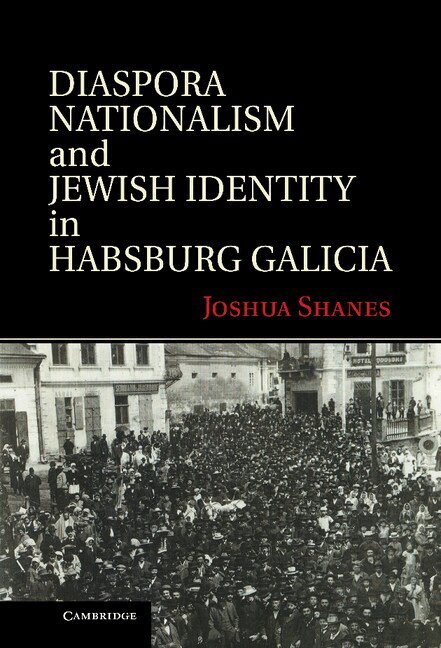
The triumph of Zionism has clouded recollection of competing forms of Jewish nationalism vying for power a century ago. This study explores alternative ways to construct the modern Jewish nation. Jewish nationalism emerges from this book as a Diaspora phenomenon much broader than the Zionist movement. Like its non-Jewish counterparts, Jewish nationalism was first and foremost a movement to nationalize Jews, to construct a modern Jewish nation while simultaneously masking its very modernity. Diaspora Nationalism and Jewish Identity in Habsburg Galicia traces this process in what was the second largest Jewish community in Europe, Galicia. The history of this vital but very much understudied community of Jews fills a critical lacuna in existing scholarship while revisiting the broader question of how Jewish nationalism - or indeed any modern nationalism - was born. Based on a wide variety of sources, many newly uncovered, this study challenges the still-dominant Zionist narrative by demonstrating that Jewish nationalism was a part of the rising nationalist movements in Europe.
While insiders and even many outsiders perceive Orthodoxy as an authentic continuation of pre-modern Jewish forms, in fact it is no less a product of modernity than its religious and political competitors. Like the others, Orthodoxy represents a range of self-conscious attempts to negotiate a Jewish identity that is cast as unchanged amidst an environment of sweeping change: the breakdown of Jewish communal autonomy and emancipation under the impact of the Enlightenment and economic revolution.Orthodox Jews are thus not traditional, but traditionalist. They are consciously and creatively attempting to recreate a pre-modern system in an entirely new context and without the benefit of a world that takes its values for granted or the political power to enforce it. Even beyond the ritual and theological innovations of Orthodoxy – which are many - its self-consciousness, its awareness that other options are available, that one's own world is constructed and not timeless and is therefore contingent and fragile, creates a firm break between Orthodoxy and the traditional world it claims to perpetuate. And it opened the door to endless battles over the boundaries of authenticity.This book traces the emergence and evolution of the term "Orthodoxy" and the communities that claimed it – while denying it to others – from Germany and Hungary into Eastern Europe and eventually America, Israel and beyond. It charts how a traditional culture shared unreflexively by most Jews evolved into a self-conscious, voluntary religio-political identity maintained by a determined minority that came to view itself as authentically "religious."
Among scholars of Jewish Studies, the process, history, and literature of exiting one’s native religious community is increasingly recognized as a new area within the field which, ironically, has a history stretching back to antiquity. By presenting scholarship from a diverse range of disciplines—including history, sociology, psychology, and gender studies—this volume deepens and broadens readers’ understanding of the complexity of the topic of taking leave of the Orthodox community in which one has been raised and establishing a different kind of life that is outside of its borders.
Among scholars of Jewish Studies, the process, history, and literature of exiting ones native religious community is increasingly recognized as a new area within the field which, ironically, has a history stretching back to antiquity. By presenting scholarship from a diverse range of disciplinesincluding history, sociology, psychology, and gender studiesthis volume deepens and broadens readers understanding of the complexity of the topic of taking leave of the Orthodox community in which one has been raised and establishing a different kind of life that is outside of its borders.