J.R. Barber – författare
Visar alla böcker från författaren J.R. Barber. Handla med fri frakt och snabb leverans.
7 produkter
7 produkter
E-bok
PDF, Engelska, 20061 140 kr
Läs direkt efter köp
Since the first edition of this book was published, there have been major improve- ™ ™ ments in symbolic mathematical languages such as Maple and Mathematica and this has opened up the possibility of solving considerably more complex and hence interesting and realistic elasticity problems as classroomexamples. It also enables the student to focus on the formulation of the problem (e. g. the appropriate governing equations and boundary conditions) rather than on the algebraic manipulations, with a consequent improvement in insight into the subject and in motivation. During the past 10 years I have developed files in Maple and Mathematica to facilitate this p- cess, notably electronic versions of the Tables in the present Chapters 19 and 20 and of the recurrence relations for generating spherical harmonics. One purpose of this new edition is to make this electronic material available to the reader through the Kluwer website www. elasticity. org. I hope that readers will make use of this resource and report back to me any aspects of the electronic material that could benefit from improvement or extension. Some hints about the use of this material are contained in Appendix A. Those who have never used Maple or Mathematica will find that it takes only a few hours of trial and error to learn how to write programs to solve boundary value problems in elasticity.
Inbunden, Engelska, 1992
1 616 kr
Skickas inom 10-15 vardagar
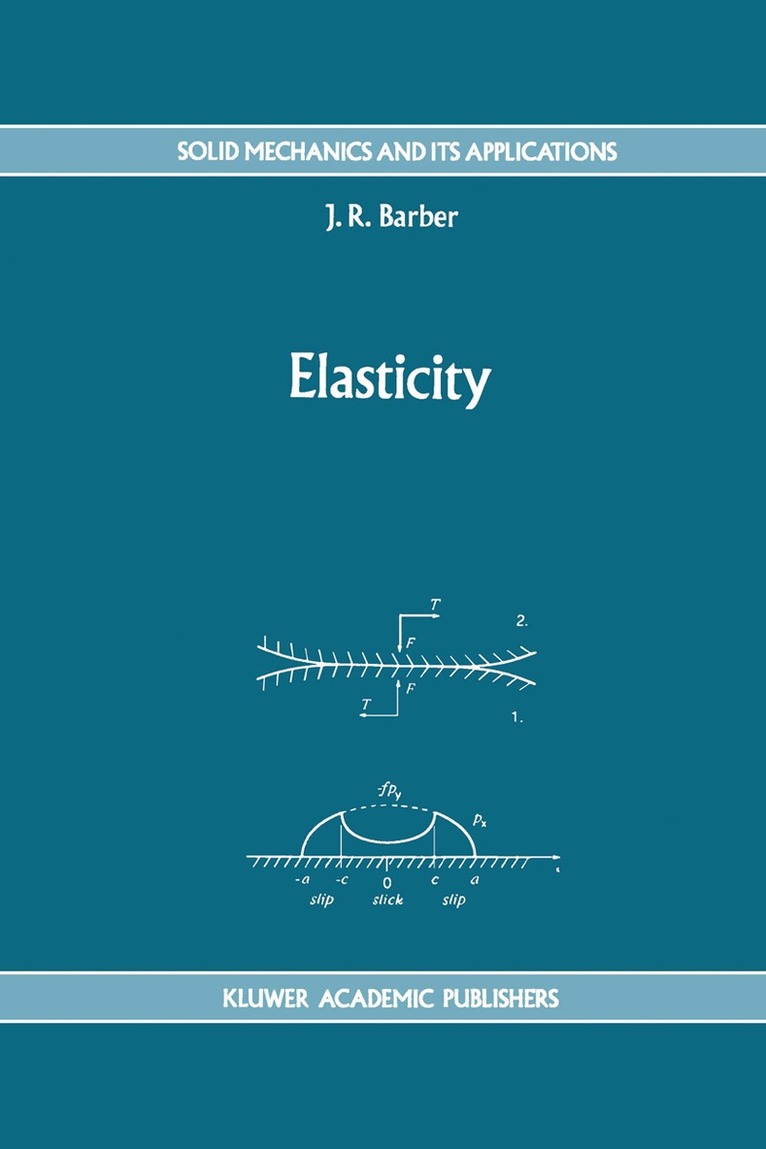
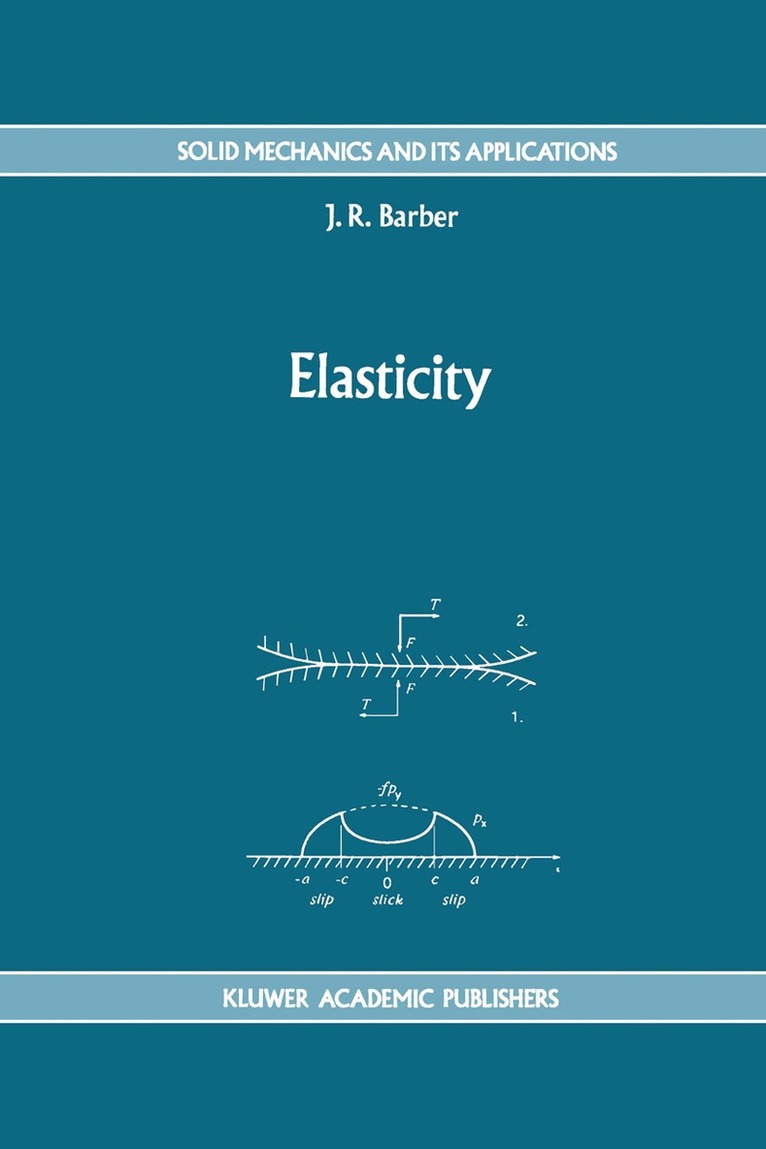
The subject of Elasticity can be approached from several points of view, depending on whether the practitioner is principally interested in the mathematicalstructure of the subject or in its use in engineering applications and in the latter case, whether essentially numerical or analytical methods are envisaged as the solution method. My first introduction to the subject was in response to a need for information about a specific problem in Tribology. As a practising engineer with a background only in elementary Strength of Materials, I approached that problem initially using the con cepts of concentrated forces and superposition. Today, with a rather more extensive knowledge of analytical techniques in Elasticity, I still find it helpful to go back to these roots in the elementary theory and think through a problem physically as well as mathematically, whenever some new and unexpected feature presents difficulties in research. This way of thinking will be found to permeate this book. My engineering background will also reveal itself in a tendency to work examples through to final expressions for stresses and displacements, rather than leave the derivation at a point where the remaining manipulations would be routine. With the practical engineering reader in mind, I have endeavoured to keep to a minimum any dependence on previous knowledge of Solid Mechanics, Continuum Mechanics or Mathematics.
Häftad, Engelska, 1993
1 616 kr
Skickas inom 10-15 vardagar
The subject of Elasticity can be approached from several points of view, depending on whether the practitioner is principally interested in the mathematicalstructure of the subject or in its use in engineering applications and in the latter case, whether essentially numerical or analytical methods are envisaged as the solution method. My first introduction to the subject was in response to a need for information about a specific problem in Tribology. As a practising engineer with a background only in elementary Strength of Materials, I approached that problem initially using the con cepts of concentrated forces and superposition. Today, with a rather more extensive knowledge of analytical techniques in Elasticity, I still find it helpful to go back to these roots in the elementary theory and think through a problem physically as well as mathematically, whenever some new and unexpected feature presents difficulties in research. This way of thinking will be found to permeate this book. My engineering background will also reveal itself in a tendency to work examples through to final expressions for stresses and displacements, rather than leave the derivation at a point where the remaining manipulations would be routine. With the practical engineering reader in mind, I have endeavoured to keep to a minimum any dependence on previous knowledge of Solid Mechanics, Continuum Mechanics or Mathematics.
Inbunden, Engelska, 2018
1 723 kr
Skickas inom 10-15 vardagar
This book describes the solution of contact problems with an emphasis on idealized (mainly linear) elastic problems that can be treated with elementary analytical methods. General physical and mathematical features of these solutions are highlighted. Topics covered include the contact of rough surfaces and problems involving adhesive (e.g. van der Waals) forces. The author is a well-known researcher in the subject with hands-on experience of the topics covered and a reputation for lucid explanations. The target readership for the book includes researchers who encounter contact problems but whose primary focus is not contact mechanics. Coverage is also suitable for a graduate course in contact mechanics and end-of-chapter problems are included.
E-bok
Engelska, 20182 207 kr
Läs direkt efter köp
This book describes the solution of contact problems with an emphasis on idealized (mainly linear) elastic problems that can be treated with elementary analytical methods. General physical and mathematical features of these solutions are highlighted. Topics covered include the contact of rough surfaces and problems involving adhesive (e.g. van der Waals) forces. The author is a well-known researcher in the subject with hands-on experience of the topics covered and a reputation for lucid explanations. The target readership for the book includes researchers who encounter contact problems but whose primary focus is not contact mechanics. Coverage is also suitable for a graduate course in contact mechanics and end-of-chapter problems are included.
Häftad, Engelska, 2019
1 723 kr
Skickas inom 10-15 vardagar
This book describes the solution of contact problems with an emphasis on idealized (mainly linear) elastic problems that can be treated with elementary analytical methods. General physical and mathematical features of these solutions are highlighted. Topics covered include the contact of rough surfaces and problems involving adhesive (e.g. van der Waals) forces. The author is a well-known researcher in the subject with hands-on experience of the topics covered and a reputation for lucid explanations. The target readership for the book includes researchers who encounter contact problems but whose primary focus is not contact mechanics. Coverage is also suitable for a graduate course in contact mechanics and end-of-chapter problems are included.
E-bok
PDF, Engelska, 20122 049 kr
Läs direkt efter köp
The subject of Elasticity can be approached from several points of view, depending on whether the practitioner is principally interested in the mathematicalstructure of the subject or in its use in engineering applications and in the latter case, whether essentially numerical or analytical methods are envisaged as the solution method. My first introduction to the subject was in response to a need for information about a specific problem in Tribology. As a practising engineer with a background only in elementary Strength of Materials, I approached that problem initially using the con cepts of concentrated forces and superposition. Today, with a rather more extensive knowledge of analytical techniques in Elasticity, I still find it helpful to go back to these roots in the elementary theory and think through a problem physically as well as mathematically, whenever some new and unexpected feature presents difficulties in research. This way of thinking will be found to permeate this book. My engineering background will also reveal itself in a tendency to work examples through to final expressions for stresses and displacements, rather than leave the derivation at a point where the remaining manipulations would be routine. With the practical engineering reader in mind, I have endeavoured to keep to a minimum any dependence on previous knowledge of Solid Mechanics, Continuum Mechanics or Mathematics.