J.T. Blackmore – författare
Visar alla böcker från författaren J.T. Blackmore. Handla med fri frakt och snabb leverans.
11 produkter
11 produkter
Del 143 - Boston Studies in the Philosophy and History of Science
Ernst Mach — A Deeper Look
Documents and New Perspectives
Inbunden, Engelska, 1992
2 161 kr
Skickas inom 10-15 vardagar
Ernst Mach -- A Deeper Look has been written to reveal to English-speaking readers the recent revival of interest in Ernst Mach in Europe and Japan. The book is a storehouse of new information on Mach as a philosopher, historian, scientist and person, containing a number of biographical and philosophical manuscripts publihsed for the first time, along with correspondence and other matters published for the first time in English. The book also provides English translations of Mach's controversies with leading physicists and psychologists, such as Max Planck and Carl Stumpf, and offers basic evidence for resolving Mach's position on atomism and Einstein's theory of relativity. Mach's scientific, philosophical and personal influence in a number of countries -- Austria, Germany, Bohemia and Yugoslavia among them -- has been carefully explored and many aspects detailed for the first time. All of the articles are eminently readable, especially those written by Mach's sister. They are deeply researched, new interpretations abound, and the bibliography includes recent works by and about Mach from over a dozen countries. The book also contains many articles by or about Mach's contemporaries, including Ostwald, Dingler, Weichert and, especially, Einstein. Finally, and most intriguingly, the original ideas of Japanese scholars are presented, built on Mach's philosophy. These demonstrate how Mach's world view is currently contributing to the solution of contemporary philosophical problems.
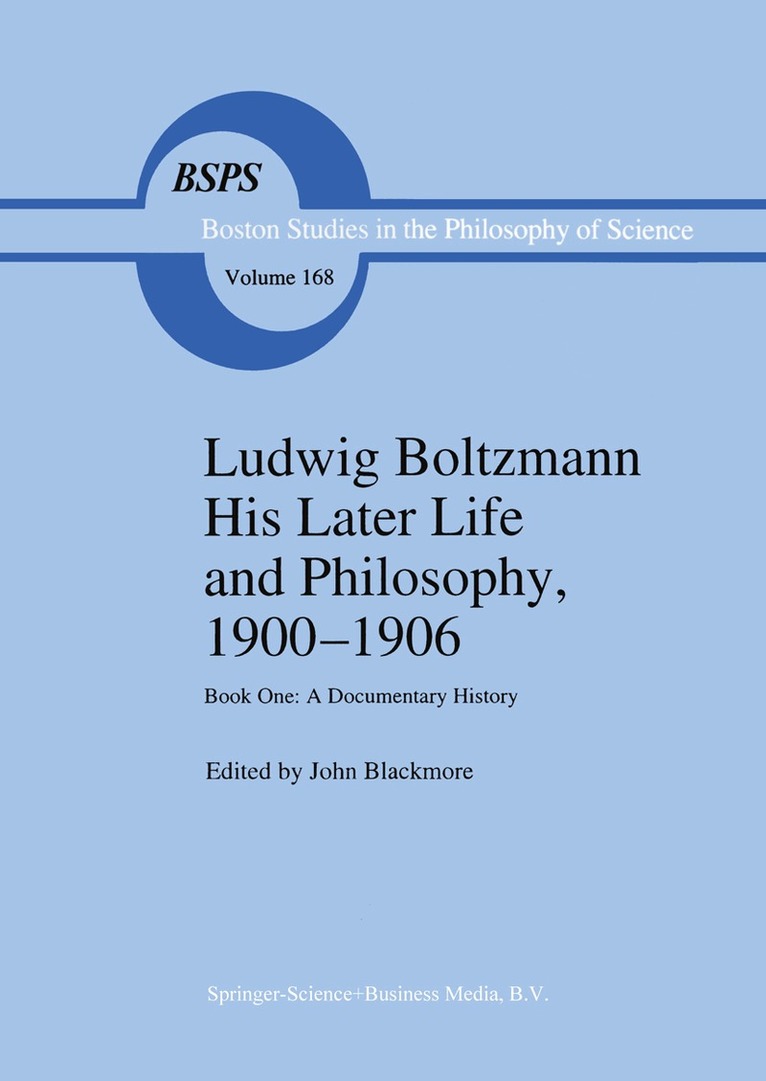
Del 168 - Boston Studies in the Philosophy and History of Science
Ludwig Boltzmann His Later Life and Philosophy, 1900–1906
Book One: A Documentary History
Inbunden, Engelska, 1995
1 730 kr
Skickas inom 10-15 vardagar
2 But already he had done important work on thermal equilibrium which helped generalize Maxwell's distribution law. Indeed, there is part of a letter by James Clerk Maxwell to Loschmidt from this period which runs: "I am very pleased over the outstanding work of your student; in England experi mental physics is much neglected. Sir William Thomson has done the most in this connection, but you [in Austria] are ahead of us with your good example. "2 But while praise was fine, Boltzmann lusted after further travel. He wanted to know what other physicists were doing first hand. In 1870 he attended lectures by Bunsen and Konigsberger in Heid elberg, and in the same year went to Berlin only to scurry back to Vienna with the outbreak of the Franco-Prussian War, but Boltzmann was back in Berlin the next year attending lectures, visiting laboratories, and working on dielectricity more or less under the direction of Kirchhhoff and Helmholtz.
Del 174 - Boston Studies in the Philosophy and History of Science
Ludwig Boltzmann: His Later Life and Philosophy, 1900-1906
Book Two: The Philosopher
Inbunden, Engelska, 1995
1 946 kr
Skickas inom 10-15 vardagar
After his failure to replace metaphysics by a linguistic approach, Ludwig Boltzmann came to identify the philosophy of science with methodology which, in turn, he considered to be part of science itself, and thus not part of philosophy at all. His definition of philosophy as metaphysics meant that, from his point of view, all philosophers were metaphysicians, himself included. Boltzmann the philosopher was advised on the improvement of his Weltanschauung by Franz Brentano; to such effect that, by the summer of 1905, Boltzmann appeared to be close to a form of critical realism. However, the stronger this realism became, the more inconsistent it seemed to be with his `Mach plus pictures' methodology of science. During this period, he planned to write a book, first on metaphysics and then later on what he called `A priori probability' and what he considered to be its shortcomings. Apparently, the book was never completed. All know Boltzmann the great physicist. Much less widely known is that he was an original philosopher: one who had a great impact on early 20th Century Viennese philosophy, beginning with Wittgenstein and the Vienna Circle and extending even to Popper and Feyerabend. Blackmore's delving into Boltzmann's correspondence, coupled with his unparalleled knowledge of Boltzmann's final years, allows him to present Boltzmann in an entirely new light to readers in the English language. For physicists, philosophers and historians.
Del 218 - Boston Studies in the Philosophy and History of Science
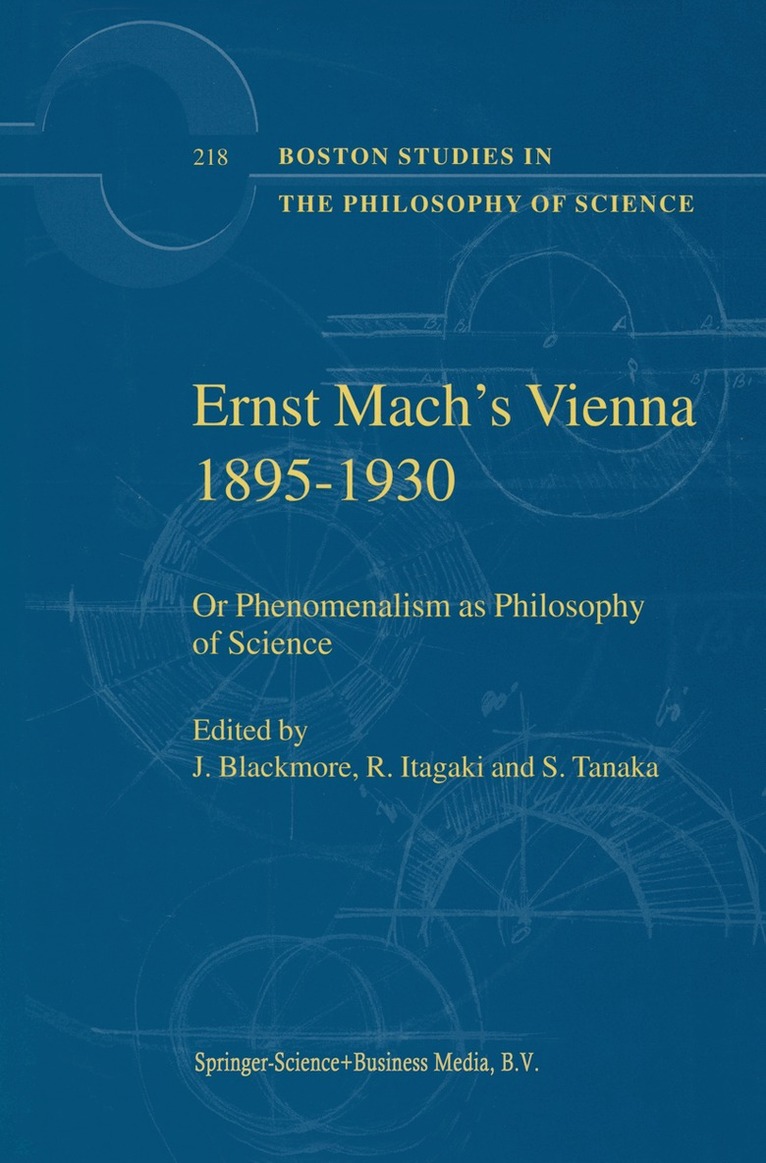
Ernst Mach's Vienna 1895-1930
Or Phenomenalism as Philosophy of Science
Inbunden, Engelska, 2001
1 623 kr
Skickas inom 10-15 vardagar
Section Guide 1. Prolegomena 2. Biographical Sketch 3. Epistemology 4. Textbook Ontology 1. PROLEGOMENA While both philosophers and historians almost always love truth and the search for truth, and both often carry out extensive research, there can be noticeable differences when historians write about the history of philosophy and when philosophers write about it. Philosophers often look at the past with categories and interests taken from the present or at the least from the recent past, but many historians, especially those who love research for its own sake, will try to look at the past from a perspective either from that period or from even earlier. Both camps look for roots, but view them with different lenses and presupposi tions. This prolegomena has been added to prepare some philosophers for what will hopefully only be the mildest of shocks, for seeing the history of philosophy in a way which does not treat what is recent or latest as best, but which loves the context of ideas for its own sake, a context which can be very foreign to contemporary likes and dislikes. To be sure, we historians can deceive ourselves as easily as philosophers, but we tend to do so about different things.
Del 168 - Boston Studies in the Philosophy and History of Science
Ludwig Boltzmann His Later Life and Philosophy, 1900–1906
Book One: A Documentary History
Häftad, Engelska, 2010
1 782 kr
Skickas inom 10-15 vardagar
2 But already he had done important work on thermal equilibrium which helped generalize Maxwell's distribution law. Indeed, there is part of a letter by James Clerk Maxwell to Loschmidt from this period which runs: "I am very pleased over the outstanding work of your student; in England experi mental physics is much neglected. Sir William Thomson has done the most in this connection, but you [in Austria] are ahead of us with your good example. "2 But while praise was fine, Boltzmann lusted after further travel. He wanted to know what other physicists were doing first hand. In 1870 he attended lectures by Bunsen and Konigsberger in Heid elberg, and in the same year went to Berlin only to scurry back to Vienna with the outbreak of the Franco-Prussian War, but Boltzmann was back in Berlin the next year attending lectures, visiting laboratories, and working on dielectricity more or less under the direction of Kirchhhoff and Helmholtz.
Del 174 - Boston Studies in the Philosophy and History of Science
Ludwig Boltzmann: His Later Life and Philosophy, 1900-1906
Book Two: The Philosopher
Häftad, Engelska, 2010
2 004 kr
Skickas inom 10-15 vardagar
After his failure to replace metaphysics by a linguistic approach, Ludwig Boltzmann came to identify the philosophy of science with methodology which, in turn, he considered to be part of science itself, and thus not part of philosophy at all. His definition of philosophy as metaphysics meant that, from his point of view, all philosophers were metaphysicians, himself included. Boltzmann the philosopher was advised on the improvement of his Weltanschauung by Franz Brentano; to such effect that, by the summer of 1905, Boltzmann appeared to be close to a form of critical realism. However, the stronger this realism became, the more inconsistent it seemed to be with his `Mach plus pictures' methodology of science. During this period, he planned to write a book, first on metaphysics and then later on what he called `A priori probability' and what he considered to be its shortcomings. Apparently, the book was never completed. All know Boltzmann the great physicist. Much less widely known is that he was an original philosopher: one who had a great impact on early 20th Century Viennese philosophy, beginning with Wittgenstein and the Vienna Circle and extending even to Popper and Feyerabend. Blackmore's delving into Boltzmann's correspondence, coupled with his unparalleled knowledge of Boltzmann's final years, allows him to present Boltzmann in an entirely new light to readers in the English language. For physicists, philosophers and historians.
Del 218 - Boston Studies in the Philosophy and History of Science
Ernst Mach's Vienna 1895-1930
Or Phenomenalism as Philosophy of Science
Häftad, Engelska, 2010
1 623 kr
Skickas inom 10-15 vardagar
Section Guide 1. Prolegomena 2. Biographical Sketch 3. Epistemology 4. Textbook Ontology 1. PROLEGOMENA While both philosophers and historians almost always love truth and the search for truth, and both often carry out extensive research, there can be noticeable differences when historians write about the history of philosophy and when philosophers write about it. Philosophers often look at the past with categories and interests taken from the present or at the least from the recent past, but many historians, especially those who love research for its own sake, will try to look at the past from a perspective either from that period or from even earlier. Both camps look for roots, but view them with different lenses and presupposi tions. This prolegomena has been added to prepare some philosophers for what will hopefully only be the mildest of shocks, for seeing the history of philosophy in a way which does not treat what is recent or latest as best, but which loves the context of ideas for its own sake, a context which can be very foreign to contemporary likes and dislikes. To be sure, we historians can deceive ourselves as easily as philosophers, but we tend to do so about different things.
Del 143 - Boston Studies in the Philosophy and History of Science
Ernst Mach — A Deeper Look
Documents and New Perspectives
Häftad, Engelska, 2012
2 161 kr
Skickas inom 10-15 vardagar
Ernst Mach -- A Deeper Look has been written to reveal to English-speaking readers the recent revival of interest in Ernst Mach in Europe and Japan. The book is a storehouse of new information on Mach as a philosopher, historian, scientist and person, containing a number of biographical and philosophical manuscripts publihsed for the first time, along with correspondence and other matters published for the first time in English. The book also provides English translations of Mach's controversies with leading physicists and psychologists, such as Max Planck and Carl Stumpf, and offers basic evidence for resolving Mach's position on atomism and Einstein's theory of relativity. Mach's scientific, philosophical and personal influence in a number of countries -- Austria, Germany, Bohemia and Yugoslavia among them -- has been carefully explored and many aspects detailed for the first time. All of the articles are eminently readable, especially those written by Mach's sister. They are deeply researched, new interpretations abound, and the bibliography includes recent works by and about Mach from over a dozen countries. The book also contains many articles by or about Mach's contemporaries, including Ostwald, Dingler, Weichert and, especially, Einstein. Finally, and most intriguingly, the original ideas of Japanese scholars are presented, built on Mach's philosophy. These demonstrate how Mach's world view is currently contributing to the solution of contemporary philosophical problems.
E-bok
PDF, Engelska, 20122 925 kr
Läs direkt efter köp
Ernst Mach -- A Deeper Look has been written to reveal to English-speaking readers the recent revival of interest in Ernst Mach in Europe and Japan. The book is a storehouse of new information on Mach as a philosopher, historian, scientist and person, containing a number of biographical and philosophical manuscripts publihsed for the first time, along with correspondence and other matters published for the first time in English. The book also provides English translations of Mach''s controversies with leading physicists and psychologists, such as Max Planck and Carl Stumpf, and offers basic evidence for resolving Mach''s position on atomism and Einstein''s theory of relativity. Mach''s scientific, philosophical and personal influence in a number of countries -- Austria, Germany, Bohemia and Yugoslavia among them -- has been carefully explored and many aspects detailed for the first time. All of the articles are eminently readable, especially those written by Mach''s sister. They are deeply researched, new interpretations abound, and the bibliography includes recent works by and about Mach from over a dozen countries. The book also contains many articles by or about Mach''s contemporaries, including Ostwald, Dingler, Weichert and, especially, Einstein. Finally, and most intriguingly, the original ideas of Japanese scholars are presented, built on Mach''s philosophy. These demonstrate how Mach''s world view is currently contributing to the solution of contemporary philosophical problems.
E-bok
PDF, Engelska, 20132 110 kr
Läs direkt efter köp
Section Guide 1. Prolegomena 2. Biographical Sketch 3. Epistemology 4. Textbook Ontology 1. PROLEGOMENA While both philosophers and historians almost always love truth and the search for truth, and both often carry out extensive research, there can be noticeable differences when historians write about the history of philosophy and when philosophers write about it. Philosophers often look at the past with categories and interests taken from the present or at the least from the recent past, but many historians, especially those who love research for its own sake, will try to look at the past from a perspective either from that period or from even earlier. Both camps look for roots, but view them with different lenses and presupposi tions. This prolegomena has been added to prepare some philosophers for what will hopefully only be the mildest of shocks, for seeing the history of philosophy in a way which does not treat what is recent or latest as best, but which loves the context of ideas for its own sake, a context which can be very foreign to contemporary likes and dislikes. To be sure, we historians can deceive ourselves as easily as philosophers, but we tend to do so about different things.
E-bok
PDF, Engelska, 20132 273 kr
Läs direkt efter köp
2 But already he had done important work on thermal equilibrium which helped generalize Maxwell''s distribution law. Indeed, there is part of a letter by James Clerk Maxwell to Loschmidt from this period which runs: "I am very pleased over the outstanding work of your student; in England experi mental physics is much neglected. Sir William Thomson has done the most in this connection, but you [in Austria] are ahead of us with your good example. "2 But while praise was fine, Boltzmann lusted after further travel. He wanted to know what other physicists were doing first hand. In 1870 he attended lectures by Bunsen and Konigsberger in Heid elberg, and in the same year went to Berlin only to scurry back to Vienna with the outbreak of the Franco-Prussian War, but Boltzmann was back in Berlin the next year attending lectures, visiting laboratories, and working on dielectricity more or less under the direction of Kirchhhoff and Helmholtz.