Judith Eve Lipton – författare
Visar alla böcker från författaren Judith Eve Lipton. Handla med fri frakt och snabb leverans.
13 produkter
Strength Through Peace
How Demilitarization Led to Peace and Happiness in Costa Rica, and What the Rest of the World can Learn From a Tiny, Tropical Nation
Av David P. Barash, Judith Eve Lipton
E-bok, 2018
353 kr
Lägg i varukorg
Costa Rica is the only full-fledged and totally independent country to be entirely demilitarized. Its military was abolished in 1948, with the keys to the armory handed to the Department of Education. Socially, Costa Rica is a success story. Although 94th in the world for GDP, it is in the top 10 …
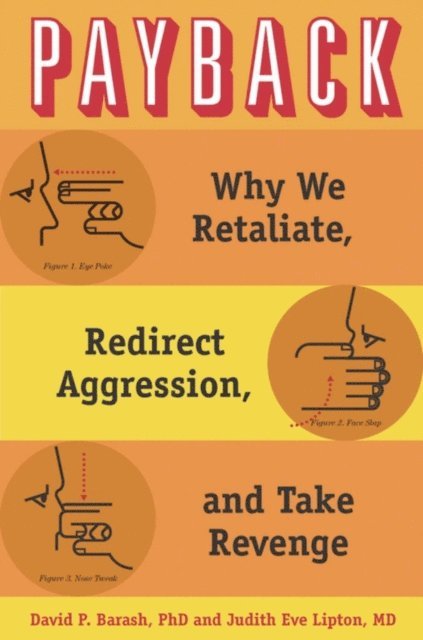
Payback
Why We Retaliate, Redirect Aggression, and Take Revenge
Av David P. Barash, Judith Eve Lipton
Inbunden, 2011
398 kr
Lägg i varukorg
From the child taunted by her playmates to the office worker who feels stifled in his daily routine, people frequently take out their pain and anger on others, even those who had nothing to do with the original stress. The bullied child may kick her puppy, the stifled worker yells at his children: …
Payback
Why We Retaliate, Redirect Aggression, and Take Revenge
Av Judith Eve Lipton, David P. Barash
E-bok, 2011
321 kr
Lägg i varukorg
From the child taunted by her playmates to the office worker who feels stifled in his daily routine, people frequently take out their pain and anger on others, even those who had nothing to do with the original stress. The bullied child may kick her puppy, the stifled worker yells at his children: …
Payback
Why We Retaliate, Redirect Aggression, and Take Revenge
Av Judith Eve Lipton, David P. Barash
E-bok, 2011
321 kr
Lägg i varukorg
From the child taunted by her playmates to the office worker who feels stifled in his daily routine, people frequently take out their pain and anger on others, even those who had nothing to do with the original stress. The bullied child may kick her puppy, the stifled worker yells at his children: …
Strength Through Peace
How Demilitarization Led to Peace and Happiness in Costa Rica, and What the Rest of the World can Learn From a Tiny, Tropical Nation
Av Judith Eve Lipton, David P. Barash
Inbunden, 2026
569 kr
Lägg i varukorg
Costa Rica is the only full-fledged and totally independent country to be entirely demilitarized. Its military was abolished in 1948, with the keys to the armory handed to the Department of Education. Socially, Costa Rica is a success story. Although 94th in the world for GDP, it is in the top 10 …
Strength Through Peace
How Demilitarization Led to Peace and Happiness in Costa Rica, and What the Rest of the World can Learn From a Tiny, Tropical Nation
Av David P. Barash, Judith Eve Lipton
E-bok, 2018
353 kr
Lägg i varukorg
Costa Rica is the only full-fledged and totally independent country to be entirely demilitarized. Its military was abolished in 1948, with the keys to the armory handed to the Department of Education. Socially, Costa Rica is a success story. Although 94th in the world for GDP, it is in the top 10 …
How Women Got Their Curves and Other Just-So Stories
Evolutionary Enigmas
Av David Barash, Judith Eve Lipton
Inbunden, 2009
1034 kr
Lägg i varukorg
So how did women get their curves? Why do they have breasts, while other mammals only develop breast tissue while lactating, and why do women menstruate, when virtually no other beings do so? What are the reasons for female orgasm? Why are human females kept in the dark about their own time of …
How Women Got Their Curves and Other Just-So Stories
Evolutionary Enigmas
Av David Barash, Judith Eve Lipton
Häftad, 2011
264 kr
Lägg i varukorg
So how did women get their curves? Why do they have breasts, while other mammals only develop breast tissue while lactating, and why do women menstruate, when virtually no other beings do so? What are the reasons for female orgasm? Why are human females kept in the dark about their own time of …
Gender Gap
How Genes and Gender Influence Our Relationships
Av David P. Barash, Judith Eve Lipton
Häftad, 2001
749 kr
Lägg i varukorg
Let's face it, say Barash and Lipton: Males and females, boys and girls, men and women are different. To be sure, these differences are often heightened by distinctions in learning, cultural tradition, and social expectation, but underpinning them all is a fundamental difference that derives from …
The Myth of Monogamy: Fidelity and Infidelity in Animals and People
Av David P. Barash, Judith Eve Lipton
Häftad, 2000
5,0 utav 5 stjärnor. Totalt antal röster: (1)
267 kr
Lägg i varukorg
Gender Gap
How Genes and Gender Influence Our Relationships
Av David P. Barash, Judith Eve Lipton
Inbunden, 2017
2743 kr
Lägg i varukorg
Let's face it, say Barash and Lipton: Males and females, boys and girls, men and women are different. To be sure, these differences are often heightened by distinctions in learning, cultural tradition, and social expectation, but underpinning them all is a fundamental difference that derives from …
Gender Gap
How Genes and Gender Influence Our Relationships
Av Judith Eve Lipton, David P. Barash
E-bok, 2017
883 kr
Lägg i varukorg
Let''s face it, say Barash and Lipton: Males and females, boys and girls, men and women are different. To be sure, these differences are often heightened by distinctions in learning, cultural tradition, and social expectation, but underpinning them all is a fundamental difference that derives from …
Gender Gap
How Genes and Gender Influence Our Relationships
Av Judith Eve Lipton, David P. Barash
E-bok, 2017
858 kr
Lägg i varukorg
Let''s face it, say Barash and Lipton: Males and females, boys and girls, men and women are different. To be sure, these differences are often heightened by distinctions in learning, cultural tradition, and social expectation, but underpinning them all is a fundamental difference that derives from …