Jules Desharnais - Böcker
Visar alla böcker från författaren Jules Desharnais. Handla med fri frakt och snabb leverans.
3 produkter
3 produkter
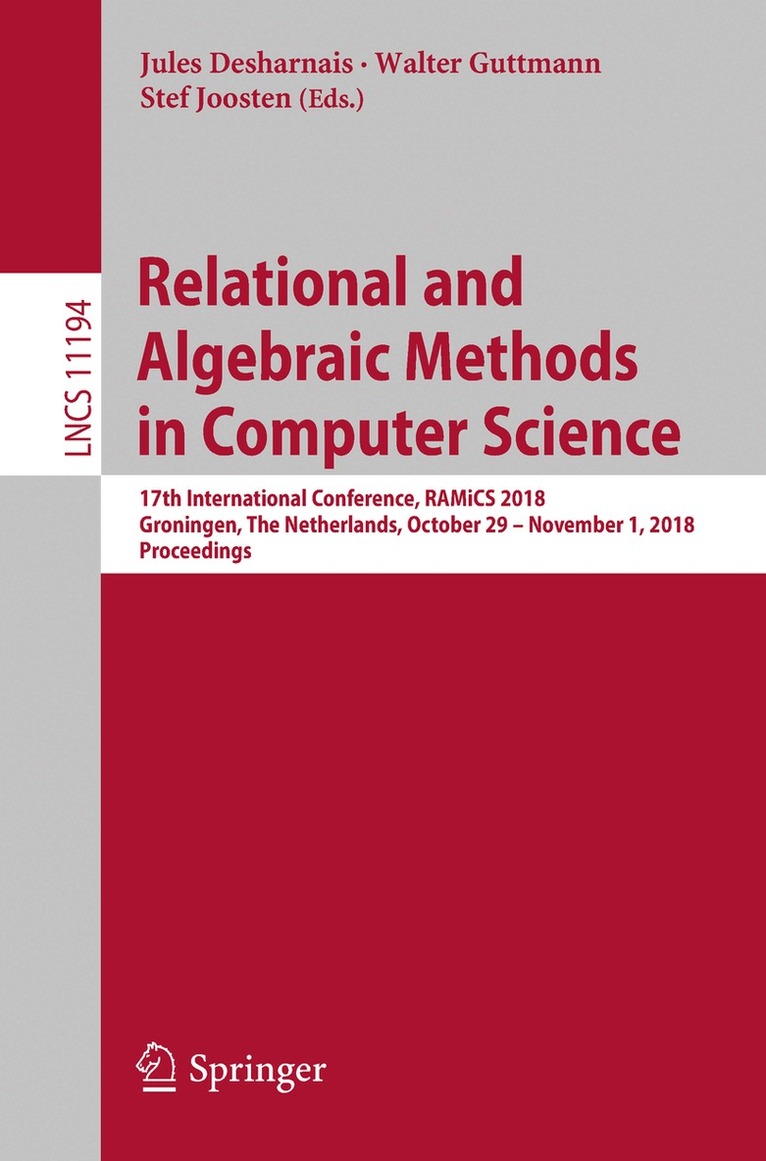
Relational and Algebraic Methods in Computer Science
17th International Conference, RAMiCS 2018, Groningen, The Netherlands, October 29 – November 1, 2018, Proceedings
Häftad, Engelska, 2018
554 kr
Skickas inom 10-15 vardagar
This book constitutes the proceedings of the 17th International Conference on Relational and Algebraic Methods in Computer Science, RAMiCS 2018, held in Groningen, The Netherlands, in October/November 2018.The 21 full papers and 1 invited paper presented together with 2 invited abstracts and 1 abstract of a tutorial were carefully selected from 31 submissions. The papers are organized in the following topics: Theoretical foundations; reasoning about computations and programs; and applications and tools.
1 528 kr
Kommande
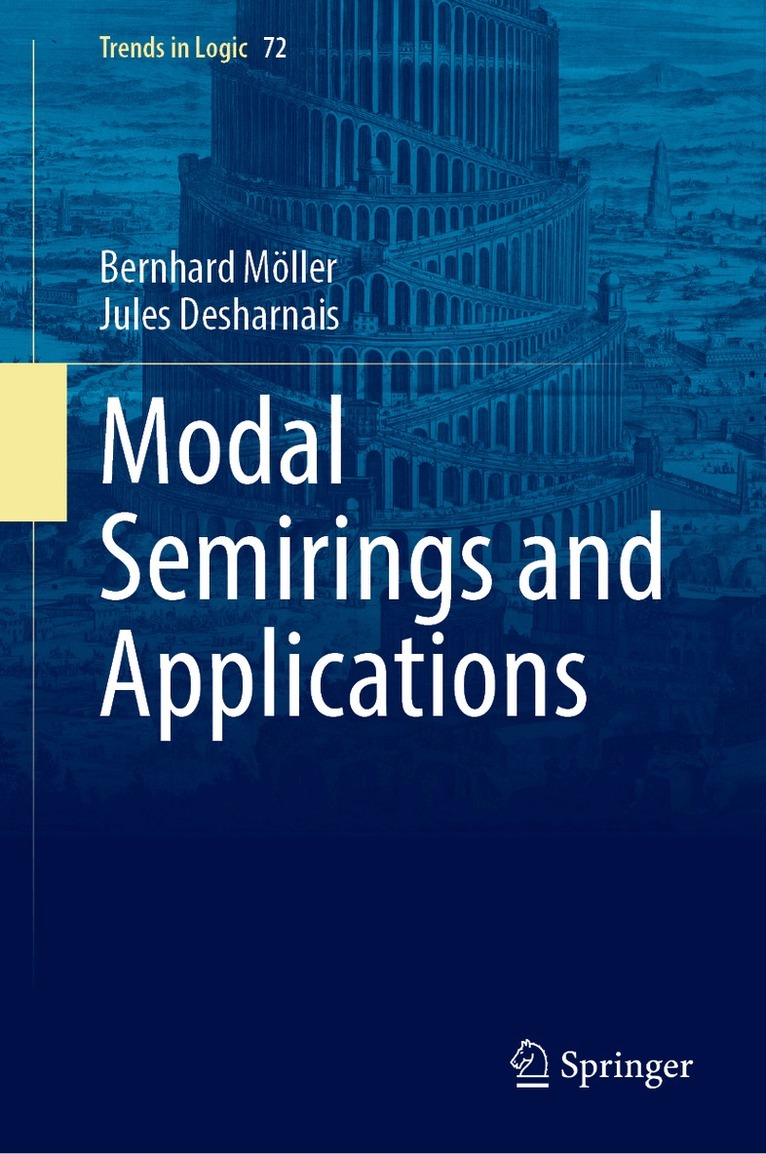
The book serves as a systematic exposition of modal semirings. Next to motivating the definitions, developing the basic calculus and discussing the most interesting examples of modal semirings, it presents a wide variety of applications. On the side of program semantics, Hoare Logic, the theory of general and partial correctness, demonic semantics and various temporal logics such as PDL, LTL andCTL* are treated. The book is situated in the general area of formal methods. Among the many approaches there, it concentrates on a strongly calculational style using algebra as its main ingredient. This field is often called \emph{algebraic logic}. Its aim is to compact series of small steps of general logical inference into larger (in)equational steps. Moreover, it attempts to replace tedious model-theoretic argumentation, in particular, element-wise argumentation, by more abstract and compact reasoning. The structure of the book is as follows: Part I presents the basic theory. Part II contains applications to program semantics, graph-theoretic algorithms, Epistemic Logic, game analysis and databases with preference relations. Part III deals with infinite computations as well as their application to the above-mentioned temporal logics and Neighbourhood Logic as used in the description of hybrid systems. Part IV presents further applications to program semantics and terminations analysis.Finally, Part V contains some advanced theoretical material.Whereas Part I should be read sequentially, the chapters in the other parts are more or less independent of each other.
Mathematics of Program Construction
10th International Conference, MPC 2010, Québec City, Canada, June 21-23, 2010, Proceedings
Häftad, Engelska, 2010
554 kr
Skickas inom 10-15 vardagar
This volumecontainsthe proceedingsof MPC2010,the 10th InternationalC- ferenceonthe MathematicsofProgramConstruction.ThebiennialMPCconf- encesaimtopromotethedevelopmentofmathematicalprinciplesandtechniques that aredemonstrablypracticalande?ective in the processof constructingc- puter programs, whether implemented in hardware or software. The focus is on techniques that combine precision with conciseness, enabling programs to be constructed by formal calculation. Within this theme, the scope of the series is very diverse, including programming methodology, program speci?cation and transformation, program analysis, programming paradigms, programming c- culi, programming language semantics, security, and program logics. The conference took place during June 21-23 in Lac-Beauport, a suburb of Qu' ebec City, Canada, prior to AMAST 2010 (June 23-26). The previous nine conferences were held in 1989 in Twente, The Netherlands (LNCS 375); in 1992 in Oxford, UK (LNCS 669); in 1995 in Kloster Irsee, Germany (LNCS 947); in 1998 in Marstrand near Got .. eborg, Sweden (LNCS 1422); in 2000 in Ponte de Lima, Portugal (LNCS 1837); in 2002 in Dagstuhl, Germany (LNCS 2386); in 2004,inStirling,UK(LNCS3125);in2006inKuressaare,Estonia(LNCS4014); and in 2008 in Marseille-Luminy, France (LNCS 5133).The volume contains one invited paper, the abstracts of two invited talks, and 19 papersselected for presentationby the ProgramCommittee from 37 s- missions. Eachpaper wasrefereed by at least three reviewers,and on averageby four. We are grateful to the members of the Program Committee and the ext- nal referees for their care and diligence in reviewing the submitted papers. The review process and compilation of the proceedings were greatly helped by - drei Voronkov's EasyChair system that we highly recommend to every Program Chair.