Julia Poncela-Casasnovas - Böcker
Visar alla böcker från författaren Julia Poncela-Casasnovas. Handla med fri frakt och snabb leverans.
6 produkter
6 produkter
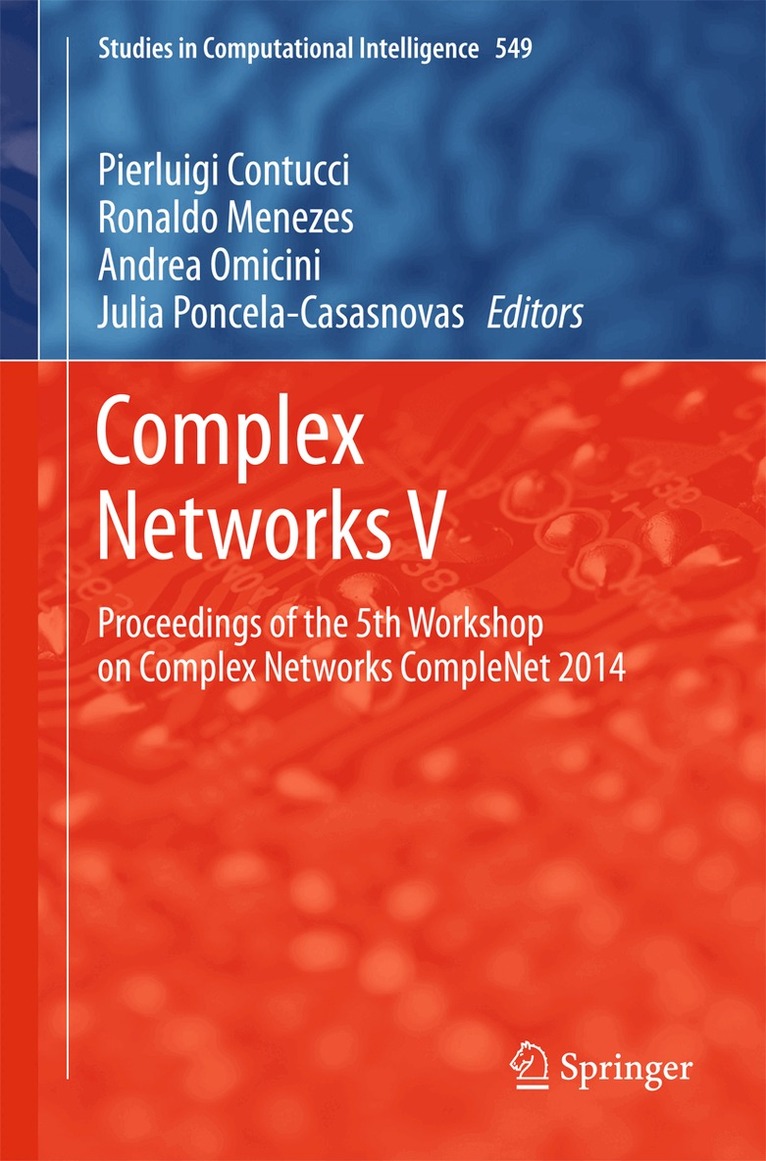
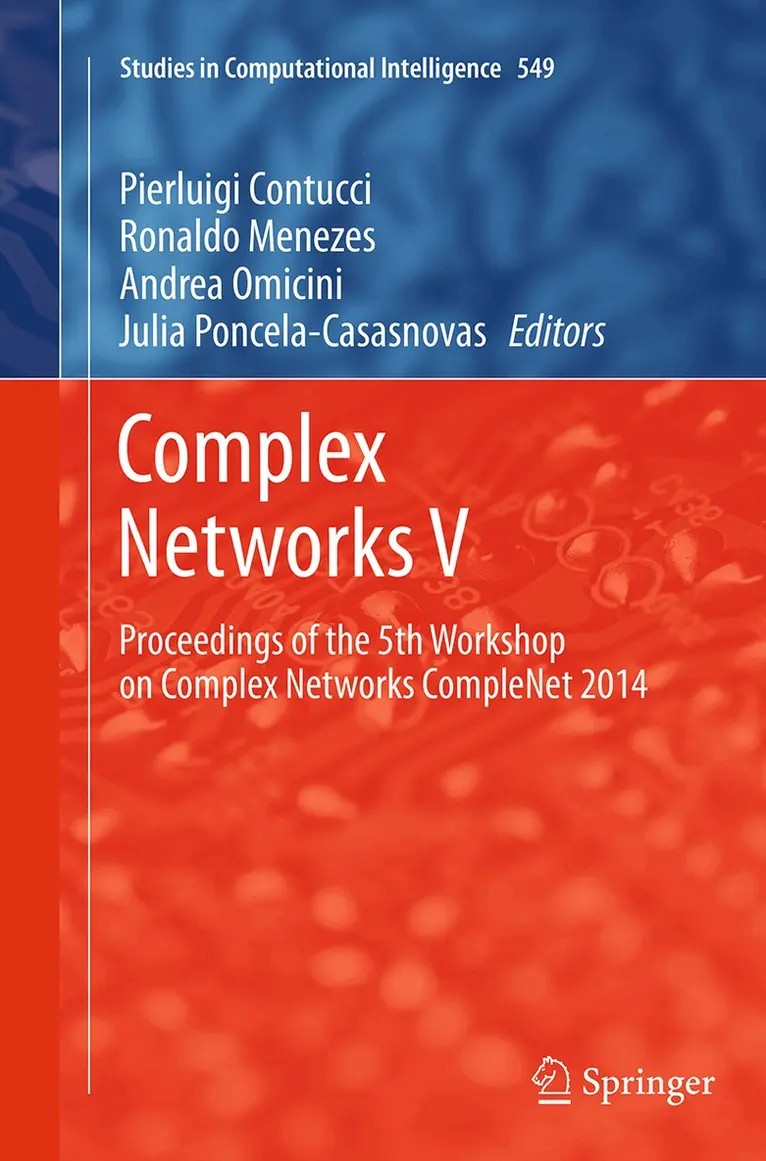
Complex Networks V
Proceedings of the 5th Workshop on Complex Networks CompleNet 2014
Inbunden, Engelska, 2014
2 185 kr
Skickas inom 10-15 vardagar
A network is a mathematical object consisting of a set of points that are connected to each other in some fashion by lines. It turns out this simple description corresponds to a bewildering array of systems in the real world, ranging from technological ones such as the Internet and World Wide Web, biological networks such as that of connections of the nervous systems, food webs or protein interactions, infrastructural systems such as networks of roads, airports or the power-grid, to patterns of social and professional relationships such as friendship, sex partners, network of Hollywood actors, co-authorship networks and many more.Recent years have witnessed a substantial amount of interest within the scientific community in the properties of these networks. The emergence of the internet in particular, coupled with the widespread availability of inexpensive computing resources has facilitated studies ranging from large scale empirical analysis of networks in the real world, to the development of theoretical models and tools to explore the various properties of these systems. The study of networks is broadly interdisciplinary and central developments have occurred in many fields, including mathematics, physics, computer and information sciences, biology and the social sciences.This book brings together a collection of cutting-edge research in the field from a diverse array of researchers ranging from physicists to social scientists and presents them in a coherent fashion, highlighting the strong interconnections between the different areas. Topics included are social networks and social media, opinion and innovation diffusion, biological and health-related networks, language networks, as well as network theory, community detection, or growth models for Complex Networks.
Complex Networks V
Proceedings of the 5th Workshop on Complex Networks CompleNet 2014
Häftad, Engelska, 2016
2 886 kr
Skickas inom 5-8 vardagar
A network is a mathematical object consisting of a set of points that are connected to each other in some fashion by lines. It turns out this simple description corresponds to a bewildering array of systems in the real world, ranging from technological ones such as the Internet and World Wide Web, biological networks such as that of connections of the nervous systems, food webs or protein interactions, infrastructural systems such as networks of roads, airports or the power-grid, to patterns of social and professional relationships such as friendship, sex partners, network of Hollywood actors, co-authorship networks and many more.Recent years have witnessed a substantial amount of interest within the scientific community in the properties of these networks. The emergence of the internet in particular, coupled with the widespread availability of inexpensive computing resources has facilitated studies ranging from large scale empirical analysis of networks in the real world, to the development of theoretical models and tools to explore the various properties of these systems. The study of networks is broadly interdisciplinary and central developments have occurred in many fields, including mathematics, physics, computer and information sciences, biology and the social sciences.This book brings together a collection of cutting-edge research in the field from a diverse array of researchers ranging from physicists to social scientists and presents them in a coherent fashion, highlighting the strong interconnections between the different areas. Topics included are social networks and social media, opinion and innovation diffusion, biological and health-related networks, language networks, as well as network theory, community detection, or growth models for Complex Networks.
Evolutionary Games in Complex Topologies
Interplay Between Structure and Dynamics
Inbunden, Engelska, 2012
1 064 kr
Skickas inom 10-15 vardagar
There are many examples of cooperation in Nature: cells cooperate to form tissues, organs cooperate to form living organisms, and individuals cooperate to raise their offspring or to hunt. However, why cooperation emerges and survives in hostile environments, when defecting would be a much more profitable short-term strategy, is a question that still remains open. During the past few years, several explanations have been proposed, including kin and group selection, punishment and reputation mechanisms, or network reciprocity. This last one will be the center of the present study. The thesis explores the interface between the underlying structure of a given population and the outcome of the cooperative dynamics taking place on top of it, (namely, the Prisoner's Dilemma Game). The first part of this work analyzes the case of a static system, where the pattern of connections is fixed, so it does not evolve over time. The second part develops two models for growing topologies, where the growth and the dynamics are entangled.
Del 476 - Studies in Computational Intelligence
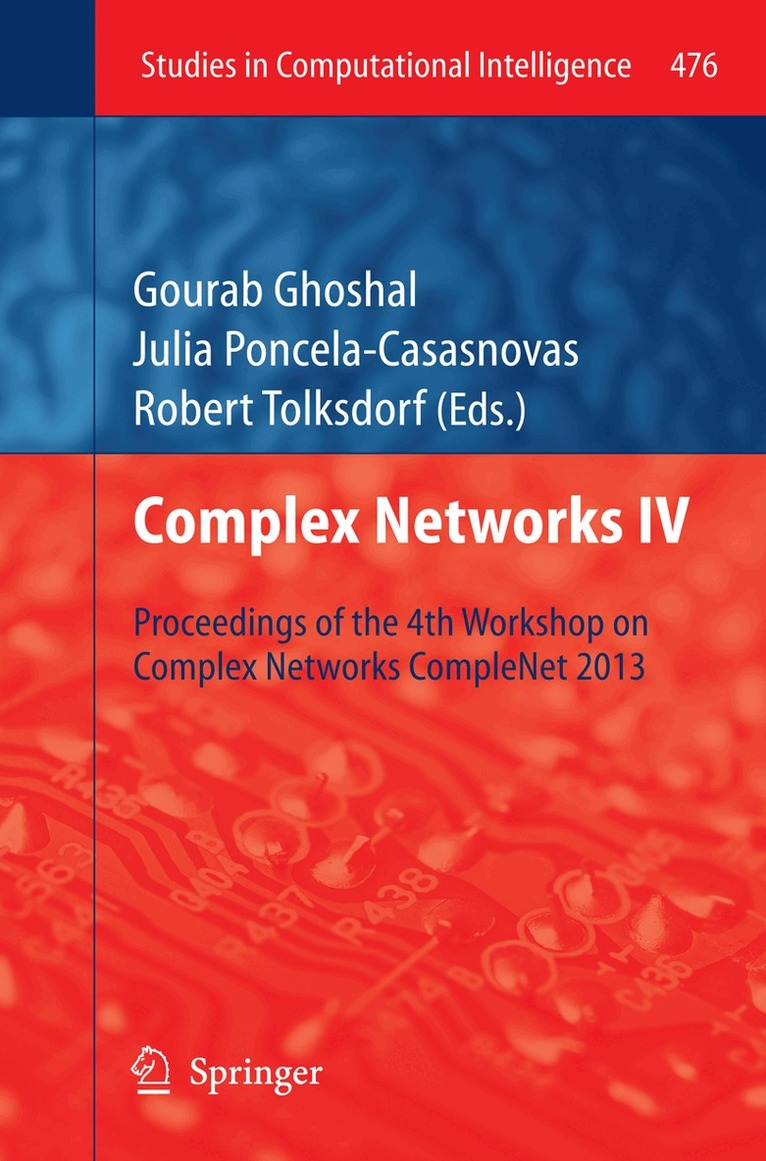
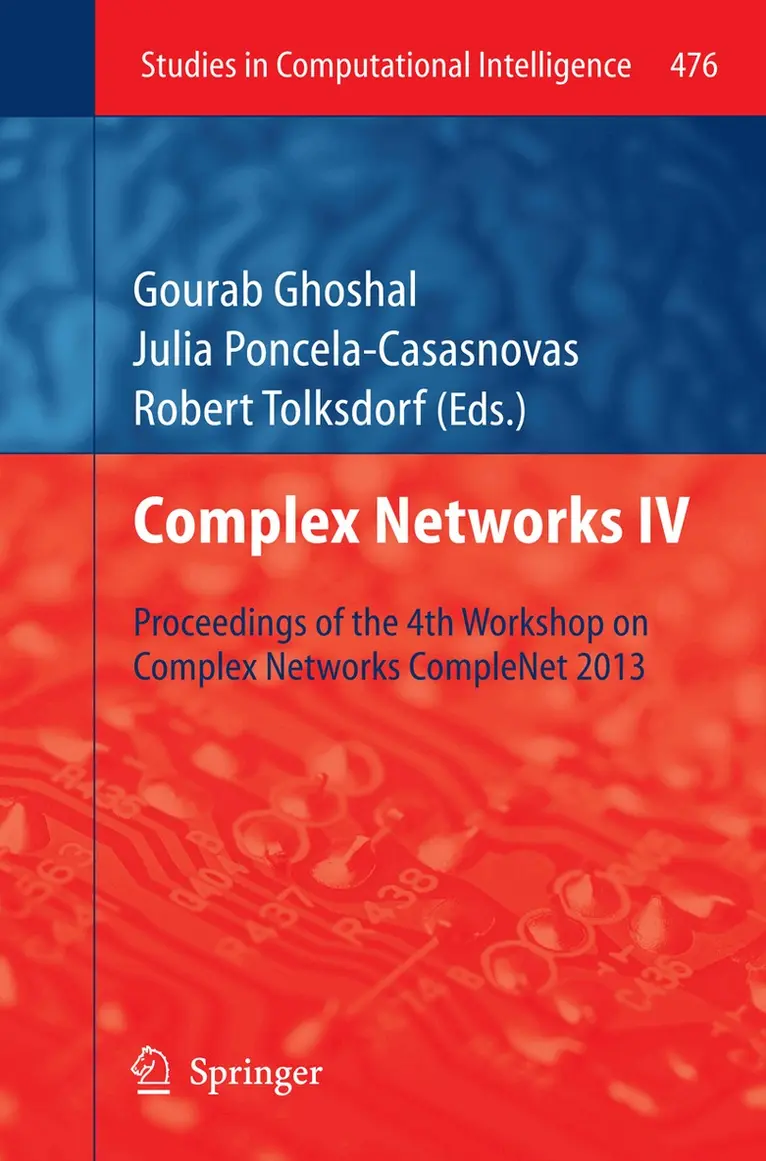
Complex Networks IV
Proceedings of the 4th Workshop on Complex Networks CompleNet 2013
Inbunden, Engelska, 2013
1 640 kr
Skickas inom 10-15 vardagar
A network is a mathematical object consisting of a set of points (called vertices or nodes) that are connected to each other in some fashion by lines (called edges). Turns out this simple description corresponds to a bewildering array of systems in the real world, ranging from technological ones such as the Internet and World Wide Web, biological networks such as that of connections of the nervous systems or blood vessels, food webs, protein interactions, infrastructural systems such as networks of roads, airports or the power-grid, to patterns of social acquaintance such as friendship, network of Hollywood actors, connections between business houses and many more. Recent years have witnessed a substantial amount of interest within the scientific community in the properties of these networks. The emergence of the internet in particular, coupled with the widespread availability of inexpensive computing resources has facilitated studies ranging from large scale empirical analysis of networks in the real world, to the development of theoretical models and tools to explore the various properties of these systems. The study of networks is broadly interdisciplinary and central developments have occurred in many fields, including mathematics, physics, computer and information sciences, biology, and the social sciences.This book brings together a collection of cutting-edge research in the field from a diverse array of researchers ranging from physicists to social scientists, and presents them in a coherent fashion, highlighting the strong interconnections between the different areas. Topics included are social networks and social media, opinion and innovation diffusion, syncronization, transportation networks and human mobility, as well as theory, modeling and metrics of Complex Networks.
Evolutionary Games in Complex Topologies
Interplay Between Structure and Dynamics
Häftad, Engelska, 2014
1 064 kr
Skickas inom 10-15 vardagar
There are many examples of cooperation in Nature: cells cooperate to form tissues, organs cooperate to form living organisms, and individuals cooperate to raise their offspring or to hunt. However, why cooperation emerges and survives in hostile environments, when defecting would be a much more profitable short-term strategy, is a question that still remains open. During the past few years, several explanations have been proposed, including kin and group selection, punishment and reputation mechanisms, or network reciprocity. This last one will be the center of the present study. The thesis explores the interface between the underlying structure of a given population and the outcome of the cooperative dynamics taking place on top of it, (namely, the Prisoner's Dilemma Game). The first part of this work analyzes the case of a static system, where the pattern of connections is fixed, so it does not evolve over time. The second part develops two models for growing topologies, where the growth and the dynamics are entangled.
Del 476 - Studies in Computational Intelligence
Complex Networks IV
Proceedings of the 4th Workshop on Complex Networks CompleNet 2013
Häftad, Engelska, 2015
1 640 kr
Skickas inom 10-15 vardagar
A network is a mathematical object consisting of a set of points (called vertices or nodes) that are connected to each other in some fashion by lines (called edges). Turns out this simple description corresponds to a bewildering array of systems in the real world, ranging from technological ones such as the Internet and World Wide Web, biological networks such as that of connections of the nervous systems or blood vessels, food webs, protein interactions, infrastructural systems such as networks of roads, airports or the power-grid, to patterns of social acquaintance such as friendship, network of Hollywood actors, connections between business houses and many more. Recent years have witnessed a substantial amount of interest within the scientific community in the properties of these networks. The emergence of the internet in particular, coupled with the widespread availability of inexpensive computing resources has facilitated studies ranging from large scale empirical analysis of networks in the real world, to the development of theoretical models and tools to explore the various properties of these systems. The study of networks is broadly interdisciplinary and central developments have occurred in many fields, including mathematics, physics, computer and information sciences, biology, and the social sciences.This book brings together a collection of cutting-edge research in the field from a diverse array of researchers ranging from physicists to social scientists, and presents them in a coherent fashion, highlighting the strong interconnections between the different areas. Topics included are social networks and social media, opinion and innovation diffusion, syncronization, transportation networks and human mobility, as well as theory, modeling and metrics of Complex Networks.