Julian Schwinger – författare
Visar alla böcker från författaren Julian Schwinger. Handla med fri frakt och snabb leverans.
27 produkter
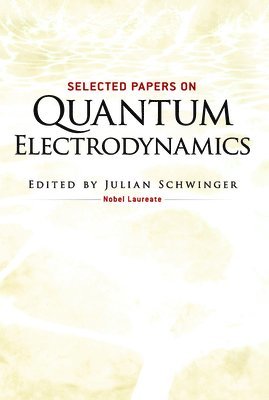
Selected Papers on Quantum Electrodynamics
Av Julian Schwinger, Julian Schwinger
Häftad, 2003
293 kr
Lägg i varukorg
Particles, Sources, And Fields, Volume 1
Inbunden, 2019
2504 kr
Lägg i varukorg
This classic, the first of three volumes, presents techniques that emphasize the unity of high-energy particle physics with electrodynamics, gravitational theory, and many-particle cooperative phenomena. What emerges is a theory intermediate in position between operator field theory and S-matrix …
Particles, Sources, And Fields, Volume 2
Inbunden, 2019
2504 kr
Lägg i varukorg
This classic book (volume two of three volumes) is almost exclusively concerned with quantum electrodynamics. As such, it is retrospective in its subject matter. The topics discussed range from anomalous magnetic moments and vacuum polarization, in a variety of applications, to the energy level …
Particles, Sources, And Fields, Volume 3
Inbunden, 2019
2504 kr
Lägg i varukorg
An extension of Dr. Schwinger's two previous classic works, this volume contains four sections in addition to the previous sections of Electrodynamics II, which were concerned with the two-particle problem, and applications to hydrogenic atoms, positronium, and muonium.
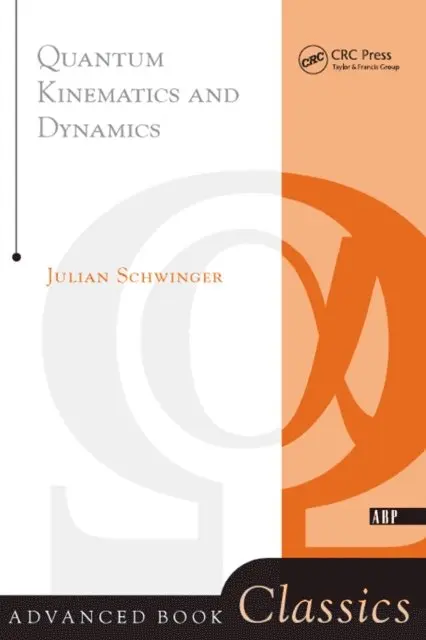
Quantum Kinematics And Dynamic
Inbunden, 2019
2504 kr
Lägg i varukorg
A classic from 1969, this book is based on a series of lectures delivered at the Les Houches Summer School of Theoretical Physics in 1955. The book outlines a general scheme of quantum kinematics and dynamics.
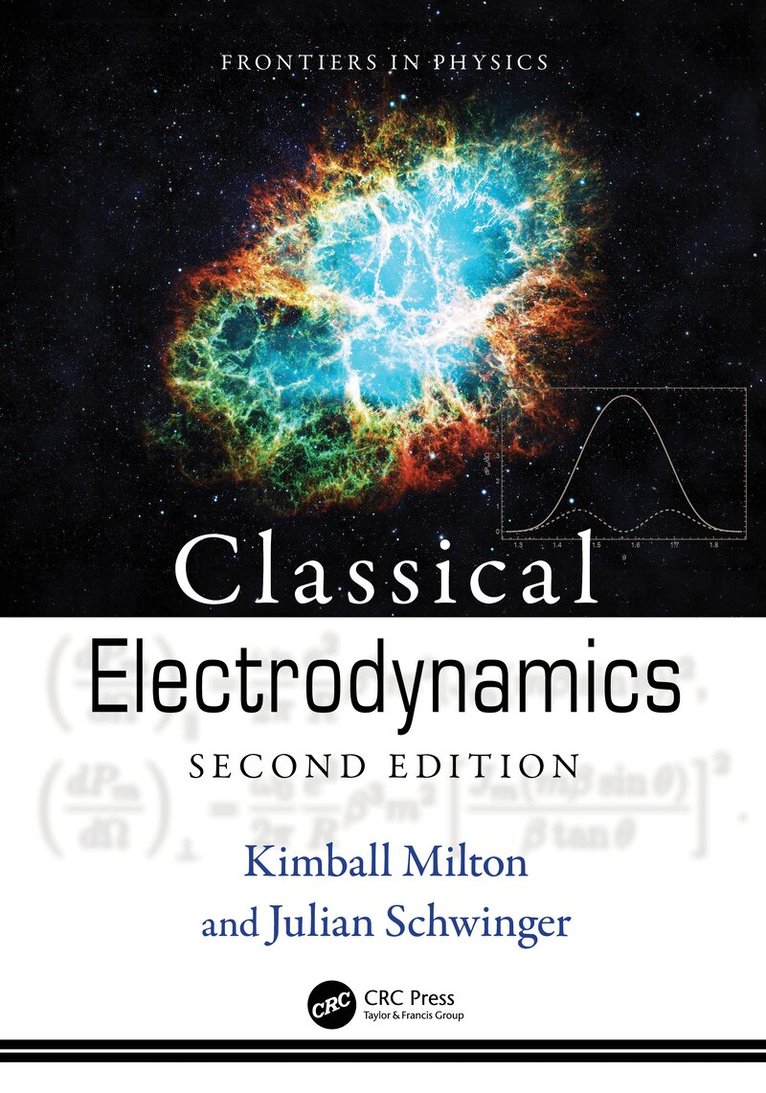
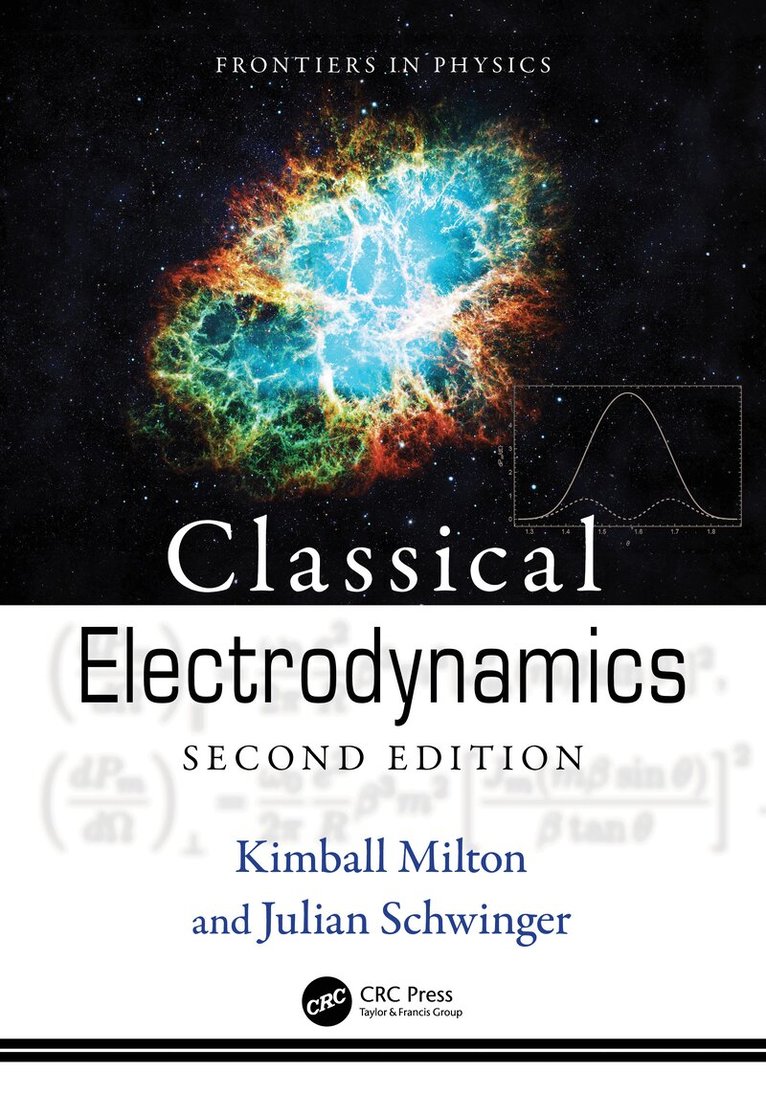
Classical Electrodynamics
Av Julian Schwinger, Kimball Milton
Inbunden, 2024
1821 kr
Lägg i varukorg
Classical Electrodynamics captures Schwinger's inimitable lecturing style, in which everything flows inexorably from what has gone before. This anniversary edition offers a refreshing update while still maintaining Schwinger’s voice.The book provides the student with a thorough grounding in …
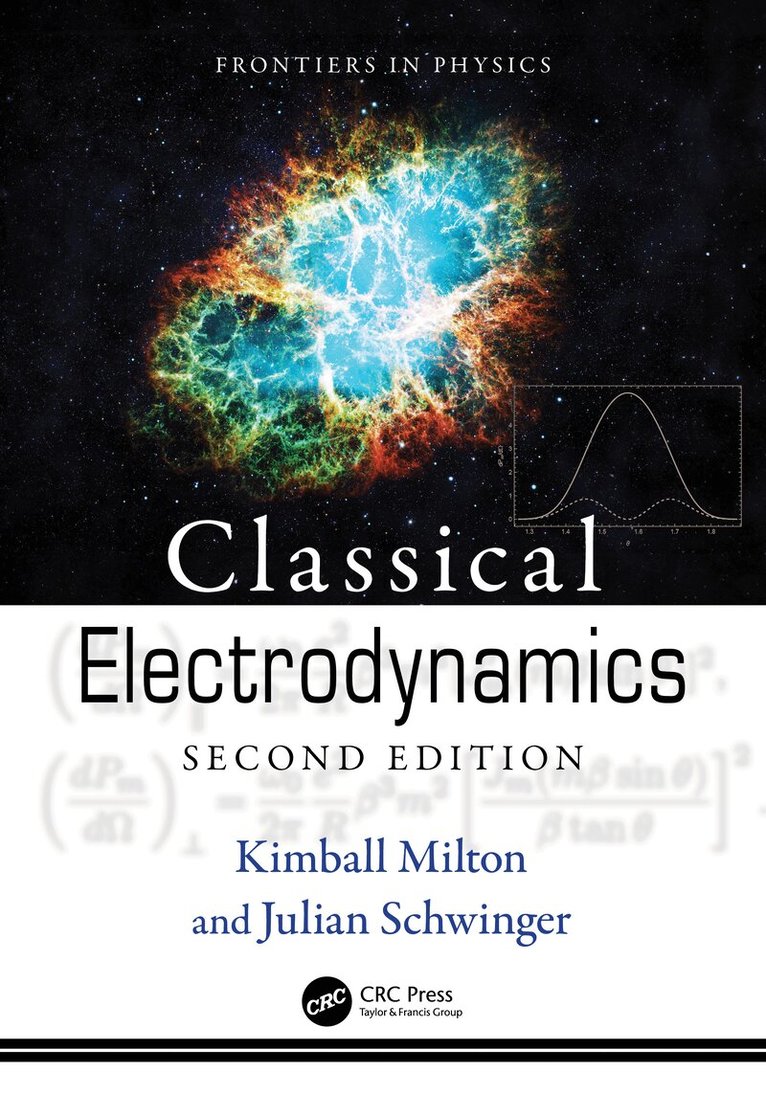
Classical Electrodynamics
Av Julian Schwinger, Kimball Milton
Häftad, 2025
820 kr
Lägg i varukorg
Classical Electrodynamics captures Schwinger's inimitable lecturing style, in which everything flows inexorably from what has gone before. This anniversary edition offers a refreshing update while still maintaining Schwinger’s voice.The book provides the student with a thorough grounding in …
Quantum Kinematics And Dynamic
E-bok, 2018
1385 kr
Lägg i varukorg
A classic from 1969, this book is based on a series of lectures delivered at the Les Houches Summer School of Theoretical Physics in 1955. The book outlines a general scheme of quantum kinematics and dynamics.
Particles, Sources, And Fields, Volume 3
E-bok, 2018
1169 kr
Lägg i varukorg
An extension of Dr. Schwinger''s two previous classic works, this volume contains four sections in addition to the previous sections of Electrodynamics II, which were concerned with the two-particle problem, and applications to hydrogenic atoms, positronium, and muonium.
Particles, Sources, And Fields, Volume 2
E-bok, 2018
1074 kr
Lägg i varukorg
This classic book (volume two of three volumes) is almost exclusively concerned with quantum electrodynamics. As such, it is retrospective in its subject matter. The topics discussed range from anomalous magnetic moments and vacuum polarization, in a variety of applications, to the energy level …
Particles, Sources, And Fields, Volume 1
E-bok, 2018
1385 kr
Lägg i varukorg
This classic, the first of three volumes, presents techniques that emphasize the unity of high-energy particle physics with electrodynamics, gravitational theory, and many-particle cooperative phenomena. What emerges is a theory intermediate in position between operator field theory and S-matrix …
Quantum Kinematics And Dynamic
E-bok, 2018
1355 kr
Lägg i varukorg
A classic from 1969, this book is based on a series of lectures delivered at the Les Houches Summer School of Theoretical Physics in 1955. The book outlines a general scheme of quantum kinematics and dynamics.
Particles, Sources, And Fields, Volume 3
E-bok, 2018
1195 kr
Lägg i varukorg
An extension of Dr. Schwinger''s two previous classic works, this volume contains four sections in addition to the previous sections of Electrodynamics II, which were concerned with the two-particle problem, and applications to hydrogenic atoms, positronium, and muonium.
Particles, Sources, And Fields, Volume 2
E-bok, 2018
1074 kr
Lägg i varukorg
This classic book (volume two of three volumes) is almost exclusively concerned with quantum electrodynamics. As such, it is retrospective in its subject matter. The topics discussed range from anomalous magnetic moments and vacuum polarization, in a variety of applications, to the energy level …
Particles, Sources, And Fields, Volume 1
E-bok, 2018
1385 kr
Lägg i varukorg
This classic, the first of three volumes, presents techniques that emphasize the unity of high-energy particle physics with electrodynamics, gravitational theory, and many-particle cooperative phenomena. What emerges is a theory intermediate in position between operator field theory and S-matrix …
Particles, Sources, And Fields, Volume 1
Häftad, 1998
1168 kr
Lägg i varukorg
This classic, the first of three volumes, presents techniques that emphasize the unity of high-energy particle physics with electrodynamics, gravitational theory, and many-particle cooperative phenomena. What emerges is a theory intermediate in position between operator field theory and S-matrix …
Particles, Sources, And Fields, Volume 2
Häftad, 1998
1009 kr
Lägg i varukorg
This classic book (volume two of three volumes) is almost exclusively concerned with quantum electrodynamics. As such, it is retrospective in its subject matter. The topics discussed range from anomalous magnetic moments and vacuum polarization, in a variety of applications, to the energy level …
Particles, Sources, And Fields, Volume 3
Häftad, 1998
1009 kr
Lägg i varukorg
An extension of Dr. Schwinger's two previous classic works, this volume contains four sections in addition to the previous sections of Electrodynamics II, which were concerned with the two-particle problem, and applications to hydrogenic atoms, positronium, and muonium.
Quantum Kinematics And Dynamic
Häftad, 2000
1168 kr
Lägg i varukorg
A classic from 1969, this book is based on a series of lectures delivered at the Les Houches Summer School of Theoretical Physics in 1955. The book outlines a general scheme of quantum kinematics and dynamics.
Classical Electrodynamics
Av Julian Schwinger, Kimball Milton
E-bok, 2024
866 kr
Lägg i varukorg
Classical Electrodynamics captures Schwinger's inimitable lecturing style, in which everything flows inexorably from what has gone before. This anniversary edition offers a refreshing update while still maintaining Schwinger’s voice.The book provides the student with a thorough grounding in …
Classical Electrodynamics
Av Julian Schwinger, Kimball Milton
E-bok, 2024
866 kr
Lägg i varukorg
Classical Electrodynamics captures Schwinger's inimitable lecturing style, in which everything flows inexorably from what has gone before. This anniversary edition offers a refreshing update while still maintaining Schwinger’s voice.The book provides the student with a thorough grounding in …
Electromagnetic Radiation: Variational Methods, Waveguides and Accelerators
Including Seminal Papers of Julian Schwinger
Av Kimball A. Milton, Julian Schwinger
Inbunden, 2006
1639 kr
Lägg i varukorg
Julian Schwinger was already the world’s leading nuclear theorist when he joined the Radiation Laboratory at MIT in 1943, at the ripe age of 25. Just 2 years earlier he had joined the faculty at Purdue, after a postdoc with OppenheimerinBerkeley,andgraduatestudyatColumbia. Anearlysemester at …
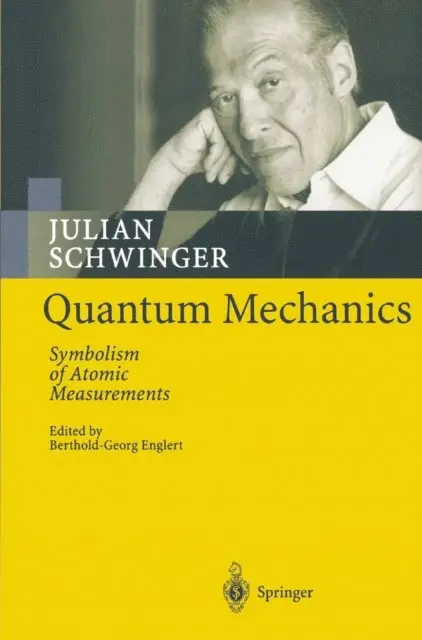
Quantum Mechanics
Symbolism of Atomic Measurements
Av Julian Schwinger, Berthold-Georg Englert
Inbunden, 2001
1204 kr
Lägg i varukorg
Julian Schwinger had plans to write a textbook on quantum mechanics since the 1950s when he was teaching the subject at Harvard University regularly. * t Roger Newton remembers: [A] group of us (Stanley Deser, Dick Arnowitt, Chuck Zemach, Paul Martin and I forgot who else) wrote up lecture notes on …
Electromagnetic Radiation: Variational Methods, Waveguides and Accelerators
Including Seminal Papers of Julian Schwinger
Av Kimball A. Milton, Julian Schwinger
Häftad, 2010
1639 kr
Lägg i varukorg
Julian Schwinger was already the world’s leading nuclear theorist when he joined the Radiation Laboratory at MIT in 1943, at the ripe age of 25. Just 2 years earlier he had joined the faculty at Purdue, after a postdoc with OppenheimerinBerkeley,andgraduatestudyatColumbia. Anearlysemester at …
Quantum Mechanics
Symbolism of Atomic Measurements
Av Julian Schwinger, Berthold-Georg Englert
Häftad, 2011
878 kr
Lägg i varukorg
Julian Schwinger had plans to write a textbook on quantum mechanics since the 1950s when he was teaching the subject at Harvard University regularly. * t Roger Newton remembers: [A] group of us (Stanley Deser, Dick Arnowitt, Chuck Zemach, Paul Martin and I forgot who else) wrote up lecture notes on …
Quantum Mechanics
Symbolism of Atomic Measurements
Av Julian Schwinger, Berthold-Georg Englert
E-bok, 2013
1141 kr
Lägg i varukorg
Julian Schwinger had plans to write a textbook on quantum mechanics since the 1950s when he was teaching the subject at Harvard University regularly. * t Roger Newton remembers: [A] group of us (Stanley Deser, Dick Arnowitt, Chuck Zemach, Paul Martin and I forgot who else) wrote up lecture notes on …
Classical Electrodynamics
Av Julian Schwinger, Lester L. Deraad Jr. m. fl.
Inbunden, 1998
1234 kr
Tillfälligt slut
Classical Electrodynamics captures Schwinger's inimitable lecturing style, in which everything flows inexorably from what has gone before.