Juliana De Nooy – författare
Visar alla böcker från författaren Juliana De Nooy. Handla med fri frakt och snabb leverans.
8 produkter
8 produkter
E-bok
PDF, Engelska, 2005790 kr
Läs direkt efter köp
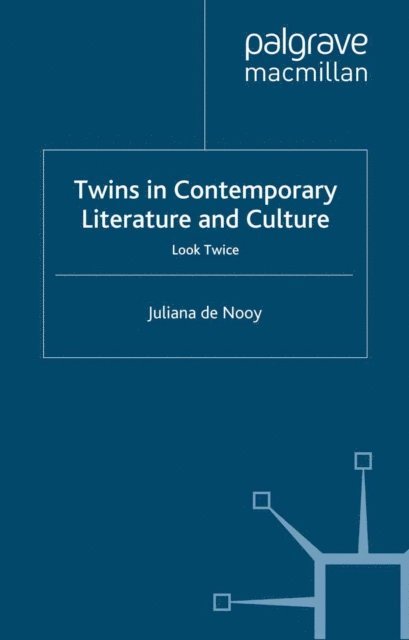
Stories of twins are told with astonishing frequency in contemporary culture. Films and novels from recent decades repeatedly tell of the stranglehold of brotherly love, the evil twin who steals her sister''s lover, the homicidal mutant twin, the reunion of twins separated at birth, warring twins, and confusion between look-alikes. Twins in Contemporary Literature and Culture asks why we keep telling twin tales and how these have been transformed in recent retellings to reflect the preoccupations of the times.
Inbunden, Engelska, 1998
1 340 kr
Skickas inom 10-15 vardagar
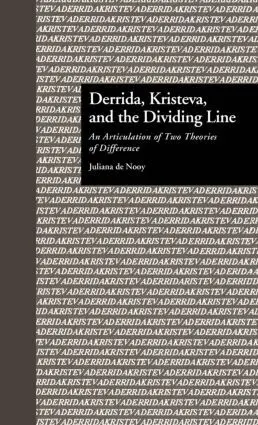
Both Jacques Derrida and Julia Kristeva have made an enormous impact throughout the humanities with their work on signification, identity and difference, and yet the nature of the relation between their theories seems oddly indeterminate: they have sometimes been regarded as more or less indistinguishable and sometimes as incompatible This book aims at establishing precisely how Kristeva's and Derrida's writings may be articulated, tracing intersections and divergences, parallels and discontinuities between them. But how do you compare two theories of the production of difference? What conception of difference do you use to go about it? Any search for a dividing line between Derrida and Kristeva already engages with their preoccupations. Should the juxtaposition of these practices be conceived as a face-to-face confrontation or rather a gap, a hiatus? Could it be a dialectic? or a diff rance? Should it be thought of in terms of Kristeva's work . . . or Derrida's? Accessible and lively, this book studies the theories on their own terms, in terms of one another, and with regard to the literary text, a privileged object of their attention. It demonstrates that the articulation of the theories shifts under different discursive conditions such that a Derridean reading of the relation is unlikely to coincide with a Kristevan interpretation. It shows why there is no single answer to the question of how the two fit together. And it investigates what is at stake in the strategic uses to which their work is put, whether separately or together.
E-bok
PDF, Engelska, 2013709 kr
Läs direkt efter köp
Both Jacques Derrida and Julia Kristeva have made an enormous impact throughout the humanities with their work on signification, identity and difference, and yet the nature of the relation between their theories seems oddly indeterminate: they have sometimes been regarded as more or less indistinguishable and sometimes as incompatible This book aims at establishing precisely how Kristeva''s and Derrida''s writings may be articulated, tracing intersections and divergences, parallels and discontinuities between them. But how do you compare two theories of the production of difference? What conception of difference do you use to go about it? Any search for a dividing line between Derrida and Kristeva already engages with their preoccupations. Should the juxtaposition of these practices be conceived as a face-to-face confrontation or rather a gap, a hiatus? Could it be a dialectic? or a diff rance? Should it be thought of in terms of Kristeva''s work . . . or Derrida''s? Accessible and lively, this book studies the theories on their own terms, in terms of one another, and with regard to the literary text, a privileged object of their attention. It demonstrates that the articulation of the theories shifts under different discursive conditions such that a Derridean reading of the relation is unlikely to coincide with a Kristevan interpretation. It shows why there is no single answer to the question of how the two fit together. And it investigates what is at stake in the strategic uses to which their work is put, whether separately or together.
E-bok
Engelska, 2013709 kr
Läs direkt efter köp
Both Jacques Derrida and Julia Kristeva have made an enormous impact throughout the humanities with their work on signification, identity and difference, and yet the nature of the relation between their theories seems oddly indeterminate: they have sometimes been regarded as more or less indistinguishable and sometimes as incompatible This book aims at establishing precisely how Kristeva''s and Derrida''s writings may be articulated, tracing intersections and divergences, parallels and discontinuities between them. But how do you compare two theories of the production of difference? What conception of difference do you use to go about it? Any search for a dividing line between Derrida and Kristeva already engages with their preoccupations. Should the juxtaposition of these practices be conceived as a face-to-face confrontation or rather a gap, a hiatus? Could it be a dialectic? or a diff rance? Should it be thought of in terms of Kristeva''s work . . . or Derrida''s? Accessible and lively, this book studies the theories on their own terms, in terms of one another, and with regard to the literary text, a privileged object of their attention. It demonstrates that the articulation of the theories shifts under different discursive conditions such that a Derridean reading of the relation is unlikely to coincide with a Kristevan interpretation. It shows why there is no single answer to the question of how the two fit together. And it investigates what is at stake in the strategic uses to which their work is put, whether separately or together.
Häftad, Engelska, 2014
620 kr
Skickas inom 10-15 vardagar
Both Jacques Derrida and Julia Kristeva have made an enormous impact throughout the humanities with their work on signification, identity and difference, and yet the nature of the relation between their theories seems oddly indeterminate: they have sometimes been regarded as more or less indistinguishable and sometimes as incompatible This book aims at establishing precisely how Kristeva's and Derrida's writings may be articulated, tracing intersections and divergences, parallels and discontinuities between them. But how do you compare two theories of the production of difference? What conception of difference do you use to go about it? Any search for a dividing line between Derrida and Kristeva already engages with their preoccupations. Should the juxtaposition of these practices be conceived as a face-to-face confrontation or rather a gap, a hiatus? Could it be a dialectic? or a diff rance? Should it be thought of in terms of Kristeva's work . . . or Derrida's? Accessible and lively, this book studies the theories on their own terms, in terms of one another, and with regard to the literary text, a privileged object of their attention. It demonstrates that the articulation of the theories shifts under different discursive conditions such that a Derridean reading of the relation is unlikely to coincide with a Kristevan interpretation. It shows why there is no single answer to the question of how the two fit together. And it investigates what is at stake in the strategic uses to which their work is put, whether separately or together.
Inbunden, Engelska, 2005
631 kr
Skickas inom 10-15 vardagar
Stories of twins are told with astonishing frequency in contemporary culture. Films and novels from recent decades repeatedly tell of the stranglehold of brotherly love, the evil twin who steals her sister's lover, the homicidal mutant twin, the reunion of twins separated at birth, warring twins, and confusion between look-alikes. Twins in Contemporary Literature and Culture asks why we keep telling twin tales and how these have been transformed in recent retellings to reflect the preoccupations of the times.
Häftad, Engelska, 2020
418 kr
Skickas inom 5-8 vardagar
Häftad, Engelska, 2005
368 kr
Tillfälligt slut
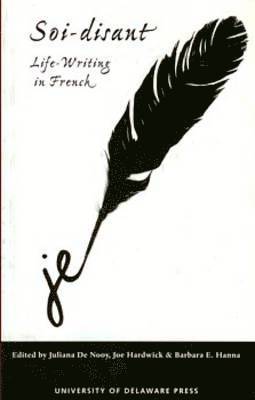
A cross-section of current work in autobiographical studies, ""Soi-disant"" brings together essays on Raymond Queneau, Georges Perec, Jean Genet, Jeanne Hyvrard, Amelle Nothomb, Yves Navarre, Catherine Pozzi, Marie Bashkirtself, and the history of Maghreb literature. It highlights the intertextual nature of autobiographical writing, the ways in which it is shaped by other texts of various genres and bears the traces of these textual intersections. Reflecting contemporary preoccupations in autobiographical studies, the collection demonstrates that the aim has moved beyond the policing of a genre. Autobiographical practices are taken to be plural and considered as sets of discursive maneuvers. The essays are thus concerned less with defining what life-writing is than with raising questions about what it can do performatively, whether in diaries, autobiographies subtitled as such and novels read as autobiographies, or in such unlikely genres as fourteenth century travel writing in Arabic and the elaborate games of OuLiPo texts.