Julie A. Deisinger - Böcker
Visar alla böcker från författaren Julie A. Deisinger. Handla med fri frakt och snabb leverans.
3 produkter
3 produkter
517 kr
Skickas inom 7-10 vardagar
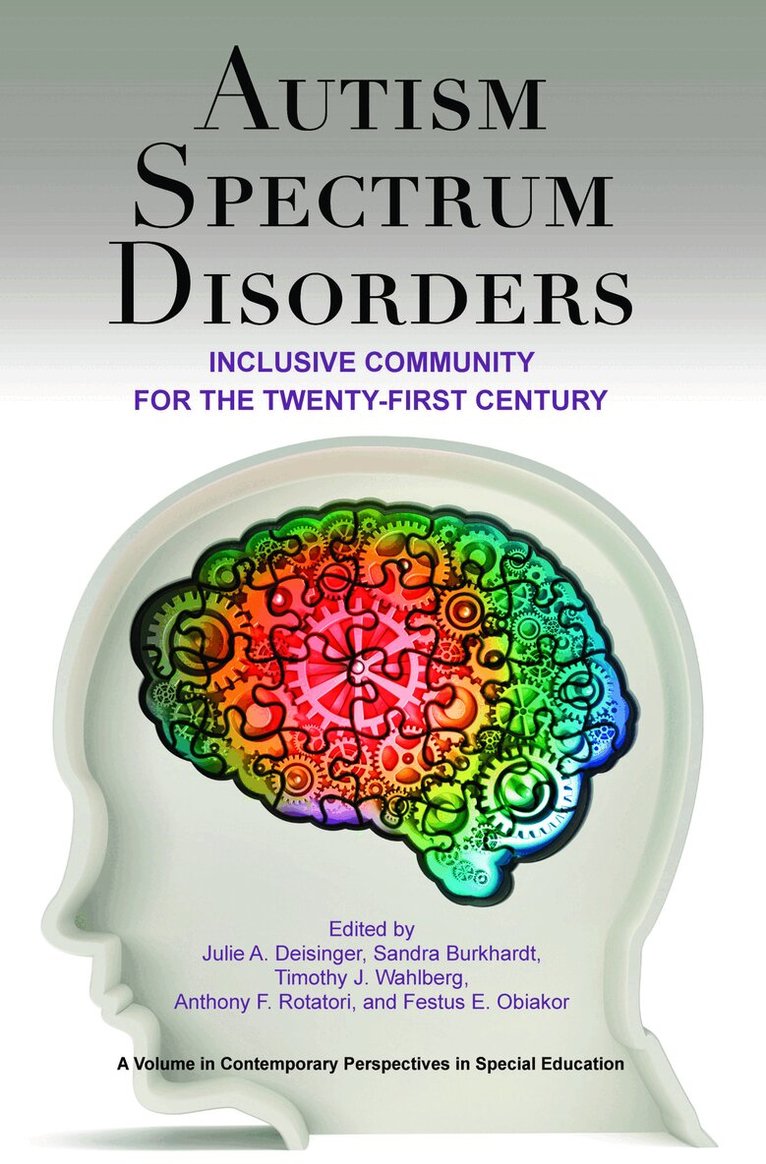
Autism Spectrum Disorders (ASD) has received considerable educational, research, medical and media attention the past ten years. Yet the condition was first described more than a hundred years ago. Due to the disorder being confused with childhood schizophrenia, there was a lack of definitive attention by special educators, medical professionals and mental health clinicians to advance parameters related to: causes; prevalence; identification and diagnosis; education and treatment. Positively, this confusion changed starting in the 1980s with the clarification of the differences between these disorders with the 1980 publication of the' Diagnostic and Statistical Manual of Mental Disorders' (DSM-III). Soon after, the 1990 federal legislation 'Individuals with Disabilities Education Act' recognized the disorder as a disability category eligible for special education services. Both of these events lead to an explosion of information related to: finding causes; accurate identification and diagnosis; best educational practices; and social, emotional, and behavioral treatments.Even with this explosion in the body of knowledge concerned with this disorder, much more needs to be learned and discovered. The successful use of this body of knowledge requires that accurate information be provided to educators, parents, clinicians, medical professionals, and mental health professionals to counter misinformation that exists among the general public, educators and clinical professionals. This is the primary purpose of 'Autism Spectrum Disorders: Inclusive Community for the 21st Century'. The chapters are written by researchers, clinicians, business professionals, and university professors who have an extensive knowledge of ASD. The contents of the book are an excellent reference for special education teachers, school psychologists, practicing mental health clinicians, and parents and family members of children and adults with ASD.
952 kr
Skickas inom 7-10 vardagar
Autism Spectrum Disorders (ASD) has received considerable educational, research, medical and media attention the past ten years. Yet the condition was first described more than a hundred years ago. Due to the disorder being confused with childhood schizophrenia, there was a lack of definitive attention by special educators, medical professionals and mental health clinicians to advance parameters related to: causes; prevalence; identification and diagnosis; education and treatment. Positively, this confusion changed starting in the 1980s with the clarification of the differences between these disorders with the 1980 publication of the' Diagnostic and Statistical Manual of Mental Disorders' (DSM-III). Soon after, the 1990 federal legislation 'Individuals with Disabilities Education Act' recognized the disorder as a disability category eligible for special education services. Both of these events lead to an explosion of information related to: finding causes; accurate identification and diagnosis; best educational practices; and social, emotional, and behavioral treatments.Even with this explosion in the body of knowledge concerned with this disorder, much more needs to be learned and discovered. The successful use of this body of knowledge requires that accurate information be provided to educators, parents, clinicians, medical professionals, and mental health professionals to counter misinformation that exists among the general public, educators and clinical professionals. This is the primary purpose of 'Autism Spectrum Disorders: Inclusive Community for the 21st Century'. The chapters are written by researchers, clinicians, business professionals, and university professors who have an extensive knowledge of ASD. The contents of the book are an excellent reference for special education teachers, school psychologists, practicing mental health clinicians, and parents and family members of children and adults with ASD.
1 295 kr
Skickas inom 7-10 vardagar
This proposed volume will provide in-depth coverage about a construct known as the broad autism phenotype (BAP). The BAP encompasses biological, cognitive, emotional, behavioral, and interpersonal characteristics resembling those found on the autism spectrum, although more subtle than what is evident among individuals who meet formal criteria for an autism spectrum diagnosis. Initially identified in 1994, the BAP has been receiving increased attention due to the recognition of autism as a spectrum of disorders that vary in symptoms and severity.