Julie Peteet - Böcker
Visar alla böcker från författaren Julie Peteet. Handla med fri frakt och snabb leverans.
6 produkter
6 produkter
281 kr
Skickas inom 7-10 vardagar
This study explores the role of politically active Palestinian women in the Lebanese Resistance Movement. The author describes the types of work involved, the organizations these women have founded, and the changing nature of gender roles set against an intense and sustained crisis.
844 kr
Skickas inom 7-10 vardagar
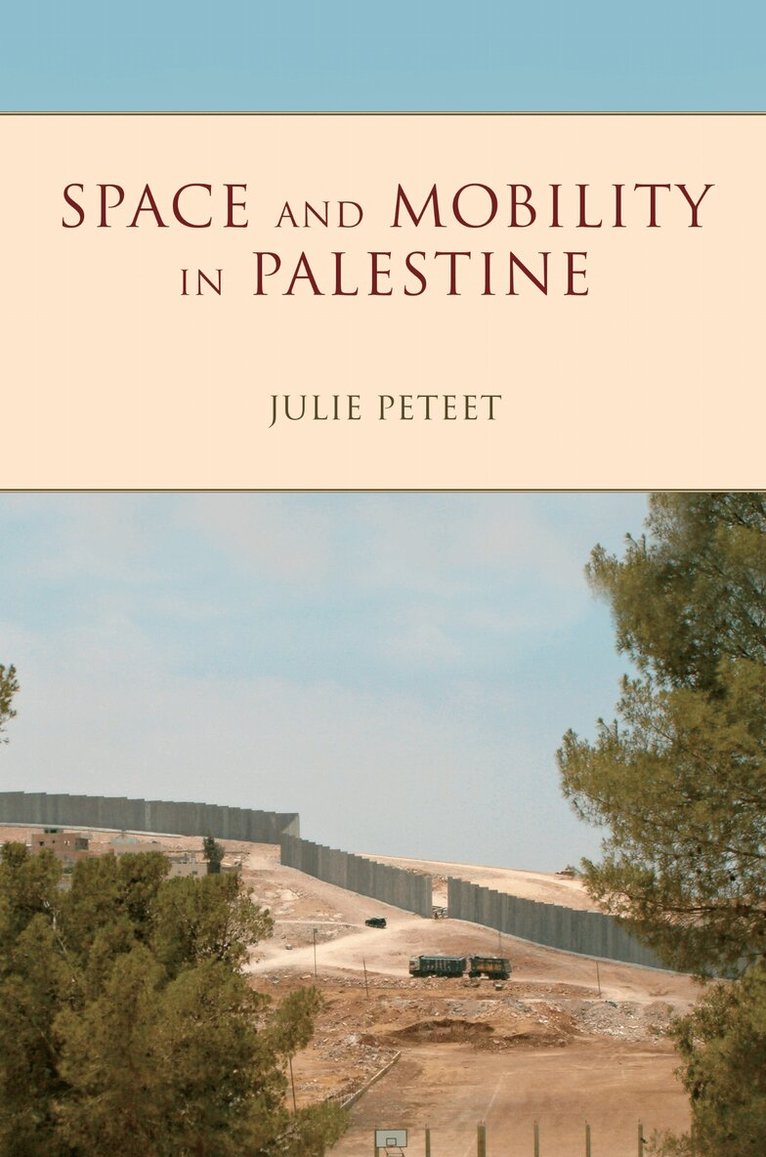
Professor Julie Peteet believes that the concept of mobility is key to understanding how place and space act as forms of power, identity, and meaning among Palestinians in Israel today. In Space and Mobility in Palestine, she investigates how Israeli policies of closure and separation influence Palestinian concerns about constructing identity, the ability to give meaning to place, and how Palestinians comprehend, experience, narrate, and respond to Israeli settler-colonialism. Peteet's work sheds new light on everyday life in the Occupied Territories and helps explain why regional peace may be difficult to achieve in the foreseeable future.
308 kr
Skickas inom 7-10 vardagar
Professor Julie Peteet believes that the concept of mobility is key to understanding how place and space act as forms of power, identity, and meaning among Palestinians in Israel today. In Space and Mobility in Palestine, she investigates how Israeli policies of closure and separation influence Palestinian concerns about constructing identity, the ability to give meaning to place, and how Palestinians comprehend, experience, narrate, and respond to Israeli settler-colonialism. Peteet's work sheds new light on everyday life in the Occupied Territories and helps explain why regional peace may be difficult to achieve in the foreseeable future.
312 kr
Skickas inom 10-15 vardagar
Nearly half of the world's eight million Palestinians are registered refugees, having faced partition and exile. Landscape of Hope and Despair examines this refugee experience in Lebanon through the medium of spatial practices and identity, set against the backdrop of prolonged violence. Julie Peteet explores how Palestinians have dealt with their experience as refugees by focusing attention on how a distinctive Palestinian identity has emerged from and been informed by fifty years of refugee history. Concentrating ethnographic scrutiny on a site-specific experience allows the author to shed light on the mutually constitutive character of place and cultural identification.Palestinian refugee camps are contradictory places: sites of grim despair but also of hope and creativity. Within these cramped spaces, refugees have crafted new worlds of meaning and visions of the possible in politics. In the process, their historical predicament was a point of departure for social action and thus became radically transformed. Beginning with the calamity of 1948, Landscape of Hope and Despair traces the dialectic of place and cultural identification through the initial despair of the 1950s and early 1960s to the tumultuous days of the resistance and the violence of the Lebanese civil war and its aftermath. Most significantly, this study invokes space, place, and identity to construct an alternative to the received national narratives of Palestinian society and history.The moving stories told here form a larger picture of these refugees as a people struggling to recreate their sense of place and identity and add meaning to their surroundings through the use of culture and memory.
1 209 kr
Skickas inom 10-15 vardagar
Julie Peteet offers a fascinating tour through the rich cultural history of hammams, or baths, in the Mediterranean and Middle East. These sacred structures date back to the Bronze and Iron Ages and have evolved through the Hellenistic, Roman, Byzantine, and Islamic periods. In this original work, Peteet provides the first comprehensive examination of hammams through their architecture, the labor pool, clientele, meanings, notions of the body and hygiene, and economy. Exploring the hammam as both a tangible architectural structure and an intangible social practice, Peteet sheds light on how the bath has functioned as a central hub of religious ceremonies and a space that transcends any specific religious affiliation.Although hammams have experienced a decline due to modernization, new domestic technologies, and rejection of the Ottoman-Islamic past, their current reinvigorated form illuminates neoliberal conceptions of heritage and leisure industries. Hammams have become spaces for cleansing and fashioning a gendered and aesthetically appropriate body as defined by a global wellness syndrome. Peteet’s captivating narrative traces the hammam’s historical significance and contemporary role as both a sacred and profane cultural phenomenon.
519 kr
Skickas inom 7-10 vardagar
Julie Peteet offers a fascinating tour through the rich cultural history of hammams, or baths, in the Mediterranean and Middle East. These sacred structures date back to the Bronze and Iron Ages and have evolved through the Hellenistic, Roman, Byzantine, and Islamic periods. In this original work, Peteet provides the first comprehensive examination of hammams through their architecture, the labor pool, clientele, meanings, notions of the body and hygiene, and economy. Exploring the hammam as both a tangible architectural structure and an intangible social practice, Peteet sheds light on how the bath has functioned as a central hub of religious ceremonies and a space that transcends any specific religious affiliation.Although hammams have experienced a decline due to modernization, new domestic technologies, and rejection of the Ottoman-Islamic past, their current reinvigorated form illuminates neoliberal conceptions of heritage and leisure industries. Hammams have become spaces for cleansing and fashioning a gendered and aesthetically appropriate body as defined by a global wellness syndrome. Peteet’s captivating narrative traces the hammam’s historical significance and contemporary role as both a sacred and profane cultural phenomenon.