Jürgen Gerhard – författare
Visar alla böcker från författaren Jürgen Gerhard. Handla med fri frakt och snabb leverans.
7 produkter
7 produkter
Del 1125 - Communications in Computer and Information Science
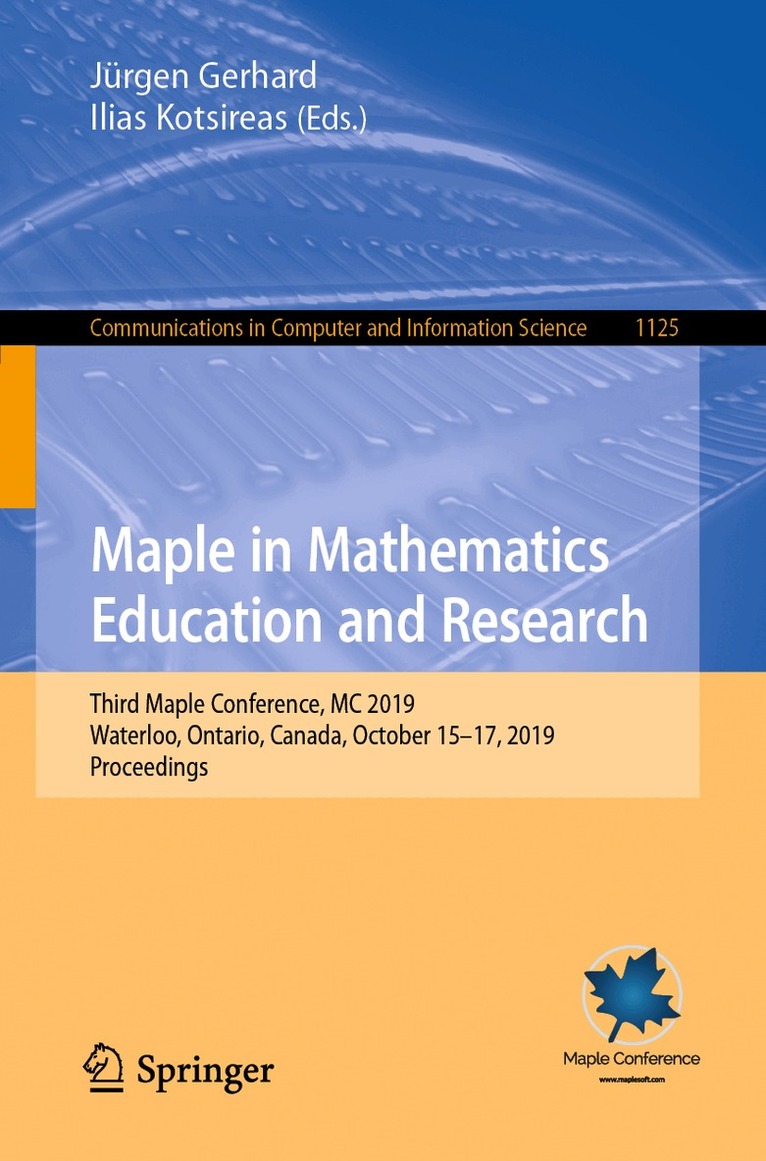
Maple in Mathematics Education and Research
Third Maple Conference, MC 2019, Waterloo, Ontario, Canada, October 15–17, 2019, Proceedings
Häftad, Engelska, 2020
529 kr
Skickas inom 10-15 vardagar
This book constitutes the refereed proceedings of the third Maple Conference, MC 2019, held in Waterloo, Ontario, Canada, in October 2019. The 21 revised full papers and 9 short papers were carefully reviewed and selected out of 37 submissions, one invited paper is also presented in the volume. The papers included in this book cover topics in education, algorithms, and applciations of the mathematical software Maple.
E-bok
Engelska, 2020692 kr
Läs direkt efter köp
This book constitutes the refereed proceedings of the third Maple Conference, MC 2019, held in Waterloo, Ontario, Canada, in October 2019. The 21 revised full papers and 9 short papers were carefully reviewed and selected out of 37 submissions, one invited paper is also presented in the volume. The papers included in this book cover topics in education, algorithms, and applciations of the mathematical software Maple.
Del 1414 - Communications in Computer and Information Science
Maple in Mathematics Education and Research
4th Maple Conference, MC 2020, Waterloo, Ontario, Canada, November 2–6, 2020, Revised Selected Papers
Häftad, Engelska, 2021
1 190 kr
Skickas inom 10-15 vardagar
This book constitutes refereed proceedings of the 4th Maple Conference, MC 2020, held in Waterloo, Ontario, Canada, in November 2020. The 25 revised full papers and 3 short papers were carefully reviewed and selected out of 75 submissions, one invited paper is also presented in the volume. The papers included in this book cover topics in education, algorithms, and applciations of the mathematical software Maple.
E-bok
Engelska, 20211 575 kr
Läs direkt efter köp
This book constitutes refereed proceedings of the 4th Maple Conference, MC 2020, held in Waterloo, Ontario, Canada, in November 2020. The 25 revised full papers and 3 short papers were carefully reviewed and selected out of 75 submissions, one invited paper is also presented in the volume. The papers included in this book cover topics in education, algorithms, and applciations of the mathematical software Maple.
Häftad, Engelska, 2004
561 kr
Skickas inom 10-15 vardagar
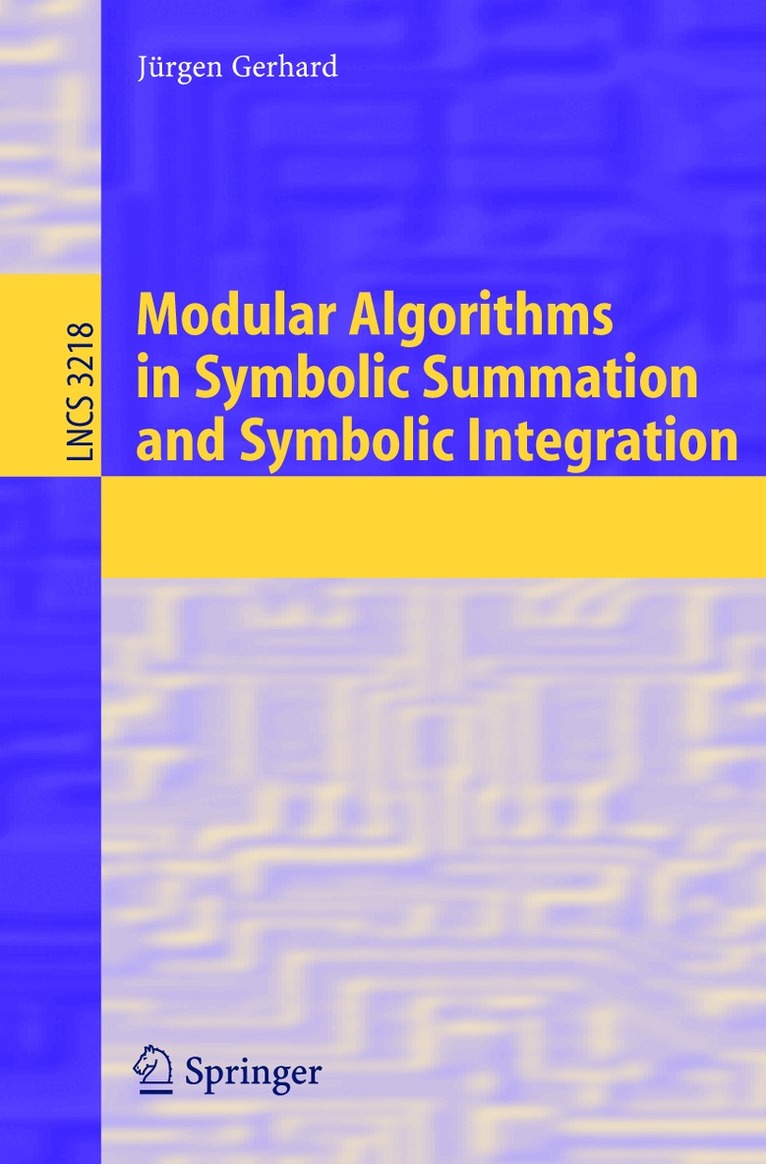
This work brings together two streams in computer algebra: symbolic integration and summation on the one hand, and fast algorithmics on the other hand. In many algorithmically oriented areas of computer science, theanalysisof- gorithms–placedintothe limelightbyDonKnuth’stalkat the 1970ICM –provides a crystal-clear criterion for success. The researcher who designs an algorithmthat is faster (asymptotically, in the worst case) than any previous method receives instant grati?cation: her result will be recognized as valuable. Alas, the downside is that such results come along quite infrequently, despite our best efforts. An alternative evaluation method is to run a new algorithm on examples; this has its obvious problems, but is sometimes the best we can do. George Collins, one of the fathers of computer algebra and a great experimenter,wrote in 1969: “I think this demonstrates again that a simple analysis is often more revealing than a ream of empirical data (although both are important). ” Within computer algebra, some areas have traditionally followed the former methodology, notably some parts of polynomial algebra and linear algebra. Other areas, such as polynomial system solving, have not yet been amenable to this - proach. The usual “input size” parameters of computer science seem inadequate, and although some natural “geometric” parameters have been identi?ed (solution dimension, regularity), not all (potential) major progress can be expressed in this framework. Symbolic integration and summation have been in a similar state.
E-bok
PDF, Engelska, 2004712 kr
Läs direkt efter köp
This work brings together two streams in computer algebra: symbolic integration and summation on the one hand, and fast algorithmics on the other hand. In many algorithmically oriented areas of computer science, theanalysisof- gorithms–placedintothe limelightbyDonKnuth’stalkat the 1970ICM –provides a crystal-clear criterion for success. The researcher who designs an algorithmthat is faster (asymptotically, in the worst case) than any previous method receives instant grati?cation: her result will be recognized as valuable. Alas, the downside is that such results come along quite infrequently, despite our best efforts. An alternative evaluation method is to run a new algorithm on examples; this has its obvious problems, but is sometimes the best we can do. George Collins, one of the fathers of computer algebra and a great experimenter,wrote in 1969: “I think this demonstrates again that a simple analysis is often more revealing than a ream of empirical data (although both are important). ” Within computer algebra, some areas have traditionally followed the former methodology, notably some parts of polynomial algebra and linear algebra. Other areas, such as polynomial system solving, have not yet been amenable to this - proach. The usual “input size” parameters of computer science seem inadequate, and although some natural “geometric” parameters have been identi?ed (solution dimension, regularity), not all (potential) major progress can be expressed in this framework. Symbolic integration and summation have been in a similar state.
Häftad, Engelska, 2000
1 114 kr
Skickas inom 5-8 vardagar
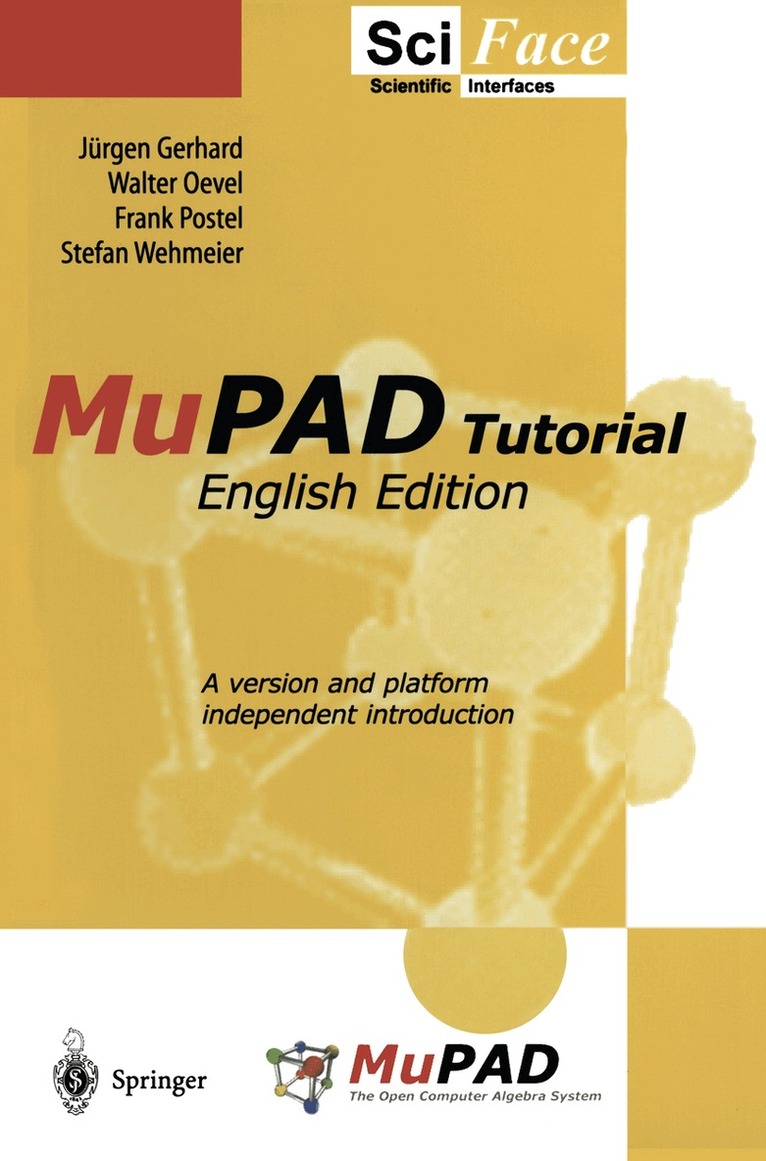
This version and platform independend tutorial explains the basic tools and main features of MuPad and their use. The mathematical applications that are mentioned in the text are intentionally kept on a rather elementary level to keep this text plain for readers with little mathematical background. 88 exercises with fully worked out solutions as well as many examples help the beginner to deepen his knowledge on the system functions, graphics, and programming lanugage.