Justin Rosenberg - Böcker
Visar alla böcker från författaren Justin Rosenberg. Handla med fri frakt och snabb leverans.
7 produkter
7 produkter
2 166 kr
Skickas inom 10-15 vardagar
This volume takes up the idea of ‘multiplicity’ as a new common ground for international theory, bringing together 10 scholars to reflect on the implications of societal multiplicity for areas as diverse as nationalism, ecology, architecture, monetary systems, cosmology and the history of political ideas. International relations (IR), it is often said, has contributed no big ideas to the interdisciplinary conversation of the social sciences and humanities. Yet this is an unnecessary silence, for IR uniquely addresses a fundamental fact about the human world: its division into a multiplicity of interacting social formations. This feature is full of consequences for the very nature of societies and for social phenomena of all kinds. And in recent years a research programme has emerged within IR to theorise these ‘consequences of multiplicity’ and to trace how the effects of the international dimension extend into other fields of social life. This book is a powerful indication of the contribution that IR may yet make to the human disciplines.The chapters in this book were originally published as a special issue of Globalizations.
640 kr
Skickas inom 10-15 vardagar
This volume takes up the idea of ‘multiplicity’ as a new common ground for international theory, bringing together 10 scholars to reflect on the implications of societal multiplicity for areas as diverse as nationalism, ecology, architecture, monetary systems, cosmology and the history of political ideas. International relations (IR), it is often said, has contributed no big ideas to the interdisciplinary conversation of the social sciences and humanities. Yet this is an unnecessary silence, for IR uniquely addresses a fundamental fact about the human world: its division into a multiplicity of interacting social formations. This feature is full of consequences for the very nature of societies and for social phenomena of all kinds. And in recent years a research programme has emerged within IR to theorise these ‘consequences of multiplicity’ and to trace how the effects of the international dimension extend into other fields of social life. This book is a powerful indication of the contribution that IR may yet make to the human disciplines.The chapters in this book were originally published as a special issue of Globalizations.
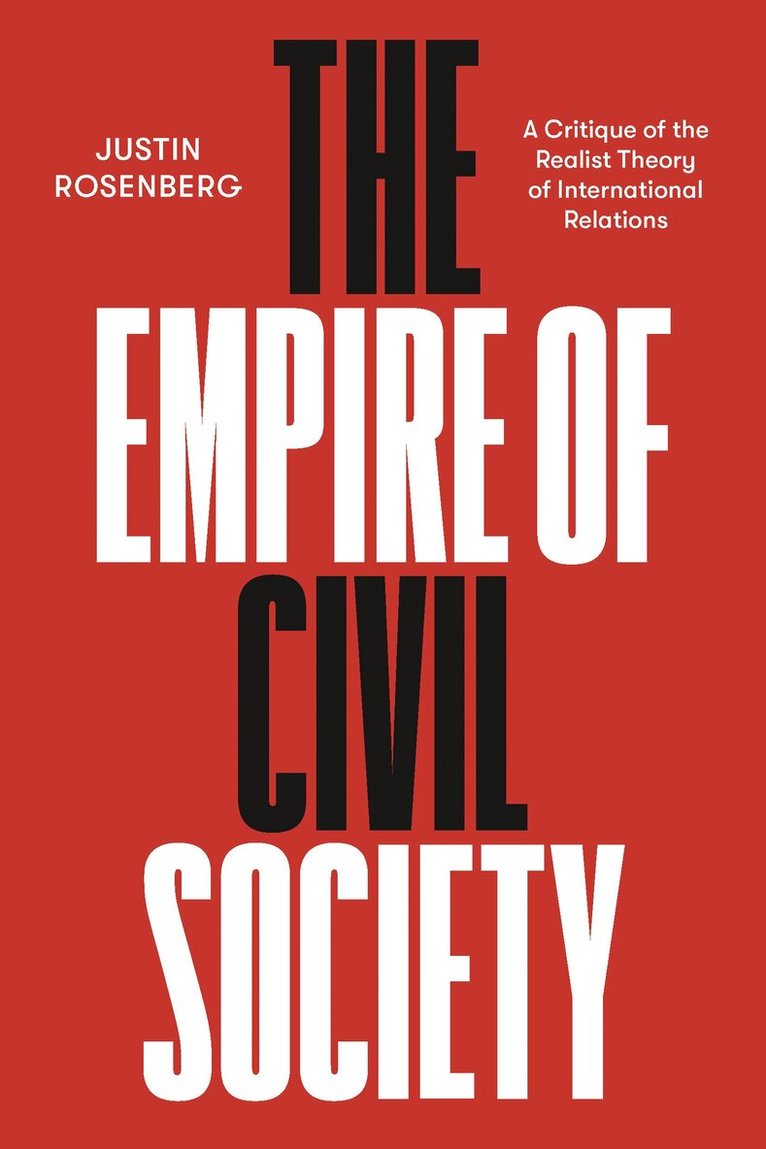
Empire of Civil Society
A Critique of the Realist Theory of International Relations
Häftad, Engelska, 1994
314 kr
Skickas inom 3-6 vardagar
The Empire of Civil Society mounts a compelling critique of the orthodox "realist" theory of international relations and provides a historical-materialist approach to the international system.Opening with an interrogation of a number of classic realist works, the book rejects outright the goal of theorizing geopolitical systems in isolation from wider social structures. In a series of case studies-including Classical Greece, Renaissance Italy and the Portuguese and Spanish empires-Justin Rosenberg shows how the historical-materialist analysis of societies is a surer guide to understanding geopolitical systems than the technical theories of realist international relations. In each case, he draws attention to the correspondence between the form of the geopolitical system and the character of the societies composing it.In the final section of the book, the tools forged in these explorations are employed to analyze the contemporary international system, with striking results. Rosenberg demonstrates that the distinctive properties of the sovereign-states system are best understood as corresponding to the social structures of capitalist society. In this light, realism emerges as incapable of explaining what it has always insisted is the central feature of the international system-namely, the balance of power. On the other hand, it is argued that Marx's social theory of value, conventionally regarded as an account of hierarchical class domination, provides the deepest understanding of the core international relations theme of "anarchy."Provocative and unconventional, The Empire of Civil Society brilliantly turns orthodox international relations on its head.
2 103 kr
Skickas inom 10-15 vardagar
This book introduces Uneven and Combined Development as an approach in international studies and showcases some of the latest and most innovative research in this field.The theory of Uneven and Combined Development originated in the writings of Leon Trotsky. However, in recent years it has become the subject of flourishing literature in the discipline of International Relations, due to its unique ability to reintegrate social and international theory. The first and second generations of this literature were focused upon retrieving the idea, expanding it into a social theory of ‘the international’, and applying it to numerous empirical cases – such as the rise of political Islam, the causes of the First World War and the Bolshevik Revolution, and even the origins of capitalism as a world system. In the present volume, a third generation has arrived which further extends the reach of UCD, connecting it in new and exciting ways to such subjects as ecology, macro-economic policy, culture, Science and Technology Studies, Comparative Literature and even science-fiction. The chapters in this book were originally published in the journal, the Cambridge Review of International Affairs.
621 kr
Skickas inom 10-15 vardagar
This book introduces Uneven and Combined Development as an approach in international studies and showcases some of the latest and most innovative research in this field.The theory of Uneven and Combined Development originated in the writings of Leon Trotsky. However, in recent years it has become the subject of flourishing literature in the discipline of International Relations, due to its unique ability to reintegrate social and international theory. The first and second generations of this literature were focused upon retrieving the idea, expanding it into a social theory of ‘the international’, and applying it to numerous empirical cases – such as the rise of political Islam, the causes of the First World War and the Bolshevik Revolution, and even the origins of capitalism as a world system. In the present volume, a third generation has arrived which further extends the reach of UCD, connecting it in new and exciting ways to such subjects as ecology, macro-economic policy, culture, Science and Technology Studies, Comparative Literature and even science-fiction. The chapters in this book were originally published in the journal, the Cambridge Review of International Affairs.
Empire of Civil Society
A Critique of the Realist Theory of International Relations
Häftad, Engelska, 2024
198 kr
Skickas inom 7-10 vardagar
The Empire of Civil Society rejects outright the goal of theorising geopolitical systems in isolation from wider social structures. In a series of case studies - including Classical Greece, Renaissance Italy and the Portuguese and Spanish empires - Justin Rosenberg shows how his historical-materialist analysis is a surer guide to understanding geopolitical systems than the supposedly timeless verities of realism. Rosenberg demonstrates that the distinctive properties of the sovereign-state system are best understood as corresponding to the framework of capitalist society. In this light, realism emerges as incapable of explaining what it has always insisted is the central feature of the interstate order - the balance of power.Winner of the 1994 Deutscher Memorial Prize
267 kr
Skickas inom 3-6 vardagar
The Follies of Globalisation Theory is an erudite and lively critique arguing that current fashionable preoccupations, such as the concern with spatiality, have generated deep intellectual confusions that stand in the way of a clear understanding of the modern world. It shows how and why these confusions ultimately condemn the globalization theorists themselves to a peculiar and quixotic stance: the more clearly they attempt to articulate their arguments, the more equivocal and evasive those arguments become, yielding at best the intellectual equivalent of an architectural folly.