J.W. Harbaugh – författare
Visar alla böcker från författaren J.W. Harbaugh. Handla med fri frakt och snabb leverans.
4 produkter
4 produkter
E-bok
PDF, Engelska, 1995763 kr
Läs direkt efter köp
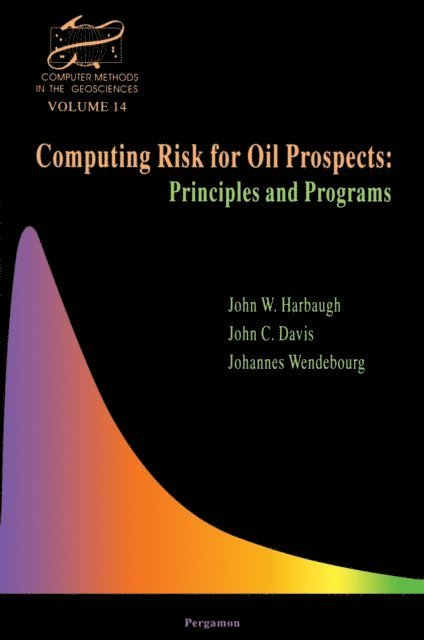
The petroleum industry is enduring difficult financial times because of the continuing depressed price of crude oil on the world market. This has caused major corporate restructuring and reductions in staff throughout the industry. Because oil exploration must now be done with fewer people under more difficult economic constraints, it is essential that the most effective and efficient procedures be used. Computing Risk for Oil Prospects describes how prospect risk assessment — predicting the distribution of financial gains or losses that may result from the drilling of an exploration well — can be done using objective procedures implemented on personal computers. The procedures include analyses of historical data, interpretation of geological and geophysical data, and financial calculations to yield a spectrum of the possible consequences of decisions. All aspects of petroleum risk assessment are covered, from evaluating regional resources, through delineating an individual prospect, to calculation of the financial consequences of alternative decisions and their possible results. The bottom lines are given both in terms of the probable volumes of oil that may be discovered and the expected monetary returns. Statistical procedures are linked with computer mapping and interpretation algorithms, which feed their results directly into routines for financial analysis. The programs in the included library of computer programs are tailored to fit seamlessly together, and are designed for ease and simplicity of operation. The two diskettes supplied are IBM compatible. Full information on loading is given in Appendix A - Software Installation. Risk I diskette contains data files and executables and Risk 2 diskette contains only executables. The authors contend that the explorationist who develops a prospect should be involved in every facet of its analysis, including risk and financial assessments. This book provides the tools necessary for these tasks.
E-bok
PDF, Engelska, 19971 680 kr
Läs direkt efter köp
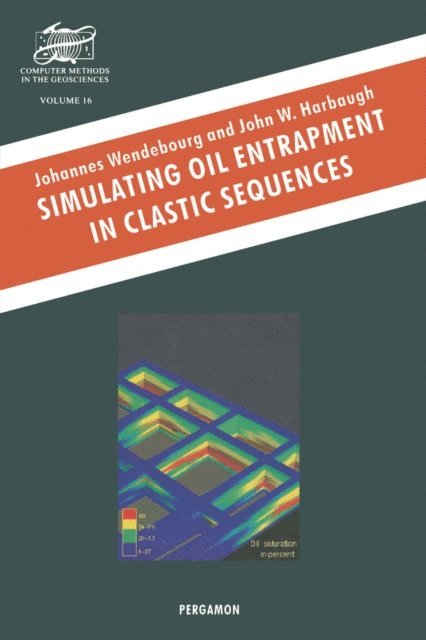
The book introduces procedures for simulating migration and entrapment of oil in three dimensions in sequences of sandstones and shales.A principal purpose is to show how simulation experiments can represent oil migration routes and predict places where oil may be trapped in sandstones and intercalated shales.The book derives the differential equations used to represent three-dimensional motions of porewater and oil in sedimentary sequences, and shows how the equations may be transformed into finite form for numerical solution with computers. There is emphasis on the graphic display of solutions, and results of example theoretical and actual applications are presented.The book is directed to geologists who have backgrounds in mathematics and computing and who are engaged in oil exploration and production.
Häftad, Engelska, 2012
1 090 kr
Skickas inom 10-15 vardagar
Simulation. "Why simulate?" we might ask. Dan Tetzlaff and John Harbaugh answer that question in Simulating Clastic Sedimentation, and answer it effec tively. Readers will have no trouble following this well-documented, clear ex pose on clastic-sedimentation simulation. The sophistication in simulation since 1970, compared to the early work, is enormous. The development and availability of hardware, especially graphics, has made such advancement pos sible. The authors' presentation allows us to share in this exciting new approach to geological problem solving. The book contains a glossary, notation conven tion, program listings, plenty of illustrations, and chapter summaries to en lighten the users. Everything is readily available to make this a self-contained, how-to and how-to-interpret book. After introducing the subject of simulation, the authors take the reader step-by-step through the computation and reasoning of the erosion, transporta tion, and deposition of clastic sediments. Fluid flow, transport, boundary con ditions, and space and time are all explained, and details are given as to how each of these factors were accounted for in the simulation. The simulation is compared to different known situations, such as braided streams and deltas, for assessment as to realism. The final chapter gives two real-world applications where a simulated model is compared to the Simpson Canyon Field in north ern Alaska and the Golden Meadow Field in southern Louisiana. From these simulations was gained some understanding of the conditions under which c- ix Series Editor's Foreword tain sedimentary units were formed.
E-bok
PDF, Engelska, 2013756 kr
Läs direkt efter köp
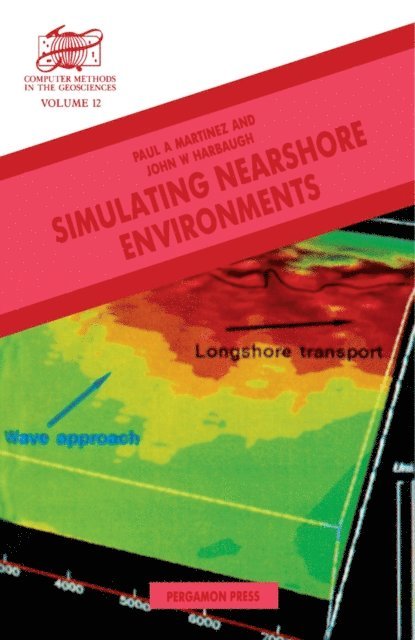
Simulating Nearshore Environments provides computer procedures that realistically represent nearshore processes and supplement or replace trial and error methodology. The procedures simulate transport by waves and fluvial processes on beaches and deltas at various scales. They will aid coastal engineers, oceanographers and sedimentary geologists who focus on both modern and ancient nearshore deposits. How do you simulate nearshore processes using a computer? Can evolving deltaic and coastal environments be simulated realistically by mathematically representing the physical processes that create them? Once the physics and mathematical formulation are described, what are the techniques for transforming them into computer programs? The authors deal with all these aspects and take a "how to" approach in guiding the reader through the development of computer models for simulating sediment transport in coastal environments. In addition to describing the devised computer programs, the book provides a basis for those wishing to formulate their own mathematical models for simulating nearshore processes.