Jyh-An Lee – författare
Visar alla böcker från författaren Jyh-An Lee. Handla med fri frakt och snabb leverans.
8 produkter
Artificial Intelligence and Intellectual Property
Av Kung-Chung Liu, Reto Hilty m. fl.
E-bok, 2021
1518 kr
Lägg i varukorg
Artificial Intelligence (AI) has become omnipresent in today''s business environment: from chatbots to healthcare services to various ways of creating useful information. While AI has been increasingly used to optimize various creative and innovative processes, the integration of AI into products, …
Artificial Intelligence and Intellectual Property
Av Kung-Chung Liu, Reto Hilty m. fl.
E-bok, 2021
1518 kr
Lägg i varukorg
Artificial Intelligence (AI) has become omnipresent in today''s business environment: from chatbots to healthcare services to various ways of creating useful information. While AI has been increasingly used to optimize various creative and innovative processes, the integration of AI into products, …
Artificial Intelligence and Intellectual Property
Av Reto Hilty, Jyh-An Lee m. fl.
Inbunden, 2021
2261 kr
Lägg i varukorg
Artificial Intelligence (AI) has become omnipresent in today's business environment: from chatbots to healthcare services to various ways of creating useful information. While AI has been increasingly used to optimize various creative and innovative processes, the integration of AI into products, …
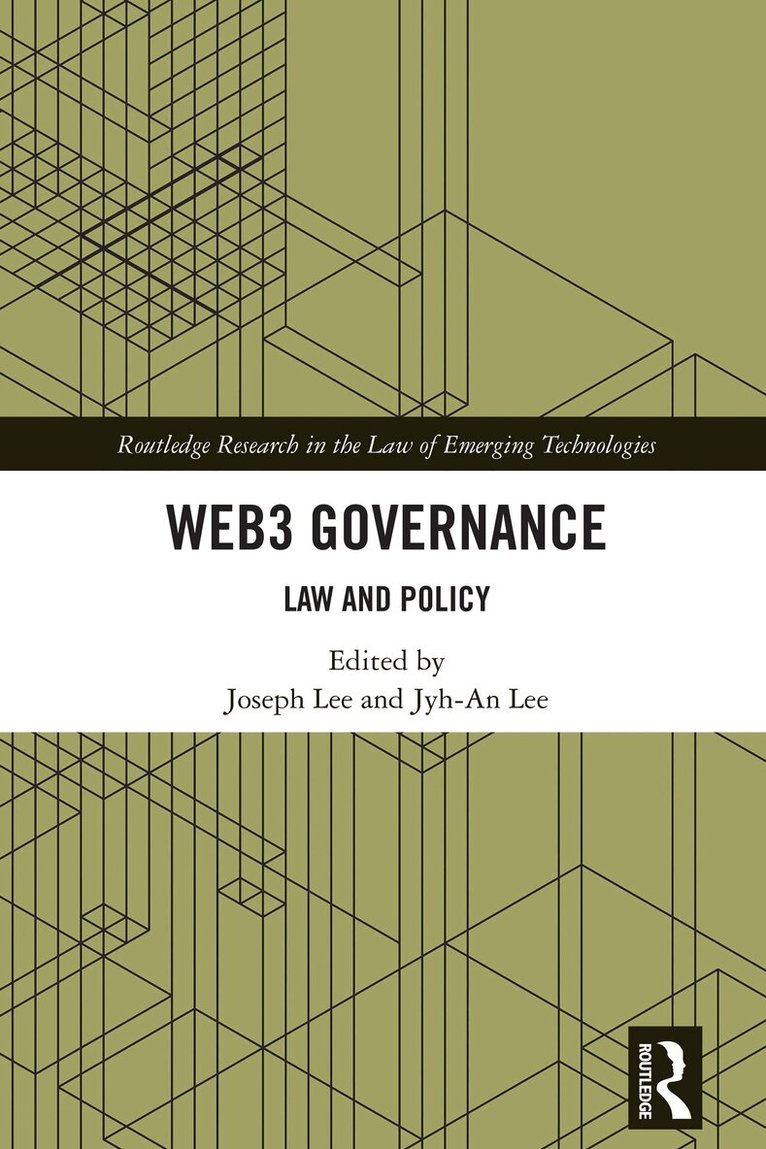
Web3 Governance
Law and Policy
Av Joseph Lee, Jyh-An Lee
Inbunden, 2025
2311 kr
Lägg i varukorg
Focusing on four key aspects of Web3, the book explores metaverses, data governance, public and private law interfaces, and access to justice, presenting new research on the impact of data analytics on transactions within law, on regulatory activities, and on the practice of law.Artificial …
Web3 Governance
Law and Policy
Av Joseph Lee, Jyh-An Lee
Häftad, 2026
649 kr
Lägg i varukorg
Focusing on four key aspects of Web3, the book explores metaverses, data governance, public and private law interfaces, and access to justice, presenting new research on the impact of data analytics on transactions within law, on regulatory activities, and on the practice of law.Artificial …
Web3 Governance
Law and Policy
Av Jyh-An Lee, Joseph Lee
E-bok, 2025
748 kr
Lägg i varukorg
Focusing on four key aspects of Web3, the book explores metaverses, data governance, public and private law interfaces, and access to justice, presenting new research on the impact of data analytics on transactions within law, on regulatory activities, and on the practice of law. Artificial …
Web3 Governance
Law and Policy
Av Jyh-An Lee, Joseph Lee
E-bok, 2025
765 kr
Lägg i varukorg
Focusing on four key aspects of Web3, the book explores metaverses, data governance, public and private law interfaces, and access to justice, presenting new research on the impact of data analytics on transactions within law, on regulatory activities, and on the practice of law. Artificial …
Nonprofit Organizations and the Intellectual Commons
Av Jyh-An Lee
Inbunden, 2012
1612 kr
Lägg i varukorg
Over the past twenty years, a number of nonprofit organizations (NPOs), such as Creative Commons, the Electronic Frontier Foundation, and the Free Software Foundation have laid essential building blocks for intellectual-commons as a social movement. Through a detailed description of these NPOs and …