K. W. Bagnall – författare
Visar alla böcker från författaren K. W. Bagnall. Handla med fri frakt och snabb leverans.
2 produkter
2 produkter
E-bok
PDF, Engelska, 2013756 kr
Läs direkt efter köp
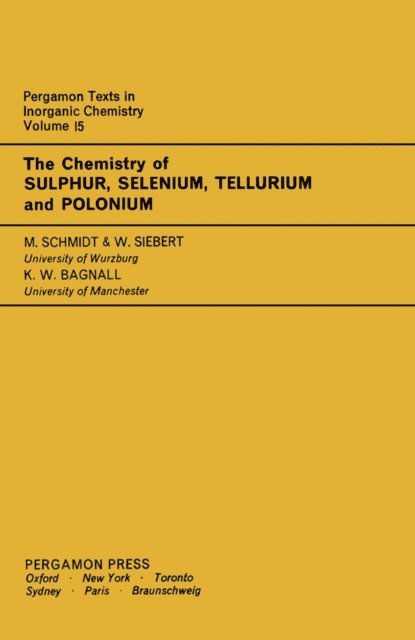
The Chemistry of Sulfur, Selenium, Tellurium and Polonium deals with the chemistry of sulfur, selenium, tellurium, and polonium. The history, occurrence and distribution, and production of all four elements are discussed, along with their industrial uses, purification, and allotropy; nuclear, physical, and chemical properties; and biological activities. Comprised of two chapters, this volume begins with an overview of the history, occurrence and distribution, and production of sulfur, selenium, tellurium, and polonium, as well as their industrial uses, purification, and allotropy; nuclear, physical, and chemical properties; and biological activities. The compounds of all four elements are also considered, including sulfanes, sulfur halides, oxides and oxyacids, and compounds composed of sulfur, nitrogen, and halogen; peroxides, hydroxides and oxo-acids, sulfides, nitrides and azides, carbon selenides and tellurides; carbonates, salts of organic acids, alkoxides, nitrates, phosphates, chromates, halates and perhalates, and organo-compounds. This book will be of interest to inorganic chemists as well as students and researchers in the field of inorganic chemistry.
E-bok
PDF, Engelska, 2016979 kr
Läs direkt efter köp
The Chemistry of the Actinides contains selected chapters from the Comprehensive Inorganic Chemistry to meet the needs of certain specialists in this field. The book describes the 14 elements after actinium in the Periodic Table, known as the actinide elements or the 5f transition series. The book notes the occurrence, separation, chemical properties, chemical structures, and preparation of the metals. In a discussion of analytical chemistry, the radioactive properties of the actinides and the lanthanides are compared. The text then describes the nuclear or radiochemical records and chemical properties of the different members of the actinide series such as thorium, uranium, plutonium, and einsteinium. The book also explains the differences between the 5f shell and the 4f shell. One paper then discusses the groups of alloy compounds, including rare earths and intra-actinides. Another paper examines the general properties of actinide ions as to their electronic structure and oxidation states; the stability and preparation of the different oxidation states; and the applicability of solvent extraction in separating and purifying various substances. The text is suitable for researchers in organic chemistry, nuclear and atomic physicists, scientists, and academicians whose work involves radioactive materials.