Kaire Põder – författare
Visar alla böcker från författaren Kaire Põder. Handla med fri frakt och snabb leverans.
5 produkter
Privatization in and of Public Education
Av Antonina Santalova, Kaire Põder
Inbunden, 2024
922 kr
Lägg i varukorg
Privatization of education has become a prevalent global trend, representing a significant shift from viewing education as a public good to considering it as a private commodity. This transformation is closely tied to the modernization of the state under the principles of neoliberalism. A …
Privatization in and of Public Education
Av Kaire Poder, Antonina Santalova
E-bok, 2024
820 kr
Lägg i varukorg
Privatization of education has become a prevalent global trend, representing a significant shift from viewing education as a public good to considering it as a private commodity. This transformation is closely tied to the modernization of the state under the principles of neoliberalism. A …
Privatization in and of Public Education
Av Kaire Poder, Antonina Santalova
E-bok, 2024
820 kr
Lägg i varukorg
Privatization of education has become a prevalent global trend, representing a significant shift from viewing education as a public good to considering it as a private commodity. This transformation is closely tied to the modernization of the state under the principles of neoliberalism. A …
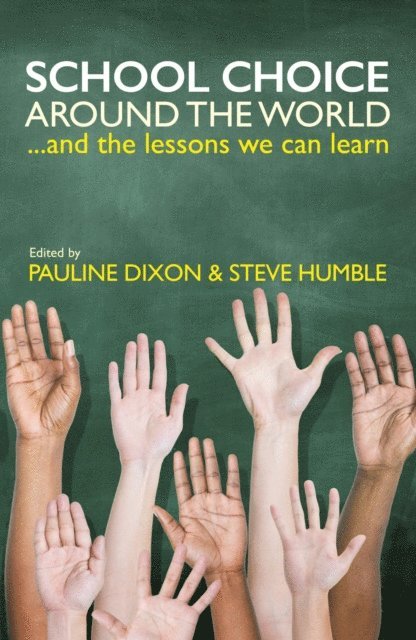
School Choice around the World
... And the Lessons We Can Learn
Av Toby Young, Patrick J. Wolf m. fl.
E-bok, 2019
101 kr
Lägg i varukorg
This volume of essays examines the empirical evidence on school choice in different countries across Europe, North America, sub-Saharan Africa and South Asia. It demonstrates the advantages which choice offers in different institutional contexts, whether it be Free Schools in the UK, voucher …
School Choice around the World
... And the Lessons We Can Learn
Av Toby Young, Patrick J. Wolf m. fl.
E-bok, 2019
104 kr
Lägg i varukorg
This volume of essays examines the empirical evidence on school choice in different countries across Europe, North America, sub-Saharan Africa and South Asia. It demonstrates the advantages which choice offers in different institutional contexts, whether it be Free Schools in the UK, voucher …