Kamal I. M. Al-Malah – författare
1 577 kr
Läs direkt efter köp
A practical, professional guide to MATLAB computational techniques and engineering applications
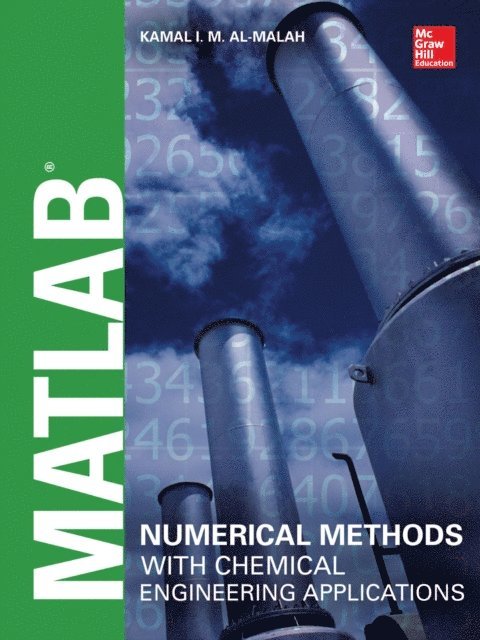
MATLAB Numerical Methods with Chemical Engineering Applications shows you, step by step, how to use MATLAB® to model and simulate physical problems in the chemical engineering realm. Written for MATLAB 7.11, this hands-on resource contains concise explanations of essential MATLAB commands, as well as easy-to-follow instructions for using the programming features, graphical capabilities, and desktop interface.
Every step needed toward the final solution is algorithmically explained via snapshots of the MATLAB platform in parallel with the text. End-of-chapter problems help you practice what you''ve learned. Master this powerful computational tool using this detailed, self-teaching guide.
COVERAGE INCLUDES:
MATLAB basicsMatricesMATLAB scripting language: M-fileImage and image analysisCurve-fittingNumerical integrationSolving differential equationsA system of algebraic equationsStatisticsChemical engineering applicationsMATLAB Graphical User Interface Design Environment (GUIDE)1 733 kr
Skickas inom 5-8 vardagar
1 961 kr
Läs direkt efter köp
Comprehensive resource covering Aspen Plus V12.1 and demonstrating how to implement the program in versatile chemical process industries
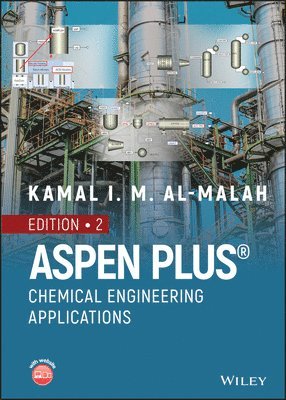
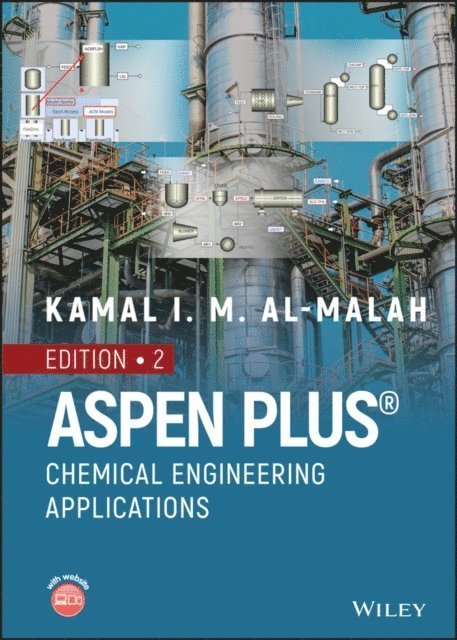
Aspen Plus®: Chemical Engineering Applications facilitates the process of learning and later mastering Aspen Plus®, the market-leading chemical process modeling software, with step-by-step examples and succinct explanations. The text enables readers to identify solutions to various process engineering problems via screenshots of the Aspen Plus® platforms in parallel with the related text.
To aid in information retention, the text includes end-of-chapter problems and term project problems, online exam and quiz problems for instructors that are parametrized (i.e., adjustable) so that each student will have a standalone version, and extra online material for students, such as Aspen Plus®-related files, that are used in the working tutorials throughout the entire textbook.
The second edition of Aspen Plus®: Chemical Engineering Applications includes information on:
Various new features that were embedded into Aspen Plus V12.1 and existing features which have been modified Aspen Custom Modeler (ACM), covering basic features to show how to merge customized models into Aspen Plus simulator New updates to process dynamics and control and process economic analysis since the first edition was published Vital areas of interest in relation to the software, such as polymerization, drug solubility, solids handling, safety measures, and energy savingFor chemical engineering students and industry professionals, the second edition of Aspen Plus®: Chemical Engineering Applications is a key resource for understanding Aspen Plus and the new features that were added in version 12.1 of the software. Many supplementary learning resources help aid the reader with information retention.
2 025 kr
Läs direkt efter köp
Comprehensive resource covering Aspen Plus V12.1 and demonstrating how to implement the program in versatile chemical process industries
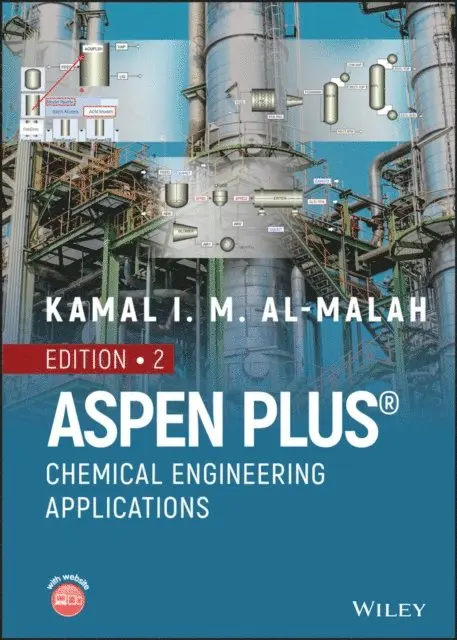
Aspen Plus®: Chemical Engineering Applications facilitates the process of learning and later mastering Aspen Plus®, the market-leading chemical process modeling software, with step-by-step examples and succinct explanations. The text enables readers to identify solutions to various process engineering problems via screenshots of the Aspen Plus® platforms in parallel with the related text.
To aid in information retention, the text includes end-of-chapter problems and term project problems, online exam and quiz problems for instructors that are parametrized (i.e., adjustable) so that each student will have a standalone version, and extra online material for students, such as Aspen Plus®-related files, that are used in the working tutorials throughout the entire textbook.
The second edition of Aspen Plus®: Chemical Engineering Applications includes information on:
Various new features that were embedded into Aspen Plus V12.1 and existing features which have been modified Aspen Custom Modeler (ACM), covering basic features to show how to merge customized models into Aspen Plus simulator New updates to process dynamics and control and process economic analysis since the first edition was published Vital areas of interest in relation to the software, such as polymerization, drug solubility, solids handling, safety measures, and energy savingFor chemical engineering students and industry professionals, the second edition of Aspen Plus®: Chemical Engineering Applications is a key resource for understanding Aspen Plus and the new features that were added in version 12.1 of the software. Many supplementary learning resources help aid the reader with information retention.
1 874 kr
Skickas inom 5-8 vardagar
2 151 kr
Läs direkt efter köp
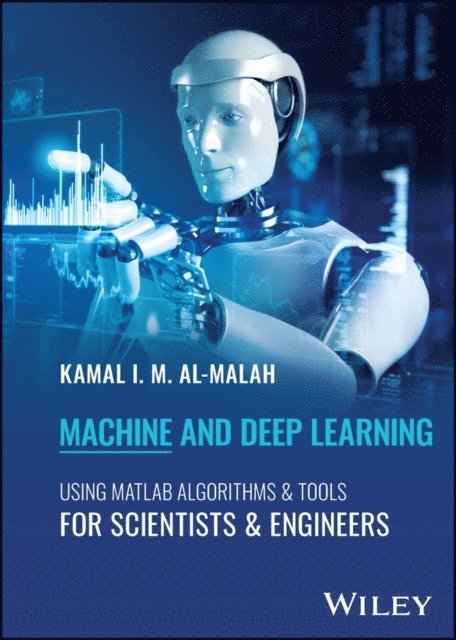
In-depth resource covering machine and deep learning methods using MATLAB tools and algorithms, providing insights and algorithmic decision-making processes
Machine and Deep Learning Using MATLAB introduces early career professionals to the power of MATLAB to explore machine and deep learning applications by explaining the relevant MATLAB tool or app and how it is used for a given method or a collection of methods. Its properties, in terms of input and output arguments, are explained, the limitations or applicability is indicated via an accompanied text or a table, and a complete running example is shown with all needed MATLAB command prompt code.
The text also presents the results, in the form of figures or tables, in parallel with the given MATLAB code, and the MATLAB written code can be later used as a template for trying to solve new cases or datasets. Throughout, the text features worked examples in each chapter for self-study with an accompanying website providing solutions and coding samples. Highlighted notes draw the attention of the user to critical points or issues.
Readers will also find information on:
Numeric data acquisition and analysis in the form of applying computational algorithms to predict the numeric data patterns (clustering or unsupervised learning) Relationships between predictors and response variable (supervised), categorically sub-divided into classification (discrete response) and regression (continuous response) Image acquisition and analysis in the form of applying one of neural networks, and estimating net accuracy, net loss, and/or RMSE for the successive training, validation, and testing steps Retraining and creation for image labeling, object identification, regression classification, and text recognitionMachine and Deep Learning Using MATLAB is a useful and highly comprehensive resource on the subject for professionals, advanced students, and researchers who have some familiarity with MATLAB and are situated in engineering and scientific fields, who wish to gain mastery over the software and its numerous applications.
2 145 kr
Läs direkt efter köp
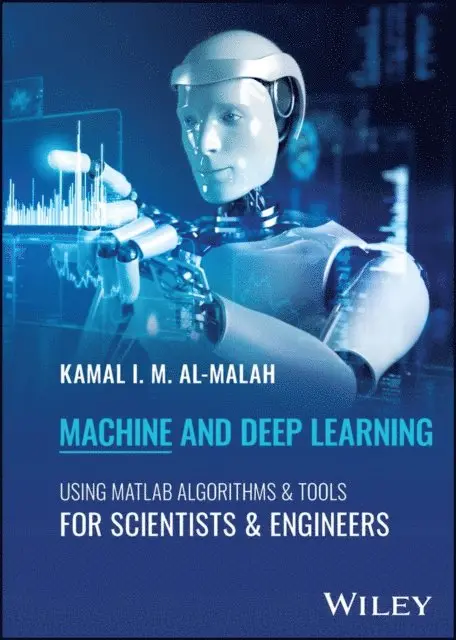
In-depth resource covering machine and deep learning methods using MATLAB tools and algorithms, providing insights and algorithmic decision-making processes
Machine and Deep Learning Using MATLAB introduces early career professionals to the power of MATLAB to explore machine and deep learning applications by explaining the relevant MATLAB tool or app and how it is used for a given method or a collection of methods. Its properties, in terms of input and output arguments, are explained, the limitations or applicability is indicated via an accompanied text or a table, and a complete running example is shown with all needed MATLAB command prompt code.
The text also presents the results, in the form of figures or tables, in parallel with the given MATLAB code, and the MATLAB written code can be later used as a template for trying to solve new cases or datasets. Throughout, the text features worked examples in each chapter for self-study with an accompanying website providing solutions and coding samples. Highlighted notes draw the attention of the user to critical points or issues.
Readers will also find information on:
Numeric data acquisition and analysis in the form of applying computational algorithms to predict the numeric data patterns (clustering or unsupervised learning) Relationships between predictors and response variable (supervised), categorically sub-divided into classification (discrete response) and regression (continuous response) Image acquisition and analysis in the form of applying one of neural networks, and estimating net accuracy, net loss, and/or RMSE for the successive training, validation, and testing steps Retraining and creation for image labeling, object identification, regression classification, and text recognitionMachine and Deep Learning Using MATLAB is a useful and highly comprehensive resource on the subject for professionals, advanced students, and researchers who have some familiarity with MATLAB and are situated in engineering and scientific fields, who wish to gain mastery over the software and its numerous applications.
1 520 kr
Skickas inom 5-8 vardagar
1 803 kr
Läs direkt efter köp
Explore chemical engineering principles using MATLAB for data analysis, visualization, and solving intricate problems
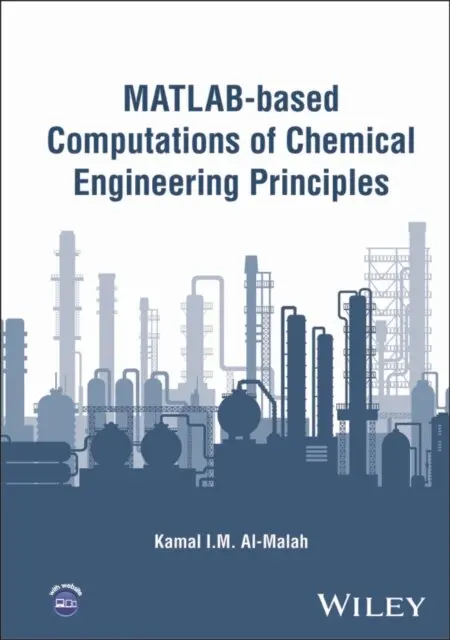
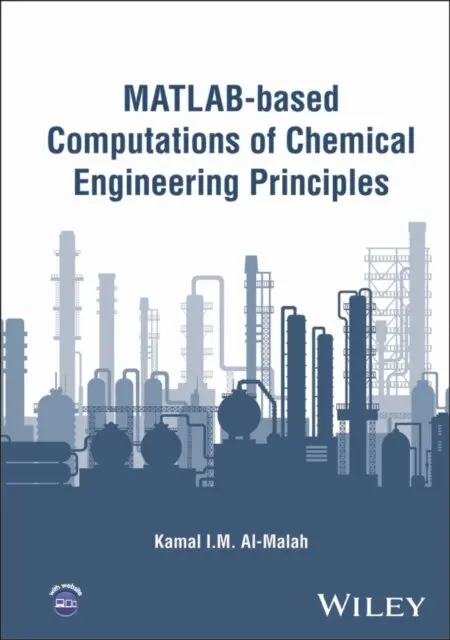
MATLAB-based Computations of Chemical Engineering Principles is an in-depth textbook that enables readers to transform classical chemical engineering principles and calculations into MATLAB-based calculations. Throughout the text, problems are solved through two methods: manually (i.e., classical) and via implementing MATLAB code (i.e., digital or software-assisted), with a focus on the latter when solving problems involving multiple steps or complex solutions, or when working with large databases, such as dealing with physical properties of compounds.
Seven appendices contain large-size MATLAB codes. In general, small-size MATLAB code is kept within the relevant chapter section. All codes have been verified using the MATLAB platform. End-of-chapter problems reinforce learning by students.
The textbook includes problems and solutions related to concepts including:
System units and measurement, process variables measurement, and measurement variations and uncertainty Types of errors involved in measurements and energy balance applications for closed and open (flow) systems Total and component material balances, chemical reaction stoichiometry, conversion, yield, selectivity, and chemical equilibrium Properties of pure substances and mixtures as well as vapor liquid equilibrium for single and multi-component mixtures Equations of state for gasesComprehensive in scope with a plethora of helpful learning aids included throughout, this is a perfect textbook for sophomore courses titled Chemical Engineering Principles, Chemical Engineering Stoichiometric Calculations, Fundamentals of Chemical Engineering, Introduction to Chemical Engineering, or Essentials of Chemical Engineering.
1 803 kr
Läs direkt efter köp
Explore chemical engineering principles using MATLAB for data analysis, visualization, and solving intricate problems
MATLAB-based Computations of Chemical Engineering Principles is an in-depth textbook that enables readers to transform classical chemical engineering principles and calculations into MATLAB-based calculations. Throughout the text, problems are solved through two methods: manually (i.e., classical) and via implementing MATLAB code (i.e., digital or software-assisted), with a focus on the latter when solving problems involving multiple steps or complex solutions, or when working with large databases, such as dealing with physical properties of compounds.
Seven appendices contain large-size MATLAB codes. In general, small-size MATLAB code is kept within the relevant chapter section. All codes have been verified using the MATLAB platform. End-of-chapter problems reinforce learning by students.
The textbook includes problems and solutions related to concepts including:
System units and measurement, process variables measurement, and measurement variations and uncertainty Types of errors involved in measurements and energy balance applications for closed and open (flow) systems Total and component material balances, chemical reaction stoichiometry, conversion, yield, selectivity, and chemical equilibrium Properties of pure substances and mixtures as well as vapor liquid equilibrium for single and multi-component mixtures Equations of state for gasesComprehensive in scope with a plethora of helpful learning aids included throughout, this is a perfect textbook for sophomore courses titled Chemical Engineering Principles, Chemical Engineering Stoichiometric Calculations, Fundamentals of Chemical Engineering, Introduction to Chemical Engineering, or Essentials of Chemical Engineering.
1 945 kr
Kommande