Karel Klinka - Böcker
Visar alla böcker från författaren Karel Klinka. Handla med fri frakt och snabb leverans.
3 produkter
3 produkter
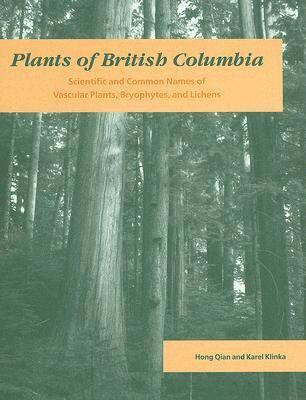
Plants of British Columbia
Scientific and Common Names of Vascular Plants, Bryophytes, and Lichens
Inbunden, Engelska, 1998
1 896 kr
Skickas inom 7-10 vardagar
This book is an up-to-date checklist of the current valid taxonomyfor all vascular plants, bryophytes, and lichens in British Columbia,including synonyms, species codes, and other information. A convenient,geographically restricted, comprehensive checklist like this one willaid greatly in avoiding the present confusion concerning the names ofmany species in the ecological and systematic literature, as well as inapplied fields.The book is organized into three sections. Part 1 organizes speciesalphabetically according to taxonomic order by families of vascularplants, bryophytes, and lichens. Within each family, the genera arelisted alphabetically, along with any synonomies (former names) andcommon names. In Part 2 species are organized alphabetically accordingto their scientific names. Part 3 lists common names followed by theirscientific names. Excluded names (names inappropriately applied toplants in B.C.) are given in an appendix. Those familiar with planttaxonomy will find Part 1 particularly helpful when checkingnomenclature; semi-professionals familiar with scientific names willuse Part 2 and then Part 1; those who know only common names will checkPart 3 and then Part 2 and Part 1 to determine families.There is presently considerable confusion about many species namesin B.C. Plant names change for many reasons and new plants invade.Information about plants in B.C. is scattered in several checklists,most of them incomplete or out of date; for some species, such asliverworts, no provincial checklist even exists. This checklisttherefore will be useful to all professionals working with vegetationand for students in agriculture, botany, ecology, forestry and othersciences. Although the focus is on B.C., the book will also be usefuloutside the province, particularly in the northwest American states andin Alberta and the Yukon.
Global to Local: Ecological Land Classification
Thunderbay, Ontario, Canada, August 14–17, 1994
Inbunden, Engelska, 1996
2 100 kr
Skickas inom 10-15 vardagar
Ecological Land Classification (ELC) refers to the description of land resources at a range of spatial resolutions (i.e. global to local) and for a range of purposes or values. The emerging science of ELC is an integrated blend of vegetation and earth sciences, climatology, cartography and ecology with a range of new technologies and methodologies including computer-based geographic information systems, remote sensing and simulation modelling. This work defines the current state of the art of ELC. It provides particular insight into the role of ELC in current and future forest resource planning and management, and emphasizes its application and usefulness at various spatial scales, for a variety of geographic locations, and under a range of management scenarios/constraints. The book should be a useful and substantial reference source about the current trends in ELC and should be of particular value to ecologists, foresters, geographers, resource managers, wildlife biologists, GIS and remote sensing specialists, educators and students.
Global to Local: Ecological Land Classification
Thunderbay, Ontario, Canada, August 14–17, 1994
Häftad, Engelska, 2011
2 100 kr
Skickas inom 10-15 vardagar
Ecological Land Classification (ELC) refers to the description of land resources at a range of spatial resolutions (i.e. global to local) and for a range of purposes or values. The emerging science of ELC is in fact a very carefully integrated blend of vegetation and earth sciences, climatology, cartography and ecology with a range of new technologies and methodologies including computer-based geographic information systems, remote sensing and simulation modelling. This publication defines the current `state-of-the-art' of ELC. It provides particular insight into the role of ELC in current and future forest resource planning and management, and emphasizes its application and usefulness at various spatial scales, for a variety of geographic locations, and under a range of management scenarios/constraints. The book is an invaluable and substantial reference source about the current trends in ELC and will be of particular value to ecologists, foresters, geographers, resource managers, wildlife biologists, GIS and remote sensing specialists, educators and students.