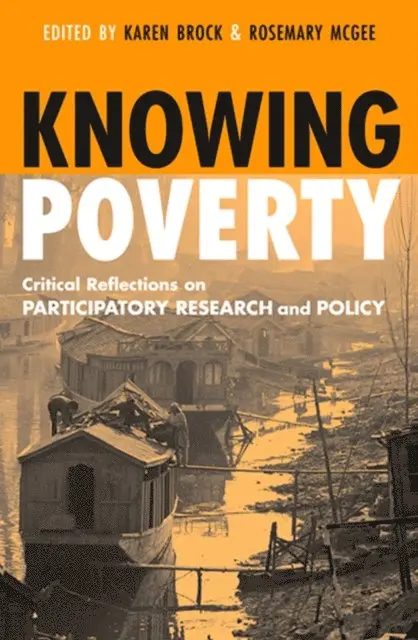
The use of participatory research techniques to provide policy-makers with information about poor people''s perspectives on poverty became increasingly common in the 1990s. This book focuses on the use of participatory research in poverty reduction policies, and presents a series of participants'' reflections on recent and ongoing processes. The 1990s witnessed a shift in the application of participatory methodologies, adding to the project planning approaches of the 1980s a new focus on participatory research for policy. Much of this centres on poverty issues. In this volume, contributions from researchers and practitioners in the field of poverty reduction examine how participatory research has affected the way poverty is understood, and how these understandings have been acted on in policy-making for poverty reduction. Coming from diverse backgrounds, the authors'' critical reflections feature various aspects of the relationship between participation and policy, spanning different levels, from the individual researcher to the global institution. They address technical, ethical, operational, political and methodological problems. Through raising their concerns, they highlight lessons to be learnt from current practice, and challenges for the future. These include the balancing of knowledge, action and consciousness in participatory research processes which can effectively influence the development of policy that reflects and responds to the needs and priorities of poor people.
Learning from others in the form of fusion and adaptation of existing tools and approaches is very much part of evolving new participatory methods, and is a key component of the process of creating fresh approaches to new challenges. Springs of Participation brings together the experiences and reflections of a group of practitioners of participatory methodologies, who work in diverse situations and countries, in order that both academics and practitioners can themselves learn how to develop effective and sustainable new methods. This book discusses a wide and rich range of participatory methods. The first part of the book focuses on Reflect and the Internal Learning System (ILS). Both have evolved considerably over a number of years. In the second part of the book, the authors reflect on what enables and constrains creativity, adaptation, and innovation, using examples of many different methodologies to illustrate their discussions. These reflections come from two broad perspectives: from innovators who have all worked principally as independent development consultants and advisors, and from researchers. These two common positions in the world of development and aid give rise to different challenges in creating and using participatory methodologies.
The use of participatory research techniques to provide policy-makers with information about poor people's perspectives on poverty became increasingly common in the 1990s. This book focuses on the use of participatory research in poverty reduction policies, and presents a series of participants' reflections on recent and ongoing processes. The 1990s witnessed a shift in the application of participatory methodologies, adding to the project planning approaches of the 1980s a new focus on participatory research for policy. Much of this centres on poverty issues. In this volume, contributions from researchers and practitioners in the field of poverty reduction examine how participatory research has affected the way poverty is understood, and how these understandings have been acted on in policy-making for poverty reduction. Coming from diverse backgrounds, the authors' critical reflections feature various aspects of the relationship between participation and policy, spanning different levels, from the individual researcher to the global institution. They address technical, ethical, operational, political and methodological problems. Through raising their concerns, they highlight lessons to be learnt from current practice, and challenges for the future. These include the balancing of knowledge, action and consciousness in participatory research processes which can effectively influence the development of policy that reflects and responds to the needs and priorities of poor people.