Karin de Boer - Böcker
Visar alla böcker från författaren Karin de Boer. Handla med fri frakt och snabb leverans.
8 produkter
8 produkter
535 kr
Skickas inom 10-15 vardagar
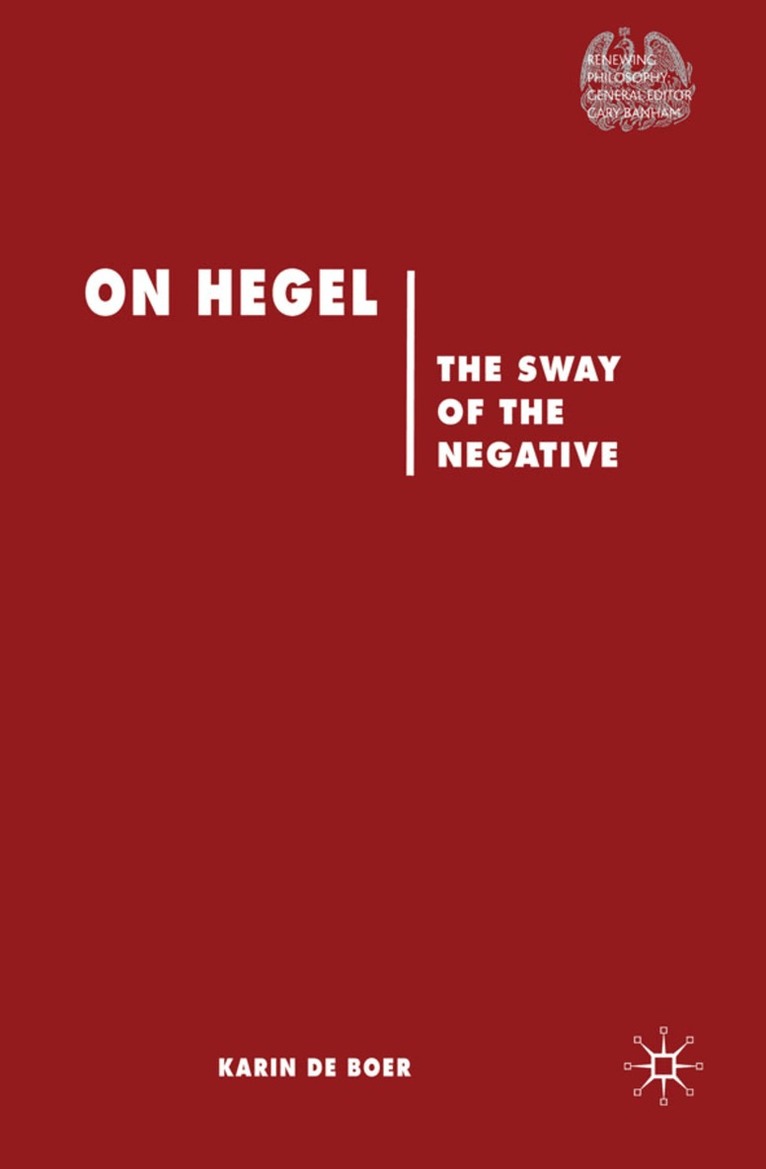
Focusing on the Science of Logic , this wide-ranging and innovative reading exposes the force as well as the limit of Hegel's philosophy. Drawing on Hegel's early account of tragic conflicts, De Boer brings into play a form of negativity that challenges the optimism inherent in modernity and Hegelian dialectics alike.
1 057 kr
Tillfälligt slut
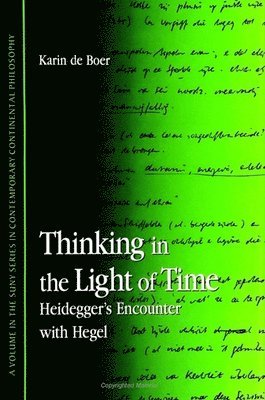
Translated from the Dutch, this book offers a systematic interpretation of Heidegger's thought, focusing particularly on recently published works.Heidegger's lifelong project of exposing and deconstructing the presuppositions governing the history of metaphysics begins with the conception of temporality outlined in Being and Time, a work which Heidegger never completed. In Thinking in the Light of Time, de Boer not only traces the notion of temporality developed in Being and Time, but goes beyond the published portion of that work to offer a reconstruction of its pivotal third division based on a systematic interpretation of other works, many of which have only recently been published. Emphasizing the continuity between Heidegger's early and later thought, de Boer provides a systematic interpretation of Heidegger's work as a whole.Hegel's claim to have perfected metaphysics is central to de Boer's concern with Heidegger's attempt to deconstruct metaphysics. Heidegger's struggles to come to terms with Hegel's speculative science, especially the manner in which Hegel regards his own project as founded upon an understanding of time, is thus one of the focal points of de Boer's interpretation of Heidegger's deconstruction of metaphysics. De Boer argues that it is especially in his reading of Hegel that one sees how deeply Heidegger is committed to the attempt to do justice to the radical finitude of human life and its possible philosophical self-interpretations. Her reading of Heidegger shows how his works paved the way for the deconstructive efforts that guide Derrida's thought.
416 kr
Tillfälligt slut
Translated from the Dutch, this book offers a systematic interpretation of Heidegger's thought, focusing particularly on recently published works.Heidegger's lifelong project of exposing and deconstructing the presuppositions governing the history of metaphysics begins with the conception of temporality outlined in Being and Time, a work which Heidegger never completed. In Thinking in the Light of Time, de Boer not only traces the notion of temporality developed in Being and Time, but goes beyond the published portion of that work to offer a reconstruction of its pivotal third division based on a systematic interpretation of other works, many of which have only recently been published. Emphasizing the continuity between Heidegger's early and later thought, de Boer provides a systematic interpretation of Heidegger's work as a whole.Hegel's claim to have perfected metaphysics is central to de Boer's concern with Heidegger's attempt to deconstruct metaphysics. Heidegger's struggles to come to terms with Hegel's speculative science, especially the manner in which Hegel regards his own project as founded upon an understanding of time, is thus one of the focal points of de Boer's interpretation of Heidegger's deconstruction of metaphysics. De Boer argues that it is especially in his reading of Hegel that one sees how deeply Heidegger is committed to the attempt to do justice to the radical finitude of human life and its possible philosophical self-interpretations. Her reading of Heidegger shows how his works paved the way for the deconstructive efforts that guide Derrida's thought.
631 kr
Skickas inom 10-15 vardagar
This collection of essays challenges the prevailing assumption that eighteenth-century German philosophy prior to Kant was largely defined by post-Leibnizian rationalism and, accordingly, a low esteem of the cognitive function of the senses. It does so by highlighting the various ways in which eighteenth-century German philosophers reconceived the notion and role of experience in their efforts to identify, defend, and contest the contribution of sensibility to disciplines such as metaphysics, theology, the natural sciences, psychology, and aesthetics. Engaging in depth with Tschirnhaus, Wolff, the Wolffians, eclecticism, Popularphilosophie, the Berlin Academy, Tetens, and Kant, its thirteen chapters present a more nuanced understanding of the German reception of British and French ideas and dismiss the prevailing view that German philosophy was largely isolated from European debates. Moreover, the book introduces a number of relatively unknown, but highly relevant philosophers and developments to non-specialized scholars and contributes to a better understanding of the richness and complexity of the German Enlightenment.
350 kr
Skickas inom 7-10 vardagar
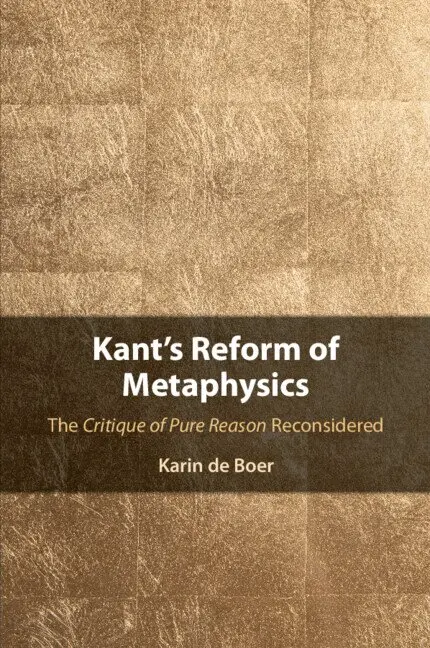
Scholarly debates on the Critique of Pure Reason have largely been shaped by epistemological questions. Challenging this prevailing trend, Kant's Reform of Metaphysics is the first book-length study to interpret Kant's Critique in view of his efforts to turn Christian Wolff's highly influential metaphysics into a science. Karin de Boer situates Kant's pivotal work in the context of eighteenth-century German philosophy, traces the development of Kant's conception of critique, and offers fresh and in-depth analyses of key parts of the Critique of Pure Reason, including the Transcendental Deduction, the Schematism Chapter, the Appendix to the Transcendental Analytic, and the Architectonic. The book not only brings out the coherence of Kant's project, but also reconstructs the outline of the 'system of pure reason' for which the Critique was to pave the way, but that never saw the light.
1 100 kr
Skickas inom 7-10 vardagar
Scholarly debates on the Critique of Pure Reason have largely been shaped by epistemological questions. Challenging this prevailing trend, Kant's Reform of Metaphysics is the first book-length study to interpret Kant's Critique in view of his efforts to turn Christian Wolff's highly influential metaphysics into a science. Karin de Boer situates Kant's pivotal work in the context of eighteenth-century German philosophy, traces the development of Kant's conception of critique, and offers fresh and in-depth analyses of key parts of the Critique of Pure Reason, including the Transcendental Deduction, the Schematism Chapter, the Appendix to the Transcendental Analytic, and the Architectonic. The book not only brings out the coherence of Kant's project, but also reconstructs the outline of the 'system of pure reason' for which the Critique was to pave the way, but that never saw the light.
2 088 kr
Skickas inom 10-15 vardagar
This collection of essays challenges the prevailing assumption that eighteenth-century German philosophy prior to Kant was largely defined by post-Leibnizian rationalism and, accordingly, a low esteem of the cognitive function of the senses. It does so by highlighting the various ways in which eighteenth-century German philosophers reconceived the notion and role of experience in their efforts to identify, defend, and contest the contribution of sensibility to disciplines such as metaphysics, theology, the natural sciences, psychology, and aesthetics. Engaging in depth with Tschirnhaus, Wolff, the Wolffians, eclecticism, Popularphilosophie, the Berlin Academy, Tetens, and Kant, its thirteen chapters present a more nuanced understanding of the German reception of British and French ideas and dismiss the prevailing view that German philosophy was largely isolated from European debates. Moreover, the book introduces a number of relatively unknown, but highly relevant philosophers and developments to non-specialized scholars and contributes to a better understanding of the richness and complexity of the German Enlightenment.
535 kr
Skickas inom 10-15 vardagar
Focusing on the Science of Logic , this wide-ranging and innovative reading exposes the force as well as the limit of Hegel's philosophy. Drawing on Hegel's early account of tragic conflicts, De Boer brings into play a form of negativity that challenges the optimism inherent in modernity and Hegelian dialectics alike.