Karl Rohr – författare
Visar alla böcker från författaren Karl Rohr. Handla med fri frakt och snabb leverans.
3 produkter
3 produkter
Inbunden, Engelska, 2001
1 086 kr
Skickas inom 10-15 vardagar
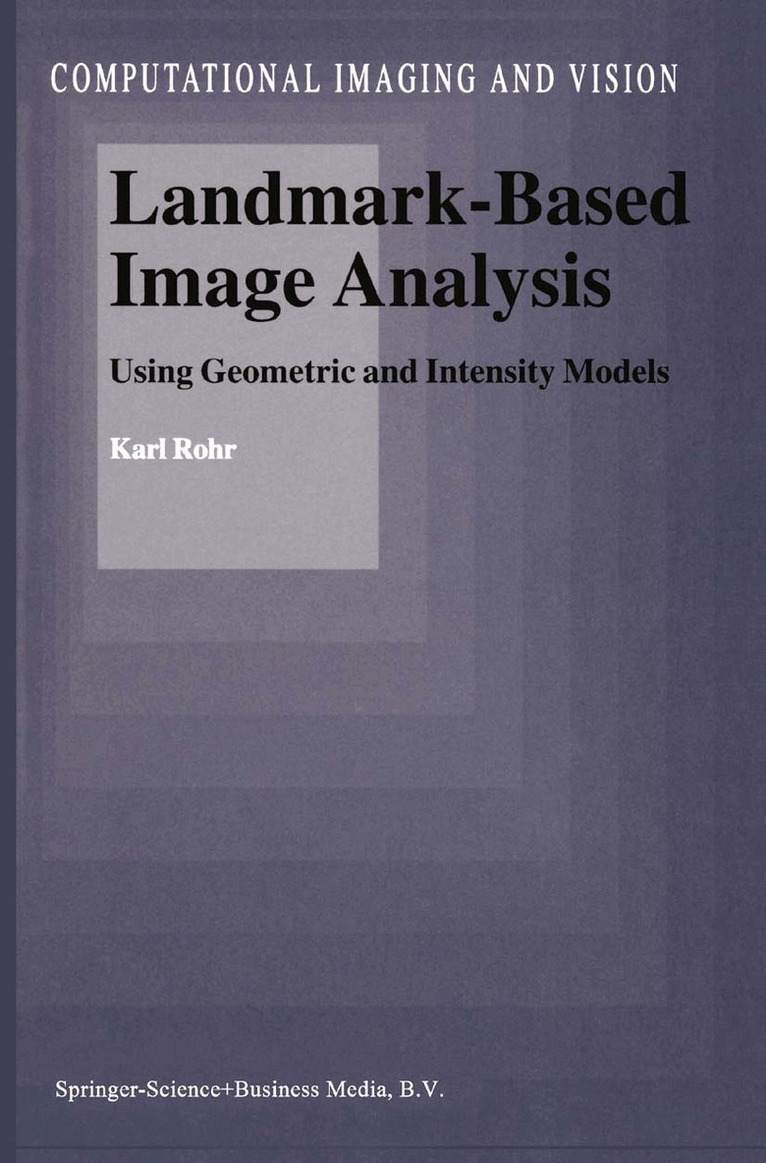
This is a comprehensive treatment of the extraction of landmarks from multi-modality images and the use of these features for elastic image registration. The emphasis is on model-based approaches, that is, the use of explicitly represented knowledge in computer vision. Both geometric models (describing the shape of objects) and intensity models (directly representing the image intensities) are utilized. The work describes theoretical foundations, computational and algorithmic issues, as well as practical applications, notably in medicine (neurosurgery and radiology), remote sensing, and industrial automation. Connections with computer graphics and artificial intelligence are illustrated.
Del 21 - Computational Imaging and Vision
Landmark-Based Image Analysis
Using Geometric and Intensity Models
Häftad, Engelska, 2010
1 123 kr
Skickas inom 10-15 vardagar
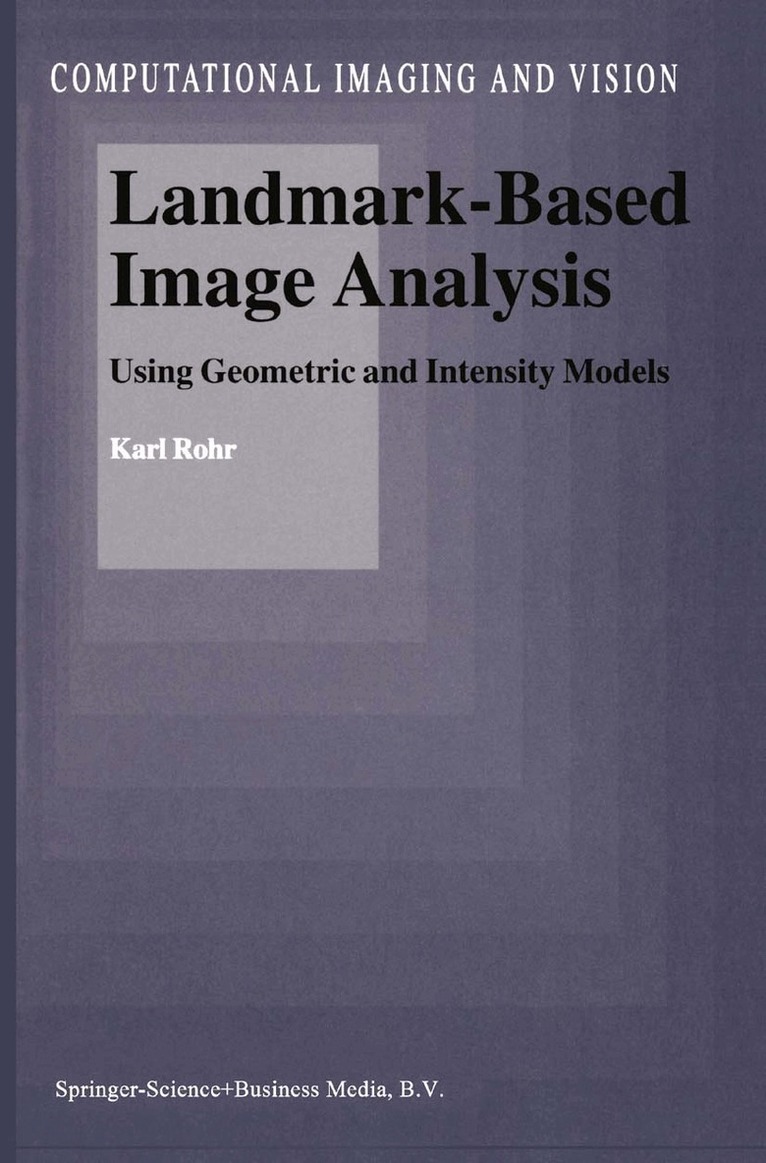
Landmarks are preferred image features for a variety of computer vision tasks such as image mensuration, registration, camera calibration, motion analysis, 3D scene reconstruction, and object recognition. Main advantages of using landmarks are robustness w. r. t. lightning conditions and other radiometric vari ations as well as the ability to cope with large displacements in registration or motion analysis tasks. Also, landmark-based approaches are in general com putationally efficient, particularly when using point landmarks. Note, that the term landmark comprises both artificial and natural landmarks. Examples are comers or other characteristic points in video images, ground control points in aerial images, anatomical landmarks in medical images, prominent facial points used for biometric verification, markers at human joints used for motion capture in virtual reality applications, or in- and outdoor landmarks used for autonomous navigation of robots. This book covers the extraction oflandmarks from images as well as the use of these features for elastic image registration. Our emphasis is onmodel-based approaches, i. e. on the use of explicitly represented knowledge in image analy sis. We principally distinguish between geometric models describing the shape of objects (typically their contours) and intensity models, which directly repre sent the image intensities, i. e. ,the appearance of objects. Based on these classes of models we develop algorithms and methods for analyzing multimodality im ages such as traditional 20 video images or 3D medical tomographic images.
E-bok
PDF, Engelska, 20131 459 kr
Läs direkt efter köp
Landmarks are preferred image features for a variety of computer vision tasks such as image mensuration, registration, camera calibration, motion analysis, 3D scene reconstruction, and object recognition. Main advantages of using landmarks are robustness w. r. t. lightning conditions and other radiometric vari ations as well as the ability to cope with large displacements in registration or motion analysis tasks. Also, landmark-based approaches are in general com putationally efficient, particularly when using point landmarks. Note, that the term landmark comprises both artificial and natural landmarks. Examples are comers or other characteristic points in video images, ground control points in aerial images, anatomical landmarks in medical images, prominent facial points used for biometric verification, markers at human joints used for motion capture in virtual reality applications, or in- and outdoor landmarks used for autonomous navigation of robots. This book covers the extraction oflandmarks from images as well as the use of these features for elastic image registration. Our emphasis is onmodel-based approaches, i. e. on the use of explicitly represented knowledge in image analy sis. We principally distinguish between geometric models describing the shape of objects (typically their contours) and intensity models, which directly repre sent the image intensities, i. e. ,the appearance of objects. Based on these classes of models we develop algorithms and methods for analyzing multimodality im ages such as traditional 20 video images or 3D medical tomographic images.