Karl T. Kurtz – författare
570 kr
Läs direkt efter köp
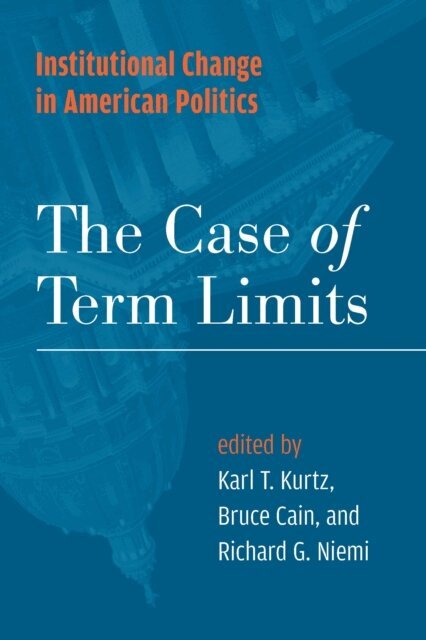
Legislative term limits adopted in the 1990s are in effect in fifteen states today. This reform is arguably the most significant institutional change in American government of recent decades. Most of the legislatures in these fifteen states have experienced a complete turnover of their membership; hundreds of experienced lawmakers have become ineligible for reelection, and their replacements must learn and perform their jobs in as few as six years.
Now that term limits have been in effect long enough for both their electoral and institutional effects to become apparent, their consequences can be gauged fully and with the benefit of hindsight. In the most comprehensive study of the subject, editors Kurtz, Cain, and Niemi and a team of experts offer their broad evaluation of the effects term limits have had on the national political landscape.
"The contributors to this excellent and comprehensive volume on legislative term limits come neither to praise the idea nor to bury it, but rather to speak dispassionately about its observed consequences. What they find is neither the horror story of inept legislators completely captive to strong governors and interest groups anticipated by the harshest critics, nor the idyll of renewed citizen democracy hypothesized by its more extreme advocates. Rather, effects have varied across states, mattering most in the states that were already most professionalized, but with countervailing factors mitigating against extreme consequences, such as a flight of former lower chamber members to the upper chamber that enhances legislative continuity. This book is must reading for anyone who wants to understand what happens to major institutional reforms after the dust has settled." ---Bernard Grofman, Professor of Political Science and Adjunct Professor of Economics, School of Social Sciences, University of California, Irvine
"A decade has passed since the first state legislators were term limited. The contributors to this volume, all well-regarded scholars, take full advantage of the distance afforded by this passage of time to explore new survey data on the institutional effects of term limits. Their book is the first major volume to exploit this superb opportunity." ---Peverill Squire, Professor, Department of Political Science, University of Iowa
Karl T. Kurtz is Director of the Trust for Representative Democracy at the National Conference of State Legislatures.
Bruce Cain is Heller Professor of Political Science and Director of the Institute of Governmental Studies at the University of California at Berkeley, and the Director of the University of California Washington Center.
Richard G. Niemi is Don Alonzo Watson Professor of Political Science at the University of Rochester.
376 kr
Skickas inom 5-8 vardagar
1 427 kr
Skickas inom 3-6 vardagar
Despite all the arguing from politicians, special interests, and political parties, Americans basically agree on the most important political issues. If only our legislators would stop fighting over obtuse policy details and really listen to what ordinary Americans want, representatives on Capitol Hill and in the statehouses would actually get something done, right? Wrong.
Americans perceive consensus when in reality there is none. The fact of the matter is Americans not only disagree on the most significant challenges facing the country, but also conflict on what to do about them. On issue after issue—crime, Social Security, homosexual rights, military intervention, abortion—the American public is deeply divided over the proper course of action. Yet our system is not flawed by this division; democracy is necessarily complex and contentious. In truth, without these messy and chaotic features of governance, our system would not be working as the Founders envisioned.
In lucid and lively prose, the authors lay out criteria with which to assess our representative system. By showing students what democracy entails in practice—the in's and out's of legislators actually doing their jobs—they will come to see that uncertainty, competing interests, confusion, bargaining, compromise, and conflict are central to the proper functioning of our democracy.