Kathleen Bruhn - Böcker
Visar alla böcker från författaren Kathleen Bruhn. Handla med fri frakt och snabb leverans.
4 produkter
4 produkter
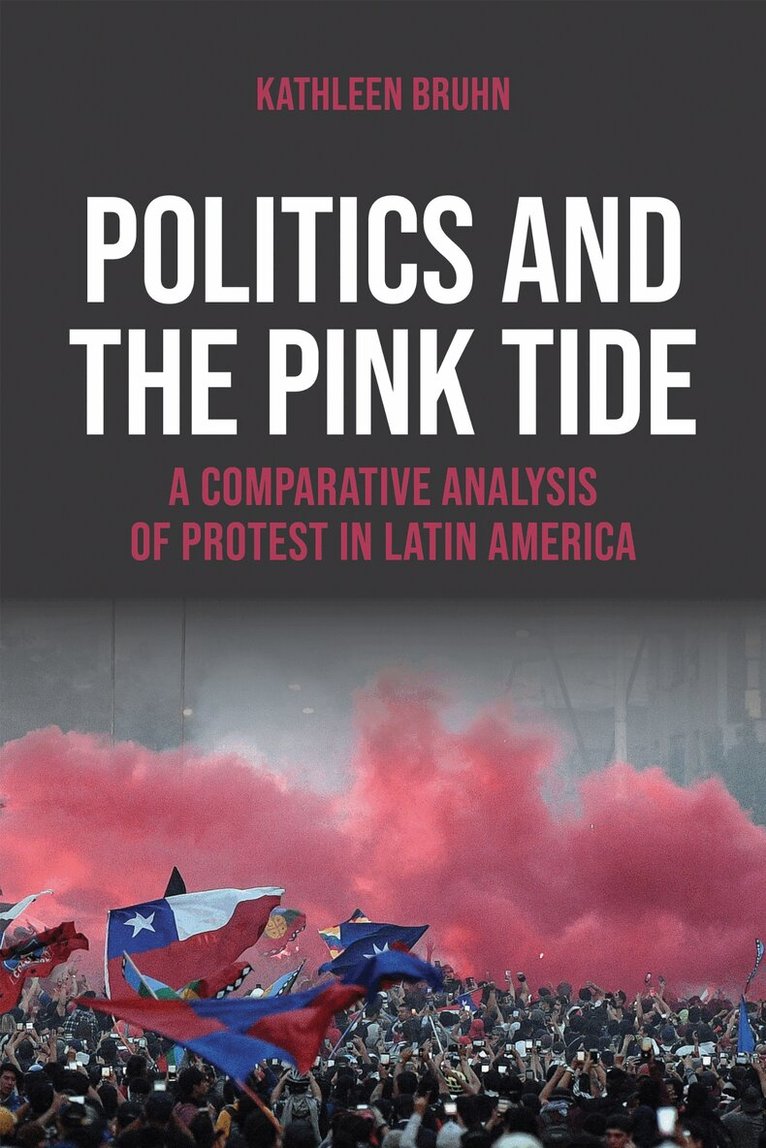
Politics and the Pink Tide
A Comparative Analysis of Protest in Latin America
Inbunden, Engelska, 2024
721 kr
Skickas inom 10-15 vardagar
Politics and the Pink Tide investigates the ways in which protest varied across five Latin American countries that elected leftist presidents during the Pink Tide.Kathleen Bruhn compares the differences in protest that occurred under the new leftist governments to their conservative, neoliberal predecessors, offering a wide-angle view into the complex relationships between neoliberalism, political party structures, and protest.Using individual and event-level data from Bolivia, Brazil, Chile, Venezuela, and Ecuador, Politics and the Pink Tide shows how economic policy choices and the links between leftist parties and social movements affect patterns of protest. For example, although more orthodox neoliberal approaches did motivate more economic protest, the book demonstrates that neither more radical nor more socially linked leftist governments were better able to contain protest—or to do so without resorting to police violence. Politics and the Pink Tide proposes a sweeping exploration of protest, one that is controlled by economic policy and grievances, the social embeddedness of political parties, and the norms surrounding protest tactics within public life.
Taking on Goliath
The Emergence of a New Left Party and the Struggle for Democracy in Mexico
Häftad, Engelska, 1996
522 kr
Skickas
Taking on Goliath analyzes the formation and decline of the most successful opposition party challenge to Mexico's long-ruling Institutional Revolutionary Party (PRI), which, until 1988, had ruled unchallenged for more than sixty years. The emergence of this new left opposition in 1988 shattered the myth of PRI invincibility. However, its failure to capitalize on its initial success raises intriguing questions about the relationship between party creation and consolidation and about the sources of party system change and democratization.This book is the only major study in English of the origins and trajectory of the PRD, the party that today represents the unified Mexican left. Kathleen Bruhn draws on extensive field research, including interviews of major participants, local case studies of party organization, documentary evidence from party statutes and reports, and newspaper archives, as well as a statistical analysis of the basis of the left vote. The insights Bruhn offers into the different conditions that affect the functioning of political parties in their emergence and in their later consolidation apply broadly to many developing countries, but they especially help us understand the possibilities for greater democracy in Mexico today.
591 kr
Skickas inom 3-6 vardagar
This engaging book provides a broad and accessible analysis of Mexico's contemporary struggle for democratic development. Now completely revised, it brings up to date issues ranging from electoral reform and accountability to drug trafficking, migration, and NAFTA. It also considers the rapidly changing role of Mexico's mass and elite groups, and its national institutions, including the media, the military, and the Church.
600 kr
Skickas inom 7-10 vardagar
Why do social organizations decide to protest instead of working through institutional channels? This book draws hypotheses from three standard models of contentious political action - POS, resource mobilization, and identity - and subjects them to a series of qualitative and quantitative tests. The results have implications for social movement theory, studies of protest, and theories of public policy/agenda setting. The characteristics of movement organizations - type of resources, internal leadership competition, and identity - shape their inherent propensity to protest. Party alliance does not constrain protest, even when the party ally wins power. Instead, protest becomes a key part of organizational maintenance, producing constant incentives to protest that do not reflect changing external conditions. Nevertheless, organizations do respond to changes in the political context, governmental cycles in particular. In the first year of a new government, organizations have strong incentives to protest in order to establish their priority in the policy agenda.