Kathleen Hicks – författare
Visar alla böcker från författaren Kathleen Hicks. Handla med fri frakt och snabb leverans.
5 produkter
Global Forecast 2014
U.S. Security Policy at a Crossroads
Av Craig Cohen, Kathleen Hicks m. fl.
Häftad, 2013
856 kr
Lägg i varukorg
After a dozen years of war, the 2008 financial crisis, budgetary contraction inside government, and growing political polarization, U.S. security policy stands at a crossroads as America finds itself lacking a durable political consensus on the nation’s role in the world. In Global Forecast 2014, …
Global Forecast 2014
U.S. Security Policy at a Crossroads
Av Craig Cohen, Kathleen Hicks m. fl.
E-bok, 2013
906 kr
Lägg i varukorg
After a dozen years of war, the 2008 financial crisis, budgetary contraction inside government, and growing political polarization, U.S. security policy stands at a crossroads as America finds itself lacking a durable political consensus on the nation’s role in the world. In Global Forecast 2014, …
Asia-Pacific Rebalance 2025
Capabilities, Presence, and Partnerships
Av Michael Green, Kathleen Hicks m. fl.
E-bok, 2016
821 kr
Lägg i varukorg
In 2015, Congress tasked the Department of Defense to commission an independent assessment of U.S. military strategy and force posture in the Asia-Pacific, as well as that of U.S. allies and partners, over the next decade. This CSIS study fulfills that congressional requirement. The authors assess …
Countering Coercion in Maritime Asia
The Theory and Practice of Gray Zone Deterrence
Av Michael Green, Kathleen Hicks m. fl.
E-bok, 2017
904 kr
Lägg i varukorg
In the past decade, tensions in Asia have risen as Beijing has become more assertive in maritime disputes with its neighbors and the United States. Although taking place below the threshold of direct military confrontation, China’s assertiveness frequently involves coercive elements that put at …
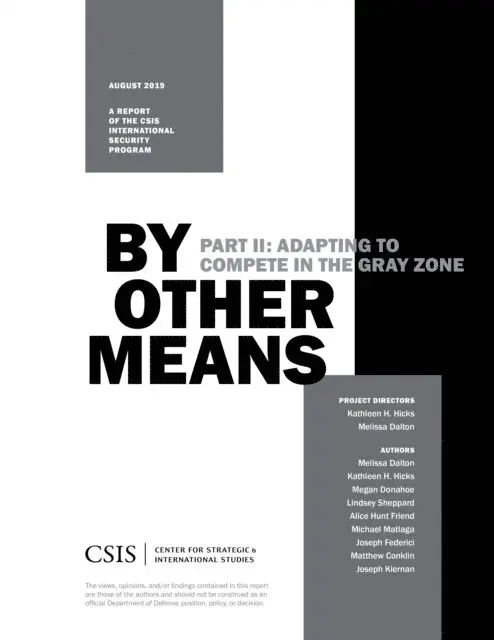
By Other Means Part II
Adapting to Compete in the Gray Zone
Av Kathleen Hicks, Melissa Dalton
E-bok, 2019
607 kr
Lägg i varukorg
Geopolitical competition is increasingly playing out in the space beyond diplomacy and short of conventional war, sometimes referred to as the gray zone, which is forcing the United States to confront the liabilities of its strengths. This report assesses current U.S. government actions to deter, …