Kathryn Bailey - Böcker
Visar alla böcker från författaren Kathryn Bailey. Handla med fri frakt och snabb leverans.
5 produkter
5 produkter
645 kr
Skickas inom 7-10 vardagar
This collection of essays looks at the music of Webern from several different perspectives. Webern scholarship, based on the sketches and other primary material now owned by the Paul Sacher Stiftung in Basel and the Library of Congress in Washington, has emphasised Webern's lyricism, and this is a theme running through Webern Studies. Most of the essays are the result of work with primary material. The volume includes entries from Webern's diaries, and all of the row tables for his twelve-note music. A comprehensive Webern bibliography covers thoroughly the period since Zoltan Roman's bibliography of 1978.
1 553 kr
Skickas inom 7-10 vardagar
This collection of essays looks at the music of Webern from several different perspectives. Webern scholarship, based on the sketches and other primary material now owned by the Paul Sacher Stiftung in Basel and the Library of Congress in Washington, has emphasised Webern's lyricism, and this is a theme running through Webern Studies. Most of the essays are the result of work with primary material. The volume includes entries from Webern's diaries, and all of the row tables for his twelve-note music. A comprehensive Webern bibliography covers thoroughly the period since Zoltan Roman's bibliography of 1978.
Del 2 - Music in the Twentieth Century
The Twelve-Note Music of Anton Webern
Old Forms in a New Language
Häftad, Engelska, 2004
441 kr
Skickas inom 7-10 vardagar
This important new study reassesses the position of Anton Webern in twentieth-century music. The twelve-note method of composition adopted by Anton Webern had profound consequences for composers of the next generation such as Stockhausen and Boulez, who saw Webern's music as revolutionary. In her detailed analyses, however, Professor Bailey demonstrates a fundamentally traditional aspect to Webern's creativity, when describing his own music. Professor Bailey analyses all Webern's twelve-note works (from Op. 17 to Op. 31) i.e. the instrumental and vocal music written between 1924 and 1943. These analyses draw on sketch material recently made available at the Paul Sacher Foundation in Basel and include transcriptions of little-known drafts and sketches. A most valuable aspect of the book is the inclusion in appendices of such materials as a complete explanation of the row content of each work, the correct prime form of each of the rows from Op. 20 onwards, with a matrix constructed for each, and exhaustive row analyses.
318 kr
Skickas inom 7-10 vardagar
On 15 September, 1945 the composer Anton Webern was shot in confusing circumstances in a small mountain village near Salzburg, and the world lost a composer of extreme originality whose mature music was still almost unknown. When Webern's works did come to light he immediately became one of the most influential figures in music of the second half of this century. But the composer who was hailed as the originator of the hyperintellectualised serialism of the 1950s and 60s was by nature an ardent romantic who held feeling - and comprehensibility - to be important above all else in art. This book focuses on several aspects of Webern's life that have been treated only briefly in earlier accounts: his youthful instability, his often embarrassing dependence on Schoenberg, his naive nationalism and his absolute belief in the value of the brief moments of music he produced.
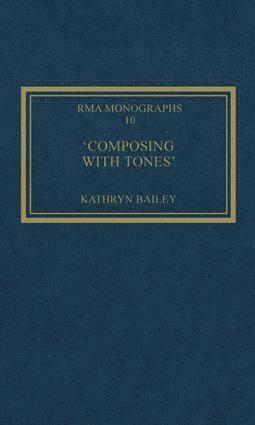
'Composing with Tones'
A Musical Analysis of Schoenberg's Op.23 Pieces for Piano
Inbunden, Engelska, 2001
1 343 kr
Skickas inom 10-15 vardagar
Schoenberg's Op.23 for solo piano, written between 1920 and 1923, represented a move from his atonal music of the preceding twelve years to 12-note music. In this analysis of the five pieces which make up Op.23, Kathryn Bailey discusses the ways in which Schoenberg clearly explores new ideas in these pieces in the context of his old style. Op.23 marked the development of a new way of organizing pitches and establishing centres of gravity in the absence of tonality; but it was also an extension of what had gone before. While moving on from Op.23 was not a big step for Schoenberg, it represented a climacteric in the history of musical composition. It was a long time before anyone outside of Schoenberg's circle would be able to see past the revolutionary idea of composing from a single pre-determined arrangement of the 12 notes of the chromatic scale to notice that in most ways this New Music answered the same conditions and fulfilled the same expectations that music had for generations.