Kathy Lavezzo – författare
Visar alla böcker från författaren Kathy Lavezzo. Handla med fri frakt och snabb leverans.
6 produkter
6 produkter
Häftad, Engelska, 2006
483 kr
Skickas inom 5-8 vardagar
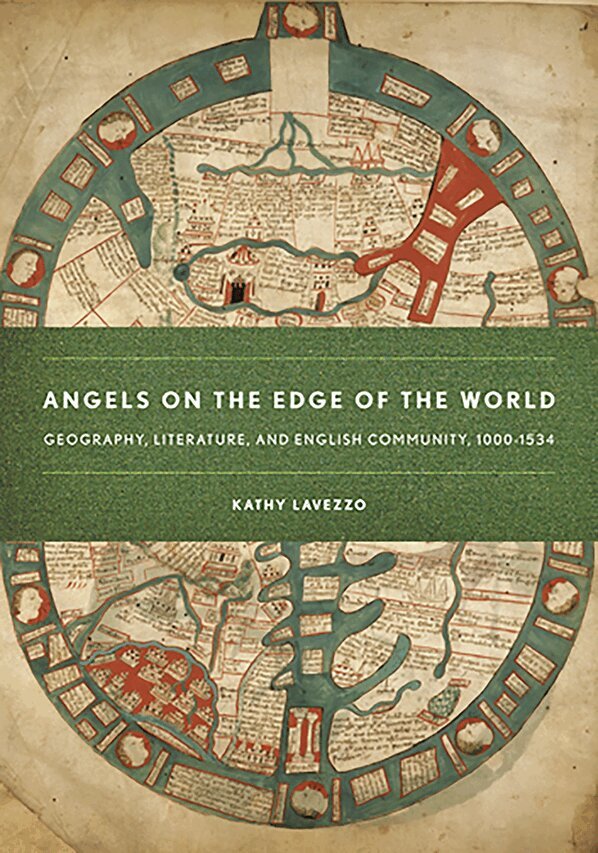
"The various and contradictory signs of English otherworldliness offered medieval writers a remarkably elastic medium with which to construct national identity.... Above all, the wonderful aspects of geographic otherness made it possible for English writers to see their homeland as not only barbarously divided but also blessed and united. Even as they acknowledged England as a barbarous wasteland... or as a site of brutal disorder..., the English also imagined England as a holy wilderness or as a blessed isle."—from the IntroductionIn a view that sweeps from the tenth century to the mid-sixteenth century, Kathy Lavezzo shows how the English people's concern with their island's relative isolation on the global map contributed to the emergence of a distinctive English national consciousness in which marginality came to be seen as a virtue. Lavezzo examines the many world maps and textual geographies produced by the English during these years. In a beautifully illustrated book, she argues that the English looked to the globe only to emphasize and, in time, to exalt their own exceptional geographic status. The author charts this process by examining a series of wondrous maps and canonical texts. Demonstrating how medieval geographic notions conditioned English attitudes toward Rome, clarifying the complicated religious history leading up to Henry the Eighth's divorce and the Reformation, Angels on the Edge of the World straddles the subjects—and methods—of literature, history, and cultural geography. It will be of special interest to those readers who use cartography as a way to map cultural identities.
Häftad, Engelska, 2003
325 kr
Skickas inom 10-15 vardagar
The first comprehensive analysis of English national identity in the late Middle AgesDuring the late Middle Ages, the increasing expansion of administrative, legal, and military systems by a central government, together with the greater involvement of the commons in national life, brought England closer than ever to political nationhood. Examining a diverse array of texts-ranging from Latin and vernacular historiography to Lollard tracts, Ricardian poetry, and chivalric treatises-this volume reveals the variety of forms “England” assumed when it was imagined in the medieval West.These essays disrupt conventional thinking about the relationship between premodernity and modernity, challenge traditional preconceptions regarding the origins of the nation, and complicate theories about the workings of nationalism. Imagining a Medieval English Nation is not only a collection of new readings of major canonical works by leading medievalists, it is among the first book-length analyses on the subject and of critical interest. Contributors: Kathleen Davis, Bucknell U; L. O. Aranye Fradenburg, U of California, Santa Barbara; Andrew Galloway, Cornell U; Jill C. Havens, Baylor U; Peggy A. Knapp, Carnegie Mellon U; Larry Scanlon, Rutgers U; D. Vance Smith, Princeton U; Claire Sponsler, U of Iowa; Lynn Staley, Colgate U; Thorlac Turville-Petre, U of Nottingham.
Inbunden, Engelska, 2016
902 kr
Skickas inom 10-15 vardagar
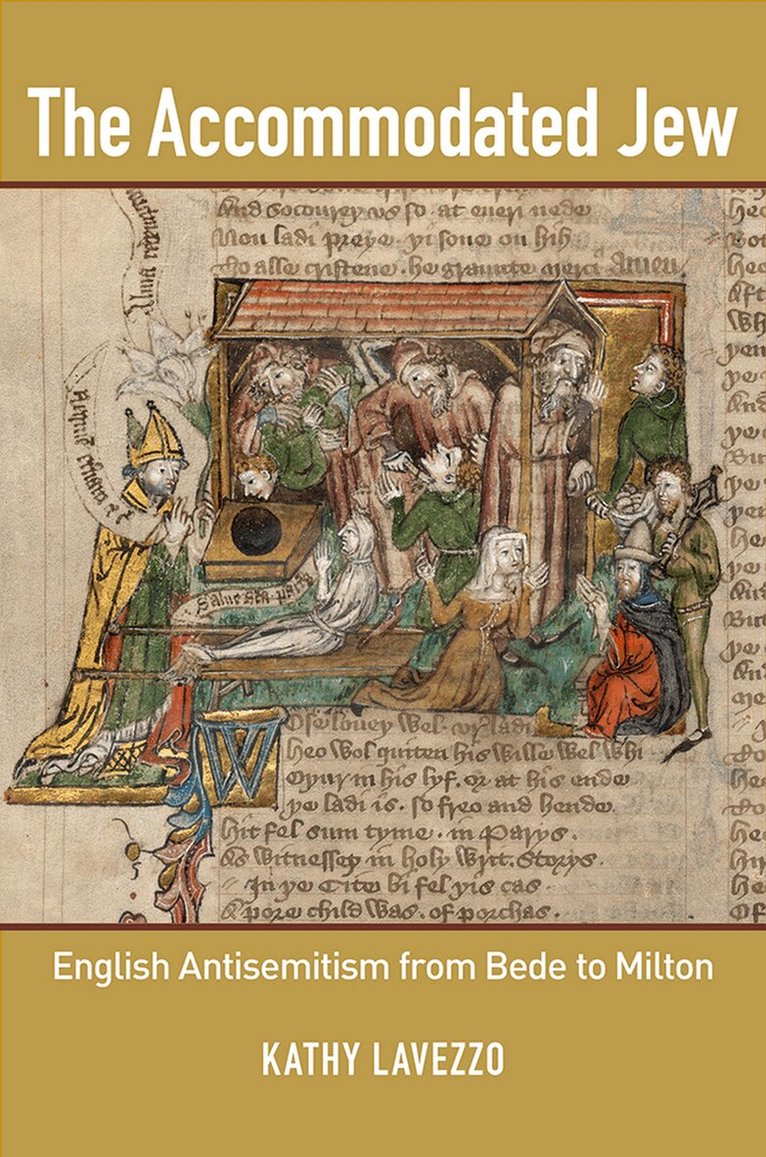
England during the Middle Ages was at the forefront of European antisemitism. It was in medieval Norwich that the notorious "blood libel" was first introduced when a resident accused the city's Jewish leaders of abducting and ritually murdering a local boy. England also enforced legislation demanding that Jews wear a badge of infamy, and in 1290, it became the first European nation to expel forcibly all of its Jewish residents. In The Accommodated Jew, Kathy Lavezzo rethinks the complex and contradictory relation between England's rejection of "the Jew" and the centrality of Jews to classic English literature. Drawing on literary, historical, and cartographic texts, she charts an entangled Jewish imaginative presence in English culture. In a sweeping view that extends from the Anglo-Saxon period to the late seventeenth century, Lavezzo tracks how English writers from Bede to Milton imagine Jews via buildings—tombs, latrines and especially houses—that support fantasies of exile. Epitomizing this trope is the blood libel and its implication that Jews cannot be accommodated in England because of the anti-Christian violence they allegedly perform in their homes. In the Croxton Play of the Sacrament, Marlowe's The Jew of Malta and Shakespeare's The Merchant of Venice, the Jewish house not only serves as a lethal trap but also as the site of an emerging bourgeoisie incompatible with Christian pieties. Lavezzo reveals the central place of "the Jew" in the slow process by which a Christian "nation of shopkeepers" negotiated their relationship to the urban capitalist sensibility they came to embrace and embody. In the book's epilogue, she advances her inquiry into Victorian England and the relationship between Charles Dickens (whose Fagin is the second most infamous Jew in English literature after Shylock) and the Jewish couple that purchased his London home, Tavistock House, showing how far relations between gentiles and Jews in England had (and had not) evolved.
Inbunden, Engelska, 2025
1 340 kr
Skickas inom 10-15 vardagar
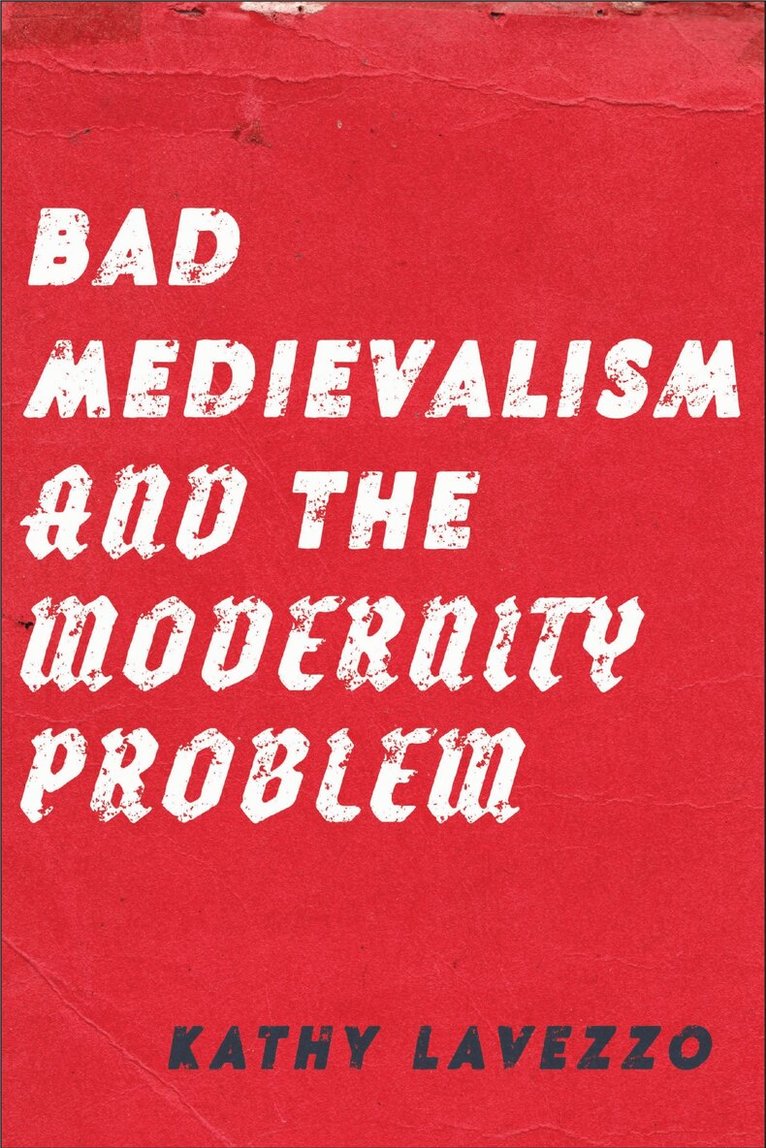
Challenges the assumptions made over the medieval/modern divide by examining the medieval roots of modern racismHumanists have long insisted on a chasm separating modernity and the Middle Ages. In Bad Medievalism and the Modernity Problem, Kathy Lavezzo demonstrates how the temporal divide scholars typically accept is a fiction that has shaped racial discourse over a longue durée. The hard line drawn between "then" and "now" is of a piece with the line separating whiteness from humans deemed irrevocably other. Thus, Lavezzo advocates a "bad" - that is, depressing and disturbing, even nauseating - historicism attuned to the interpenetration of race, whiteness and periodicity in the "west." Teasing out the dialectical invocation of both periods by figures as diverse as W. E. B. Du Bois, Carolyn Bynum, Stuart Hall, Johan Huizinga, Paule Marshall, Karl Marx, Gloria Naylor, J. R. R. Tolkien and Sylvia Wynter, Lavezzo demonstrates how the tension between and across categories of the "medieval" and the "modern" has mobilized intense emotional and political responses. Inspired by Lavezzo’s discovery that Hall, the beloved founder of cultural studies, planned as a student at Oxford to become a medievalist, but was dissuaded from that path by his teacher Tolkien, Bad Medievalism unpacks the implications of that charged encounter. Central chapters contrast Tolkien’s white heritage medievalism with a speculative inquiry into the Piers Plowman dissertation that Hall never wrote. Other chapters assess the white "feel" of periodization by scholars including Jacob Burckhardt, Huizinga, Fredric Jameson, and Bynum, and draw on theorists including Du Bois and Wynter to chart the medieval roots of a racialized discourse of progress and primitivism. Bad Medievalism culminates in new readings of Gloria Naylor’s Bailey’s Cafe and Paule Marshall’s The Fisher King, demonstrating their importance as productively pessimistic engagements with the racial legacies of both the medieval and the modern.
Häftad, Engelska, 2025
367 kr
Skickas inom 5-8 vardagar
Challenges the assumptions made over the medieval/modern divide by examining the medieval roots of modern racismHumanists have long insisted on a chasm separating modernity and the Middle Ages. In Bad Medievalism and the Modernity Problem, Kathy Lavezzo demonstrates how the temporal divide scholars typically accept is a fiction that has shaped racial discourse over a longue durée. The hard line drawn between "then" and "now" is of a piece with the line separating whiteness from humans deemed irrevocably other. Thus, Lavezzo advocates a "bad"—that is, depressing and disturbing, even nauseating—historicism attuned to the interpenetration of race, whiteness and periodicity in the "west." Teasing out the dialectical invocation of both periods by figures as diverse as W. E. B. Du Bois, Carolyn Bynum, Stuart Hall, Johan Huizinga, Paule Marshall, Karl Marx, Gloria Naylor, J. R. R. Tolkien and Sylvia Wynter, Lavezzo demonstrates how the tension between and across categories of the "medieval" and the "modern" has mobilized intense emotional and political responses. Inspired by Lavezzo’s discovery that Hall, the beloved founder of cultural studies, planned as a student at Oxford to become a medievalist, but was dissuaded from that path by his teacher Tolkien, Bad Medievalism unpacks the implications of that charged encounter. Central chapters contrast Tolkien’s white heritage medievalism with a speculative inquiry into the Piers Plowman dissertation that Hall never wrote. Other chapters assess the white "feel" of periodization by scholars including Jacob Burckhardt, Huizinga, Fredric Jameson, and Bynum, and draw on theorists including Du Bois and Wynter to chart the medieval roots of a racialized discourse of progress and primitivism. Bad Medievalism culminates in new readings of Gloria Naylor’s Bailey’s Cafe and Paule Marshall’s The Fisher King, demonstrating their importance as productively pessimistic engagements with the racial legacies of both the medieval and the modern.
E-bok
Engelska, 20111 620 kr
Läs direkt efter köp
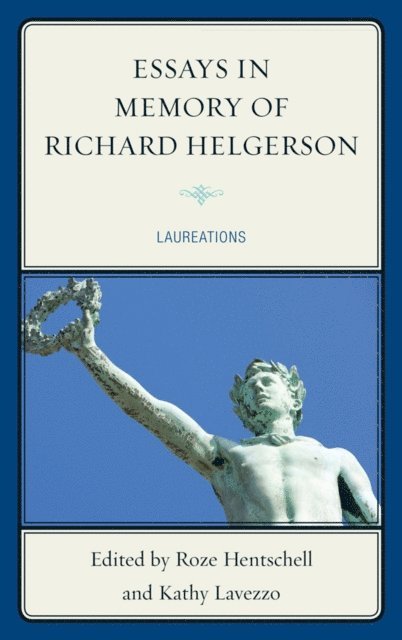
This book brings together new essays by leading cultural critics who have been influenced by the groundbreaking scholarship of Richard Helgerson. The original essays penned for this anthology evince the ongoing impact of Helgerson’s work in major critical debates including national identity, literary careerism, and studies of form. Analyzing not only early modern but also medieval literary texts, the pieces that comprise Essays in Memory of Richard Helgerson: Laureations respond to both Helgerson’s more famous scholarly works and the whole range of his critical corpus, from his earliest work on prodigality to his latest writings on mid-sixteenth century European poets. The interdisciplinary, transnational, and comparativist spirit of Helgerson’s criticism is reflected in the essays, as is his commitment to studies of multiple genres that nevertheless attend to the particularities of form.Contributors offer new interpretations of several of Shakespeare’s plays—Hamlet, I Henry IV, The Tempest, Coriolanus, Antony and Cleopatra, King Lear—and other dramas such as Beaumont’s The Knight of the Burning Pestle, the anonymous drama The London Prodigal, and Stephen Greenblatt and John Mee’s contemporary play Cardenio. In keeping with Helgerson’s comparativist turn, the volume includes analyses of Joachim Du Bellay’s poetry and Donato Gianotti’s discussion of The Divine Comedy. Prose works featured in the volume encompass More’s Utopia and Isaac Walton’s The Compleat Angler. Spenser’s early poetry and the medieval romance Floris and Blanchflour also receive new readings.