Kenneth Kollman - Böcker
Visar alla böcker från författaren Kenneth Kollman. Handla med fri frakt och snabb leverans.
2 produkter
2 produkter
502 kr
Skickas inom 7-10 vardagar
In Outside Lobbying, Ken Kollman explores why and when interest group leaders in Washington seek to mobilize the public in order to influence policy decisions in Congress. In the past, political scientists have argued that lobbying groups make outside appeals primarily because of their own internal dynamics--to recruit new members, for example. Kollman, however, grants a more important role to the need for interest group leaders to demonstrate popular support on particular issues. He interviewed more than ninety interest group leaders and policy makers active on issues ranging from NAFTA to housing for the poor. While he concludes that group leaders most often appeal to the public when they perceive that their stand has widespread popular support, he also shows that there are many important and revealing exceptions to this pattern. Kollman develops his theory of outside lobbying through a combination of rational choice modeling and statistical tests that compare public opinion data with data from his interviews about interest groups' policy positions and activities.The tests reveal that group leaders use outside lobbying to take advantage of pre-existing public preferences, not to recruit members or to try to generate the mere appearance of grass-roots support. Kollman's innovative book will clarify the complex relationship among lobbying, public opinion, and public policy, and will set a new standard for interest group research.

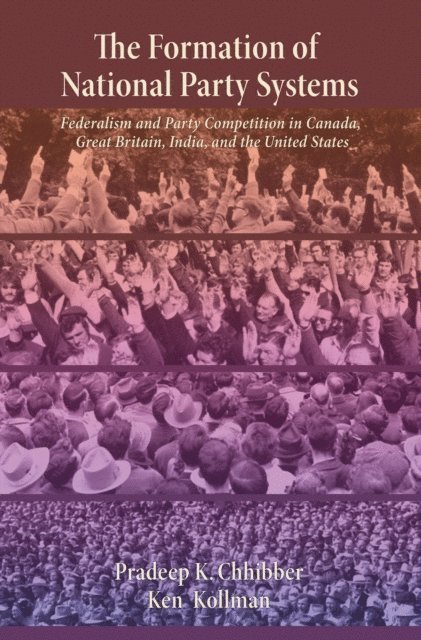
Formation of National Party Systems
Federalism and Party Competition in Canada, Great Britain, India, and the United States
Häftad, Engelska, 2004
439 kr
Skickas inom 7-10 vardagar
Pradeep Chhibber and Ken Kollman rely on historical data spanning back to the eighteenth century from Canada, Great Britain, India, and the United States to revise our understanding of why a country's party system consists of national or regional parties. They demonstrate that the party systems in these four countries have been shaped by the authority granted to different levels of government. Departing from the conventional focus on social divisions or electoral rules in determining whether a party system will consist of national or regional parties, they argue instead that national party systems emerge when economic and political power resides with the national government. Regional parties thrive when authority in a nation-state rests with provincial or state governments. The success of political parties therefore depends on which level of government voters credit for policy outcomes. National political parties win votes during periods when political and economic authority rests with the national government, and lose votes to regional and provincial parties when political or economic authority gravitates to lower levels of government.This is the first book to establish a link between federalism and the formation of national or regional party systems in a comparative context. It places contemporary party politics in the four examined countries in historical and comparative perspectives, and provides a compelling account of long-term changes in these countries. For example, the authors discover a surprising level of voting for minor parties in the United States before the 1930s. This calls into question the widespread notion that the United States has always had a two-party system. In fact, only recently has the two-party system become predominant.