Kent E. Portney - Böcker
Visar alla böcker från författaren Kent E. Portney. Handla med fri frakt och snabb leverans.
5 produkter
5 produkter
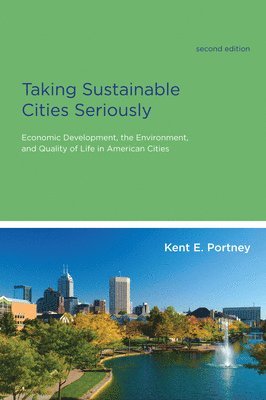
Taking Sustainable Cities Seriously
Economic Development, the Environment, and Quality of Life in American Cities
Häftad, Engelska, 2013
500 kr
Skickas inom 5-8 vardagar
171 kr
Skickas
A concise and accessible examination of sustainability in a range of contemporary contexts, from economic development to government policy.The word "sustainability" has been connected to everything from a certain kind of economic development to corporate promises about improved supply sourcing. But despite the apparent ubiquity of the term, the concept of sustainability has come to mean a number of specific things. In this accessible guide to the meanings of sustainability, Kent Portney describes the evolution of the idea and examines its application in a variety of contemporary contexts—from economic growth and consumption to government policy and urban planning.Portney takes as his starting point the 1987 definition by the World Commission on Environment and Development of sustainability as economic development activity that "meets the needs of the present without compromising the ability of future generations to meet their own needs." At its heart, Portney explains, sustainability focuses on the use and depletion of natural resources. It is not the same as environmental protection or natural resource conservation; it is more about finding some sort of steady state so that the earth can support both human population and economic growth. Portney looks at political opposition to the promotion of sustainability, which usually questions the need for sustainability or calls its costs unacceptable; collective and individual consumption of material goods and resources and to what extent they must be curtailed to achieve sustainability; the role of the private sector, and the co-opting of sustainability by corporations; government policy on sustainability at the international, national, and subnational levels; and how cities could become models for sustainability action.
Virtual Decisions
Digital Simulations for Teaching Reasoning in the Social Sciences and Humanities
Inbunden, Engelska, 2005
2 030 kr
Skickas inom 10-15 vardagar
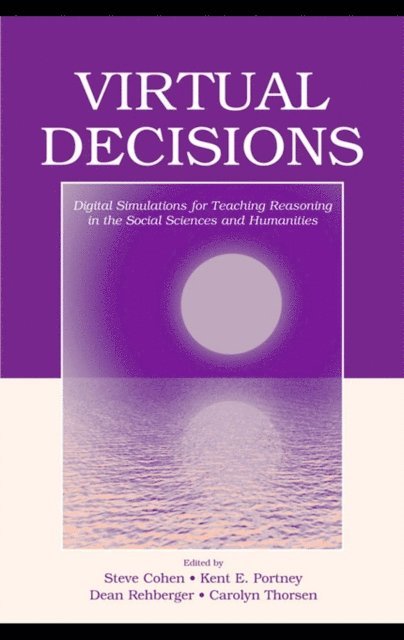
Developments in digital technologies--and in understandings of how best to use them--have altered teaching and learning environments, and stand to do so even more rapidly in the future. Virtual Decisions: Digital Simulations for Teaching Reasoning in the Social Sciences and Humanities focuses on the special issues related to the use of digital technologies in teaching the complex nature of social decisions, with particular attention to the use of digital role-play simulations as a means to accomplish this. With the advent of new technologies for delivering multimedia simulations to students, and advanced graphics capabilities to create life-like decision environments, digital role-play simulations are increasingly available for K-12 and higher education teachers to use in the classroom. This book helps both users and developers make intelligent choices about the value added by using simulations, technology, and media to teach reasoning in social sciences and humanities classrooms.The book relies on a four-part framework for developing a digital multimedia-based simulation approach, which represents: a cross-disciplinary method to describing simulations; the students who are using them; the educational setting in which they are used; and a rubric for assessing learning. The volume is divided into two parts. The first part presents a review of the theory and research detailing why didactic approaches do not or cannot address specific learning goals, as well as a description of the theoretical framework for using and developing simulations. The second part includes chapters on specific digital simulations and how they fit with the theoretical framework.Virtual Decisions fills a significant gap in the existing literature of instructional technology and is of interest to instructors, primarily in the social sciences and humanities, who are potential users of the simulations. It is also a resource for graduate students and pre-service teachers studying simulation design.
Virtual Decisions
Digital Simulations for Teaching Reasoning in the Social Sciences and Humanities
Häftad, Engelska, 2005
178 kr
Skickas inom 10-15 vardagar
Developments in digital technologies--and in understandings of how best to use them--have altered teaching and learning environments, and stand to do so even more rapidly in the future. Virtual Decisions: Digital Simulations for Teaching Reasoning in the Social Sciences and Humanities focuses on the special issues related to the use of digital technologies in teaching the complex nature of social decisions, with particular attention to the use of digital role-play simulations as a means to accomplish this. With the advent of new technologies for delivering multimedia simulations to students, and advanced graphics capabilities to create life-like decision environments, digital role-play simulations are increasingly available for K-12 and higher education teachers to use in the classroom. This book helps both users and developers make intelligent choices about the value added by using simulations, technology, and media to teach reasoning in social sciences and humanities classrooms.The book relies on a four-part framework for developing a digital multimedia-based simulation approach, which represents: a cross-disciplinary method to describing simulations; the students who are using them; the educational setting in which they are used; and a rubric for assessing learning. The volume is divided into two parts. The first part presents a review of the theory and research detailing why didactic approaches do not or cannot address specific learning goals, as well as a description of the theoretical framework for using and developing simulations. The second part includes chapters on specific digital simulations and how they fit with the theoretical framework.Virtual Decisions fills a significant gap in the existing literature of instructional technology and is of interest to instructors, primarily in the social sciences and humanities, who are potential users of the simulations. It is also a resource for graduate students and pre-service teachers studying simulation design.
287 kr
Skickas inom 10-15 vardagar
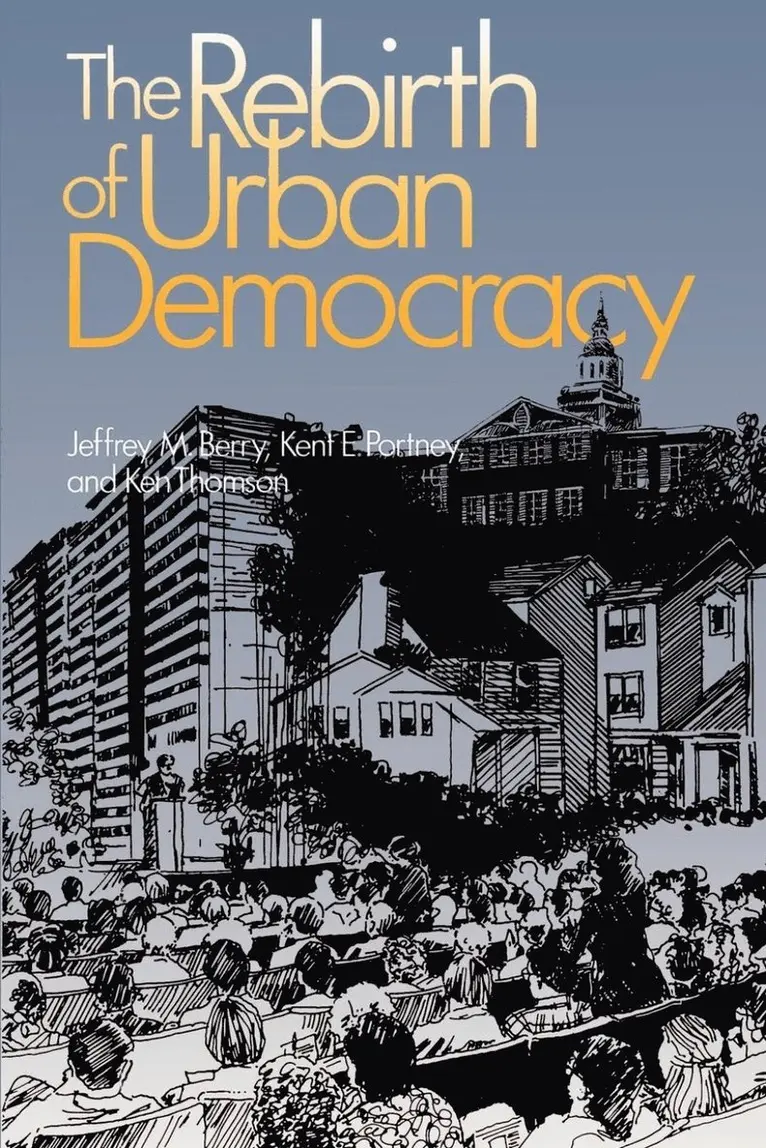
In an era when government seems remote and difficult to approach, participatory democracy may seem a hopelessly romantic notion. Yet nothing is more crucial to the future of American democracy than to develop some way of spurring greater citizen participation. In this important book, Jeffrey Berry, Ken Portney, and Ken Thompson examine cities that have created systems of neighborhood government and incorporated citizens in public policymaking. Through careful research and analysis, the authors find that neighborhood based participation is the key to revitalizing American democracy. The Rebirth of Urban Democracy provides a thorough examination of five cities with strong citizen participation programs--Birmingham, Dayton, Portland, St. Paul, and San Antonio. In each city, the authors explore whether neighborhood associations encourage more people to participate; whether these associations are able to promote policy responsiveness on the art of local governments; and whether participation in these associations increases the capacity of people to take part in government. Finally, the authors outline the steps that can be taken to increase political participation in urban America. Berry, Portney, and Thomson show that citizens in participatory programs are able to get their issues on the public agenda and develop a stronger sense of community, greater trust in government officials, and more confidence in the political system. From a rigorous evaluation of surveys and interviews with thousands of citizens and policymakers, the authors also find that central governments in these cities are highly responsive to their neighborhoods and that less conflict exists among citizens and policymakers. The authors assert that these programs can provide a blueprint for major reform in cities across the country. They outline the components for successful participation programs and offer recommendations for those who want to get involved. They demonstrate that participatio