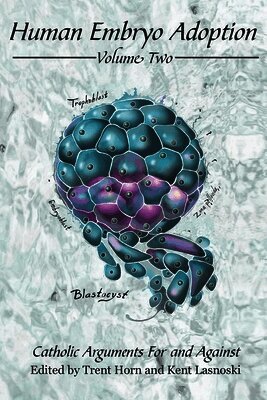
Half a century after the birth of the first person conceived through in vitro fertilization, there remains no definitive magisterial teaching on the moral liceity of embryo adoption. Catholics agree that the status quo, which has led to millions of unborn children being frozen in suspended animation as byproducts of IVF, is unacceptable. Nevertheless, consensus is elusive, and faithful Catholics sit in a kind of limbo, not knowing what if anything can be done for these young prisoners.Human Embryo Adoption, vol. 2: Catholic Arguments For and Against is the first academic book to systematically investigate the new argumentative strategies proposed since the 2008 promulgation of Dignitas personae, which contains the Church’s most direct statement on embryo adoption. The volume organizes current perspectives thematically, pairing arguments from one side of the debate with corresponding arguments from the other side. These involve questions on the proper use of sexual faculties, parenthood and the rights of the child, the theology of adoption, the example of the Annunciation, the Theology of the Body, and the works of mercy.By gathering the best arguments from a variety of approaches on both sides of the debate, Human Embryo Adoption presents the positions, arguments, and replies as they currently stand and as they are poised to move forward. This not only will help moral theologians move past the current impasses in the debate but will inform the consciences of faithful Catholics as they consider the practical question of what to do with offspring whose lives have been placed in a state of suspended animation.
For decades, respected Scripture scholar Fr. William S. Kurz, S.J. has exemplified the unity of scholarship, faith, and action. In this book, an international gathering of scholars pays tribute to his life and work.The first essay speaks to the need for the unity Fr. Kurz has lived so well. The next three essays illuminate the kind of scholarship typical of Fr. Kurz's career: one tracks the key verb "choose" across Luke-Acts; another investigates the dinner at Emmaus through an interpretation of Caravaggio's famous painting; a third explores how we should imagine the everyday life of ordinary people in the seven cities that first received the book of Revelation. The next two essays, together with the final essay of the volume, examine the necessary union of exegesis and faith: one cannot separate exegesis of the human events of Scripture from the theological meaning of the text, because human agency cannot be separated from the action of the divine agency. The remaining essays highlight how faith-filled scholarship should feed action: one interprets the relevance of Genesis 1–3 for a theology of work, and another argues that the early chapters of Genesis are still relevant for morality today; a third essay highlights the role of the charisms of the Spirit in the Christian life, reflecting Fr. Kurz's own background in the charismatic movement; lastly, one essay describes Fr. Kurz's long life of action in the pro-life movement.Written and assembled by friends, colleagues, students, and long-time friends of Fr. Kurz, this festschrift honours his accomplishments and mirrors his virtues.
New Wine, New Wineskins: Perspectivesof Young Moral TheologiansEdited byConor Hill, Kent Lasnoski, Matthew Sherman, John Sikorski and Matthew WhelanIs New Wine, New Wineskins Still New? Reflecting on Wineskins after Seventeen Years Conor Hill, Kent Lasnoski, Matthew Sherman, John Sikorski and Matthew WhelanBefore the Eucharist, a Familial Morality Arises Matthew Sherman The Works of Mercy: Francis and the Family Kevin SchemenauerMercy Is A Person: Pope Francis and the Christological Turn in Moral Theology Alessandro RovatiMorality, Human Nature, and the Sacred Heart of Jesus Joshua EvansLiving the Mystery: Doctrine, Intellectual Disability, and Christian Imagination Medi Ann VolpeTowards a Conjugal Spirituality: Karol Wojtyla's Vision of Marriage Before, During, and After Vatican II John SikorskiThe Principle of Double Effect within Catholic Moral Theology: A Response to Two Criticisms of the Principle in Relation to Palliative Sedation Gina Maria NoiaIs Aquinas's Envy Pagan? Sheryl OvermyerResisting the Less Important: Aquinas on Modesty John-Mark MiravalleAgere Contra: An "e;Ignatian Option"e; for Engagement with American Society and Culture Benjamin T. PetersHuman or Person? On the Burial of Aborted Children Justin MennoJesus is the Jubilee: A Theological Reflection on the Pontifical Council of Justice and Peace's Toward a Better Distribution of Land: The Challenge of Agrarian Reform Matthew Philipp WhelanLaudato Si' on Non-Human Animals Anatoly Angelo R. Aseneta