Kevin Jack Riley – författare
Visar alla böcker från författaren Kevin Jack Riley. Handla med fri frakt och snabb leverans.
5 produkter
5 produkter
Häftad, Engelska, 2018
447 kr
Skickas inom 10-15 vardagar
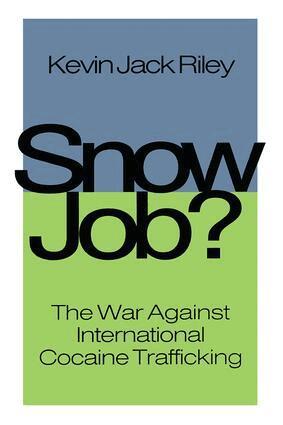
Cocaine has had a long and prominent position in the history of American substance abuse. As far back as the late 1800s cocaine was commonly found hi patent medicines, elixirs, and, astonishingly, in the earliest versions of Coca-Cola. Eventually, the potency of cocaine was recognized and its purveyors came under gradual regulation. Events hi the early 1900s kept cocaine use down until World War II, but the extensive drug use of the 1960s once again sparked a national temperance movement. Created in 1989, the Office of National Drug Control Policy maintains responsibility for coordinating and monitoring the nation's countemarcotics policy. But responsibility for coordination and monitoring is not the same thing as control.In Snow Job? Kevin Jack Riley examines source country control policies policies intended to control the production and export of cocaine from Latin America and their limitations. Part I draws together drug use, drug production, and drug control policies hi an analytic framework. It goes on to examine the recent history of U.S. drug control policies, source country control policies, the ways hi which cocaine prices affect cocaine use, how cocaine is made, and the vulnerable points in its production. Part II examines the economic effects that production and controls exert on the sources of cocaine Bolivia and Peru and probes the Colombian drug lord connection. Part III prescribes an appropriate path for source country cocaine policies and examines their implications for two other widely smuggled drugs, heroin and marijuana.Riley disagrees with analysts who believe that source country control policies can lead to permanent victory hi the war against cocaine, because of the potentially high costs associated with implementing source country control policies on a large scale. He suggests a better strategy would be one that recognizes the severe limits facing interdiction, eradication, and other source country policies, and instead focuses on directing source country resources where they will be most useful. This necessitates defining a regional strategy that elevates political stability and institution building, and demotes traditional countemarcotics objectives. Snow Job? offers original thinking and practical approaches to a multidimensional world problem and will be of interest to policymakers, political scientists, sociologists, and law enforcement officials.
Häftad, Engelska, 2017
832 kr
Skickas inom 10-15 vardagar
Robert Redfield is remembered today primarily as an anthropologist, but during his lifetime Redfield's cross-disciplinary activity reflected a strong interest in infusing anthropological practice with sociological theory. Like a handful of other anthropologists, including A.R. Radcliffe-Brown and Bronislaw Malinowski, who shared his interests during the 1920s through 1930s, his works came to define a new subfield known as social anthropology.Redfield was distinct in being one of the first Americans to devote himself seriously to social anthropology, a field dominated initially by British scholars. He spent his career at the University of Chicago, and his anthropology bore the distinct mark of sociology as developed and practiced at that institution. Indeed, Redfield played a major role in defining what has been called the "second Chicago school of sociology." This volume brings together Redfield's most important contributions to social anthropology.During the 1920s, sociology and anthropology constituted a single department at the University of Chicago. Although most students concentrated on sociology or anthropology, Redfield chose to pursue both fields with equal intensity. He adopted as his central interest the leading problematic of the 1920s: the study of social change. "Chicago School" sociologists approached social change by examining zones of rapid transition within the city, for example, areas populated by recently-arrived immigrants, with the goal of elucidating general principles or dynamics of social transition.Redfield's work can be seen as falling into three distinct theoretical categories: (1) the study of social change or modernization; (2) peasant studies; and (3), the comparative study of civilizations. Drawing from articles, book excerpts, and unpublished papers and letters, this work presents Redfield's central contributions in each of these areas. Seen as a whole, this volume traces Redfield's seminal contributions to the early development of modernization theory and the interdisciplinary fields of peasant and comparative civilizations studies. This is a monumental book on a highly influential figure.
Inbunden, Engelska, 2008
2 138 kr
Skickas inom 10-15 vardagar
Robert Redfield is remembered today primarily as an anthropologist, but during his lifetime Redfield's cross-disciplinary activity reflected a strong interest in infusing anthropological practice with sociological theory. Like a handful of other anthropologists, including A.R. Radcliffe-Brown and Bronislaw Malinowski, who shared his interests during the 1920s through 1930s, his works came to define a new subfield known as social anthropology.Redfield was distinct in being one of the first Americans to devote himself seriously to social anthropology, a field dominated initially by British scholars. He spent his career at the University of Chicago, and his anthropology bore the distinct mark of sociology as developed and practiced at that institution. Indeed, Redfield played a major role in defining what has been called the "second Chicago school of sociology." This volume brings together Redfield's most important contributions to social anthropology.During the 1920s, sociology and anthropology constituted a single department at the University of Chicago. Although most students concentrated on sociology or anthropology, Redfield chose to pursue both fields with equal intensity. He adopted as his central interest the leading problematic of the 1920s: the study of social change. "Chicago School" sociologists approached social change by examining zones of rapid transition within the city, for example, areas populated by recently-arrived immigrants, with the goal of elucidating general principles or dynamics of social transition.Redfield's work can be seen as falling into three distinct theoretical categories: (1) the study of social change or modernization; (2) peasant studies; and (3), the comparative study of civilizations. Drawing from articles, book excerpts, and unpublished papers and letters, this work presents Redfield's central contributions in each of these areas. Seen as a whole, this volume traces Redfield's seminal contributions to the early development of modernization theory and the interdisciplinary fields of peasant and comparative civilizations studies. This is a monumental book on a highly influential figure.
Inbunden, Engelska, 1996
1 313 kr
Skickas inom 10-15 vardagar
Cocaine has had a long and prominent position in the history of American substance abuse. As far back as the late 1800s cocaine was commonly found hi patent medicines, elixirs, and, astonishingly, in the earliest versions of Coca-Cola. Eventually, the potency of cocaine was recognized and its purveyors came under gradual regulation. Events hi the early 1900s kept cocaine use down until World War II, but the extensive drug use of the 1960s once again sparked a national temperance movement. Created in 1989, the Office of National Drug Control Policy maintains responsibility for coordinating and monitoring the nation's countemarcotics policy. But responsibility for coordination and monitoring is not the same thing as control.In Snow Job? Kevin Jack Riley examines source country control policies—policies intended to control the production and export of cocaine from Latin America—and their limitations. Part I draws together drug use, drug production, and drug control policies hi an analytic framework. It goes on to examine the recent history of U.S. drug control policies, source country control policies, the ways hi which cocaine prices affect cocaine use, how cocaine is made, and the vulnerable points in its production. Part II examines the economic effects that production and controls exert on the sources of cocaine—Bolivia and Peru—and probes the Colombian drug lord connection. Part III prescribes an appropriate path for source country cocaine policies and examines their implications for two other widely smuggled drugs, heroin and marijuana.Riley disagrees with analysts who believe that source country control policies can lead to permanent victory hi the war against cocaine, because of the potentially high costs associated with implementing source country control policies on a large scale. He suggests a better strategy would be one that recognizes the severe limits facing interdiction, eradication, and other source country policies, and instead focuses on directing source country resources where they will be most useful. This necessitates defining a regional strategy that elevates political stability and institution building, and demotes traditional countemarcotics objectives. Snow Job? offers original thinking and practical approaches to a multidimensional world problem and will be of interest to policymakers, political scientists, sociologists, and law enforcement officials.
Häftad, Engelska, 1995
212 kr
Tillfälligt slut