Kirsten Widner – författare
Visar alla böcker från författaren Kirsten Widner. Handla med fri frakt och snabb leverans.
8 produkter
8 produkter
Inbunden, Engelska, 2020
412 kr
Skickas inom 5-8 vardagar
It is well established that the race and gender of elected representatives influence the ways in which they legislate, but surprisingly little research exists on how race and gender interact to affect who is elected and how they behave once in office. How do race and gender affect who gets elected, as well as who is represented? What issues do elected representatives prioritize? Does diversity in representation make a difference?Race, Gender, and Political Representation takes up the call to think about representation in the United States as intersectional, and it measures the extent to which political representation is simultaneously gendered and raced. Specifically, the book examines how race and gender interact to affect the election, behavior, and impact of all individuals. By putting women of color at the center of their analysis and re-evaluating traditional, "single-axis" approaches to studying the politics of race or gender, the authors demonstrate what an intersectional approach to identity politics can reveal. Drawing on original data on the presence, policy leadership, and policy impact of Black women and men, Latinas and Latinos, and White women and men in state legislative office in the late twentieth and early twenty-first centuries, each chapter shows how the politics of race, gender, and representation are far more complex than recurring "Year of the Woman" frameworks suggest. An array of race-gender similarities and differences are evident in the experiences, activities, and accomplishments of these state legislators. Yet one thing is clear: the representation of those marginalized by multiple, intersecting systems of power and inequality is intricately bound to the representation of women of color.
E-bok
PDF, Engelska, 2020336 kr
Läs direkt efter köp
It is well established that the race and gender of elected representatives influence the ways in which they legislate, but surprisingly little research exists on how race and gender interact to affect who is elected and how they behave once in office. How do race and gender affect who gets elected, as well as who is represented? What issues do elected representatives prioritize? Does diversity in representation make a difference?Race, Gender, and Political Representation takes up the call to think about representation in the United States as intersectional, and it measures the extent to which political representation is simultaneously gendered and raced. Specifically, the book examines how race and gender interact to affect the election, behavior, and impact of all individuals. By putting women of color at the center of their analysis and re-evaluating traditional, "single-axis" approaches to studying the politics of race or gender, the authors demonstrate what an intersectional approach to identity politics can reveal. Drawing on original data on the presence, policy leadership, and policy impact of Black women and men, Latinas and Latinos, and White women and men in state legislative office in the late twentieth and early twenty-first centuries, each chapter shows how the politics of race, gender, and representation are far more complex than recurring "Year of the Woman" frameworks suggest. An array of race-gender similarities and differences are evident in the experiences, activities, and accomplishments of these state legislators. Yet one thing is clear: the representation of those marginalized by multiple, intersecting systems of power and inequality is intricately bound to the representation of women of color.
336 kr
Läs direkt efter köp
It is well established that the race and gender of elected representatives influence the ways in which they legislate, but surprisingly little research exists on how race and gender interact to affect who is elected and how they behave once in office. How do race and gender affect who gets elected, as well as who is represented? What issues do elected representatives prioritize? Does diversity in representation make a difference?Race, Gender, and Political Representation takes up the call to think about representation in the United States as intersectional, and it measures the extent to which political representation is simultaneously gendered and raced. Specifically, the book examines how race and gender interact to affect the election, behavior, and impact of all individuals. By putting women of color at the center of their analysis and re-evaluating traditional, "single-axis" approaches to studying the politics of race or gender, the authors demonstrate what an intersectional approach to identity politics can reveal. Drawing on original data on the presence, policy leadership, and policy impact of Black women and men, Latinas and Latinos, and White women and men in state legislative office in the late twentieth and early twenty-first centuries, each chapter shows how the politics of race, gender, and representation are far more complex than recurring "Year of the Woman" frameworks suggest. An array of race-gender similarities and differences are evident in the experiences, activities, and accomplishments of these state legislators. Yet one thing is clear: the representation of those marginalized by multiple, intersecting systems of power and inequality is intricately bound to the representation of women of color.
Häftad, Engelska, 2023
341 kr
Skickas inom 5-8 vardagar
It is well established that the race and gender of elected representatives influence the ways in which they legislate, but surprisingly little research exists on how race and gender interact to affect who is elected and how they behave once in office. How do race and gender affect who gets elected, as well as who is represented? What issues do elected representatives prioritize? Does diversity in representation make a difference?Race, Gender, and Political Representation takes up the call to think about representation in the United States as intersectional, and it measures the extent to which political representation is simultaneously gendered and raced. Specifically, the book examines how race and gender interact to affect the election, behavior, and impact of all individuals. By putting women of color at the center of their analysis and re-evaluating traditional, "single-axis" approaches to studying the politics of race or gender, the authors demonstrate what an intersectional approach to identity politics can reveal. Drawing on original data on the presence, policy leadership, and policy impact of Black women and men, Latinas and Latinos, and White women and men in state legislative office in the late twentieth and early twenty-first centuries, each chapter shows how the politics of race, gender, and representation are far more complex than recurring "Year of the Woman" frameworks suggest. An array of race-gender similarities and differences are evident in the experiences, activities, and accomplishments of these state legislators. Yet one thing is clear: the representation of those marginalized by multiple, intersecting systems of power and inequality is intricately bound to the representation of women of color.
Häftad, Engelska, 2025
212 kr
Skickas inom 7-10 vardagar
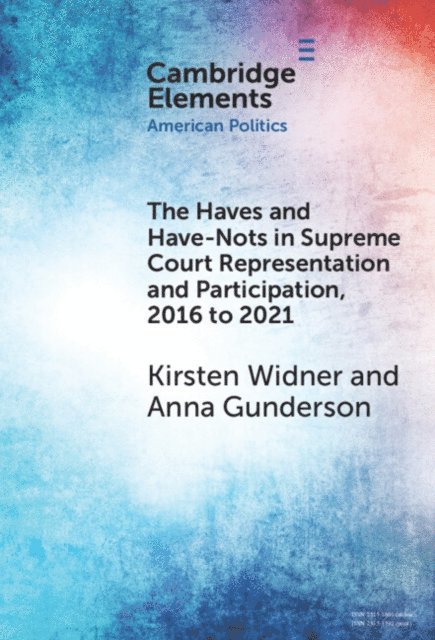
Courts are often thought of as protectors of minority rights. What happens when the composition of courts changes such that politically disadvantaged groups expect a less favorable reception? This Element examines whether the increasing conservatism of the US Supreme Court during Donald Trump's presidency changed the behavior of litigants and amicus curiae. The authors test whether membership changes led to reduced filings by individuals and organizations representing marginalized groups and increased filings by businesses and conservative states and interest groups. The authors find substantial reductions in participation by the most politically disadvantaged and substantial increases in participation by the most conservative groups.
E-bok
Engelska, 2025253 kr
Läs direkt efter köp
E-bok
PDF, Engelska, 2025256 kr
Läs direkt efter köp
Inbunden, Engelska, 2025
683 kr
Skickas inom 7-10 vardagar
Courts are often thought of as protectors of minority rights. What happens when the composition of courts changes such that politically disadvantaged groups expect a less favorable reception? This Element examines whether the increasing conservatism of the US Supreme Court during Donald Trump's presidency changed the behavior of litigants and amicus curiae. The authors test whether membership changes led to reduced filings by individuals and organizations representing marginalized groups and increased filings by businesses and conservative states and interest groups. The authors find substantial reductions in participation by the most politically disadvantaged and substantial increases in participation by the most conservative groups.