Kishore Bingi – författare
975 kr
Skickas inom 10-15 vardagar
740 kr
Skickas inom 10-15 vardagar
1 146 kr
Läs direkt efter köp
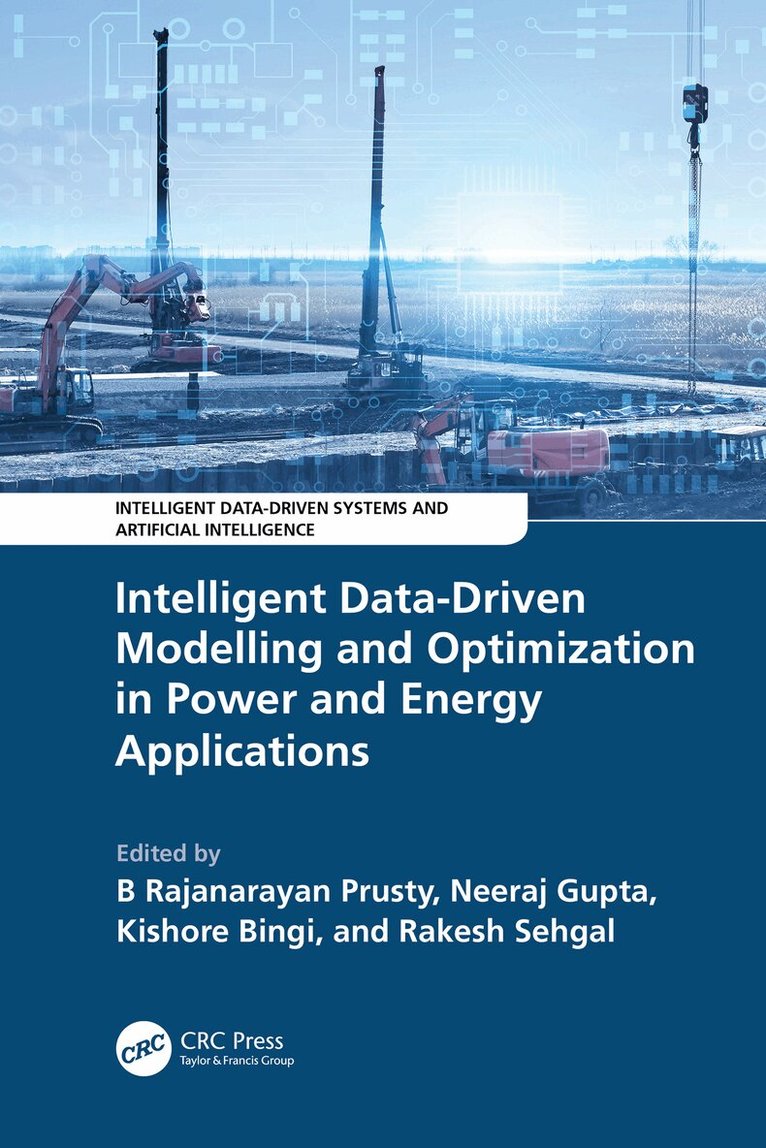
This book provides a comprehensive understanding of how intelligent data-driven techniques can be used for modelling, controlling, and optimizing various power and energy applications. It aims to develop multiple data-driven models for forecasting renewable energy sources and to interpret the benefits of these techniques in line with first-principles modelling approaches. By doing so, the book aims to stimulate deep insights into computational intelligence approaches in data-driven models and to promote their potential applications in the power and energy sectors. Its key features include:
an exclusive section on essential preprocessing approaches for the data-driven model a detailed overview of data-driven model applications to power system planning and operational activities specific focus on developing forecasting models for renewable generations such as solar PV and wind power, and showcasing the judicious amalgamation of allied mathematical treatments such as optimization and fractional calculus in data-driven model-based frameworksThis book presents novel concepts for applying data-driven models, mainly in the power and energy sectors, and is intended for graduate students, industry professionals, research, and academic personnel.
1 136 kr
Läs direkt efter köp
This book provides a comprehensive understanding of how intelligent data-driven techniques can be used for modelling, controlling, and optimizing various power and energy applications. It aims to develop multiple data-driven models for forecasting renewable energy sources and to interpret the benefits of these techniques in line with first-principles modelling approaches. By doing so, the book aims to stimulate deep insights into computational intelligence approaches in data-driven models and to promote their potential applications in the power and energy sectors. Its key features include:
an exclusive section on essential preprocessing approaches for the data-driven model a detailed overview of data-driven model applications to power system planning and operational activities specific focus on developing forecasting models for renewable generations such as solar PV and wind power, and showcasing the judicious amalgamation of allied mathematical treatments such as optimization and fractional calculus in data-driven model-based frameworksThis book presents novel concepts for applying data-driven models, mainly in the power and energy sectors, and is intended for graduate students, industry professionals, research, and academic personnel.
1 619 kr
Skickas inom 10-15 vardagar
1 977 kr
Läs direkt efter köp
1 619 kr
Skickas inom 10-15 vardagar
Hybrid PID Based Predictive Control Strategies for WirelessHART Networked Control Systems
1 082 kr
Skickas inom 10-15 vardagar
1 379 kr
Läs direkt efter köp
Recent advances in wireless technology have led to the emergence of industry standards such as WirelessHART. These strategies minimise the need for cumbersome cabling, thereby reducing costs. However, applying them involves the challenge of handling stochastic network delays, which can degrade control performance. To address this problem, commonly used simple PID could be employed. However, PID suffers from gain range limitations when used in a delayed environment. Furthermore, model-based controllers are complex and require exact models of the process and systematic system identification for implementation.
Therefore, to address these issues, the book proposes control strategies that retain the simplicity of PID in terms of ease of tuning and structure, while improving on the performance of the closed-loop system with regard to stochastic network delays and mismatches. Concretely, it proposes and discusses three strategies, namely: Setpoint Weighting (SW), Filtered Predictive PI (FPPI) and Optimal Fuzzy PID. In order to optimise some of these controllers, two novel hybrid optimisation algorithms combining the dynamism of the Bacterial Foraging Algorithm (BFA) and advantages of both the Spiral Dynamic Algorithm (SDA) and the Accelerated Particle Swarm Optimisation (APSO) have been used. The strategies proposed here can also be applied in stochastic control scenarios (not necessarily wireless) characterised by uncertainties.
This book will be useful to engineers and researchers in both industry and academia. In industry, it will be particularly useful to research and development efforts where PID controllers and wireless sensor networks (WSNs) involving both short and long term stochastic network delay are employed. Thus, it can be used for real-time control design in these areas. In the academic setting, the book will be useful for researchers, undergraduate and graduate students of instrumentation and control. It can also be used as referencematerial for teaching courses on predictive and adaptive controls and their application.Hybrid PID Based Predictive Control Strategies for WirelessHART Networked Control Systems
1 082 kr
Skickas inom 10-15 vardagar
Fractional-Order Activation Functions for Neural Networks
Case Studies on Forecasting Wind Turbines' Generated Power
1 727 kr
Skickas inom 10-15 vardagar
2 149 kr
Läs direkt efter köp
This book suggests the development of single and multi-layer fractional-order neural networks that incorporate fractional-order activation functions derived using fractional-order derivatives. Activation functions are essential in neural networks as they introduce nonlinearity, enabling the models to learn complex patterns in data. However, traditional activation functions have limitations such as non-differentiability, vanishing gradient problems, and inactive neurons at negative inputs, which can affect the performance of neural networks, especially for tasks involving intricate nonlinear dynamics. To address these issues, fractional-order derivatives from fractional calculus have been proposed. These derivatives can model complex systems with non-local or non-Markovian behavior. The aim is to improve wind power prediction accuracy using datasets from the Texas wind turbine and Jeju Island wind farm under various scenarios. The book explores the advantages of fractional-order activation functions in terms of robustness, faster convergence, and greater flexibility in hyper-parameter tuning. It includes a comparative analysis of single and multi-layer fractional-order neural networks versus conventional neural networks, assessing their performance based on metrics such as mean square error and coefficient of determination. The impact of using machine learning models to impute missing data on the performance of networks is also discussed. This book demonstrates the potential of fractional-order activation functions to enhance neural network models, particularly in predicting chaotic time series. The findings suggest that fractional-order activation functions can significantly improve accuracy and performance, emphasizing the importance of advancing activation function design in neural network analysis. Additionally, the book is a valuable teaching and learning resource for undergraduate and postgraduate students conducting research in this field.
Fractional-Order Activation Functions for Neural Networks
Case Studies on Forecasting Wind Turbines' Generated Power
1 727 kr
Skickas inom 10-15 vardagar
1 073 kr
Skickas inom 10-15 vardagar
1 374 kr
Läs direkt efter köp
1 073 kr
Skickas inom 10-15 vardagar
1 392 kr
Skickas inom 10-15 vardagar
1 680 kr
Läs direkt efter köp
This book presents the study to design, develop, and implement improved PI control techniques using dead-time compensation, structure enhancements, learning functions and fractional ordering parameters. Two fractional-order PI controllers are proposed and designed: fractional-order predictive PI and hybrid iterative learning based fractional-order predictive PI controller. Furthermore, the proposed fractional-order control strategies and filters are simulated over first- and second-order benchmark process models and further validated using the real-time experimentation of the pilot pressure process plant.
In this book, five chapters are structured with a proper sequential flow of details to provide a better understanding for the readers. A general introduction to the controllers, filters and optimization techniques is presented in Chapter 1. Reviews of the PI controllers family and their modifications are shown in the initial part of Chapter 2, followed by the development of the proposed fractional-order predictive PI (FOPPI) controller with dead-time compensation ability. In the first part of chapter 3, a review of the PI based iterative learning controllers, modified structures of the ILC and their modifications are presented. Then, the design of the proposed hybrid iterative learning controller-based fractional-order predictive PI controller based on the current cyclic feedback structure is presented. Lastly, the results and discussion of the proposed controller on benchmark process models and the real-time experimentation of the pilot pressure process plant are given. Chapter 4 presents the development of the proposed filtering techniques and their performance comparison with the conventional methods. Chapter 5 proposes the improvement of the existing sine cosine algorithm (SCA) and arithmetic optimization algorithm (AOA) to form a novel arithmetic-trigonometric optimization algorithm (ATOA) to accelerate the rate of convergence in lesser iterations with mitigation towards getting caught in the same local position. The performance analysis of the optimization algorithm will be carried out on benchmark test functions and the real-time pressure process plant.
1 392 kr
Skickas inom 10-15 vardagar
2 138 kr
Skickas inom 10-15 vardagar
2 848 kr
Läs direkt efter köp
This book offers a wide range of interesting correlations beyond the domains of dynamical systems, complex systems, and fractal geometry. Exploring complex systems and their properties using the fractal approaches, this book provides initial solutions for new areas where fractal theory has yet to verify its
expertise. Further, the book focusses on the latest scientific interest and illustrates general fractal theory in multidisciplinary areas such as computer science, electronics engineering, electrical engineering, bioengineering, biomedical, quantum physics and fluid dynamics research. This edited book is designed for professionals in the field of mathematics, computer science and physics, and even for non-specialists to help understand the concepts of fractals in nonlinear dynamical systems and complex systems while offering applications for researchers in the pure as well as in the applied background of science and
engineering.
2 202 kr
Skickas inom 10-15 vardagar