Kiss Katalin E. Kiss – författare
Visar alla böcker från författaren Kiss Katalin E. Kiss. Handla med fri frakt och snabb leverans.
2 produkter
2 produkter
E-bok
PDF, Engelska, 20151 384 kr
Läs direkt efter köp
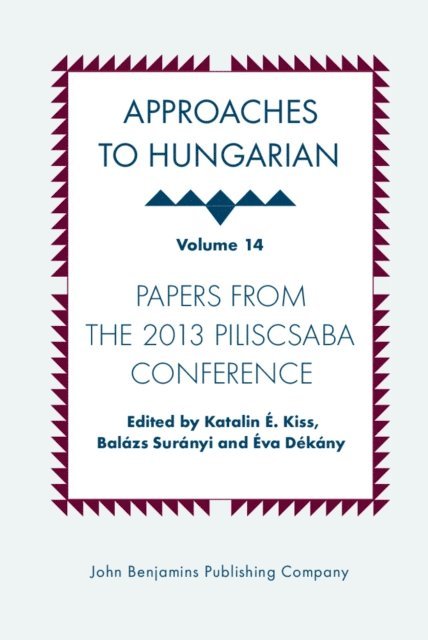
This volume of papers selected from the 11th International Conference on the Structure of Hungarian addresses current topics in Hungarian linguistics, focusing on their theoretical implications.The papers in syntax investigate the complement zone of nouns, the syntax of case assigning adpositions, sluicing in relative clauses, generic/habitual readings in clauses containing a free choice item, the argument structure of experiencer verbs in Hungarian, and cataphoric propositional pronoun insertion in Hungarian and German. The papers in morphosyntax analyze morphological alienability splits and the manifestation of the Inverse Agreement Constraint in Hungarian. The studies in phonetics and phonology inquire into regressive voicing assimilation in Hungarian and Slovak, and explore the predictions of the Functional Load Hypothesis for stress-marking and the relationship between the phonetic and phonological properties of /a:/ in Hungarian.The volume will appeal not just to scholars working on Hungarian, but to a general audience of theoretical linguists.
E-bok
PDF, Engelska, 20041 918 kr
Läs direkt efter köp
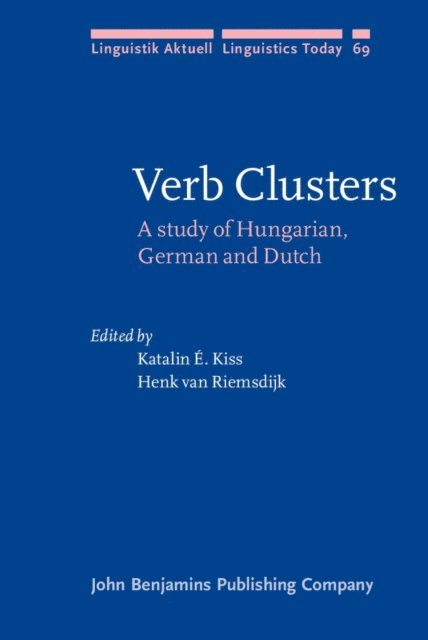
Many languages have constructions in which verbs cluster. But few languages have verb clusters as rich and complex as Continental West Germanic and Hungarian. Furthermore the precise ordering properties and the variation in the cluster patterns are remarkably similar in Hungarian and Germanic. This similarity is, of course, unexpected since Hungarian is not an Indo-European language like the Germanic language group. Instead it appears that the clustering, inversion and roll-up patterns found may constitute an areal feature. This book presents the relevant language data in considerable detail, taking into account also the variation observed, for example, among dialects. But it also discusses the various analytical approaches that can be brought to bear on this set of phenomena. In particular, there are various hypotheses as to what is the underlying driving force behind cluster formation: stress patterns, aspectual features, morpho- syntactic constraints? And the analytical approaches are closely linked to a number of questions that are at the core of current syntactic theorizing: does head movement exist or should all apparent verb displacement be reduced to remnant movement, are morphology and syntax really just different sides of the same coin?