Klaus Brinkmann - Böcker
Visar alla böcker från författaren Klaus Brinkmann. Handla med fri frakt och snabb leverans.
11 produkter
11 produkter
Georg Wilhelm Friedrich Hegel: Encyclopedia of the Philosophical Sciences in Basic Outline, Part 1, Science of Logic
Inbunden, Engelska, 2010
1 417 kr
Skickas inom 7-10 vardagar
Hegel's Encyclopaedia Logic constitutes the foundation of the system of philosophy presented in his Encyclopaedia of the Philosophical Sciences. Together with his Science of Logic, it contains the most explicit formulation of his enduringly influential dialectical method and of the categorical system underlying his thought. It offers a more compact presentation of his dialectical method than is found elsewhere, and also incorporates changes that he would have made to the second edition of the Science of Logic if he had lived to do so. This volume presents it in a new translation with a helpful introduction and notes. It will be a valuable reference work for scholars and students of Hegel and German idealism, as well as for those who are interested in the post-Hegelian character of contemporary philosophy.
Georg Wilhelm Friedrich Hegel: Encyclopedia of the Philosophical Sciences in Basic Outline, Part 1, Science of Logic
Häftad, Engelska, 2015
427 kr
Skickas inom 7-10 vardagar
Hegel's Encyclopaedia Logic constitutes the foundation of the system of philosophy presented in his Encyclopaedia of the Philosophical Sciences. Together with his Science of Logic, it contains the most explicit formulation of his enduringly influential dialectical method and of the categorical system underlying his thought. It offers a more compact presentation of his dialectical method than is found elsewhere, and also incorporates changes that he would have made to the second edition of the Science of Logic if he had lived to do so. This volume presents it in a new translation with a helpful introduction and notes. It will be a valuable reference work for scholars and students of Hegel and German idealism, as well as for those who are interested in the post-Hegelian character of contemporary philosophy.
2 068 kr
Skickas inom 7-10 vardagar
464 kr
Skickas inom 3-6 vardagar
387 kr
Skickas inom 3-6 vardagar
464 kr
Skickas inom 3-6 vardagar
336 kr
Skickas inom 3-6 vardagar
490 kr
Skickas inom 3-6 vardagar
592 kr
Skickas inom 3-6 vardagar
1 069 kr
Skickas inom 10-15 vardagar
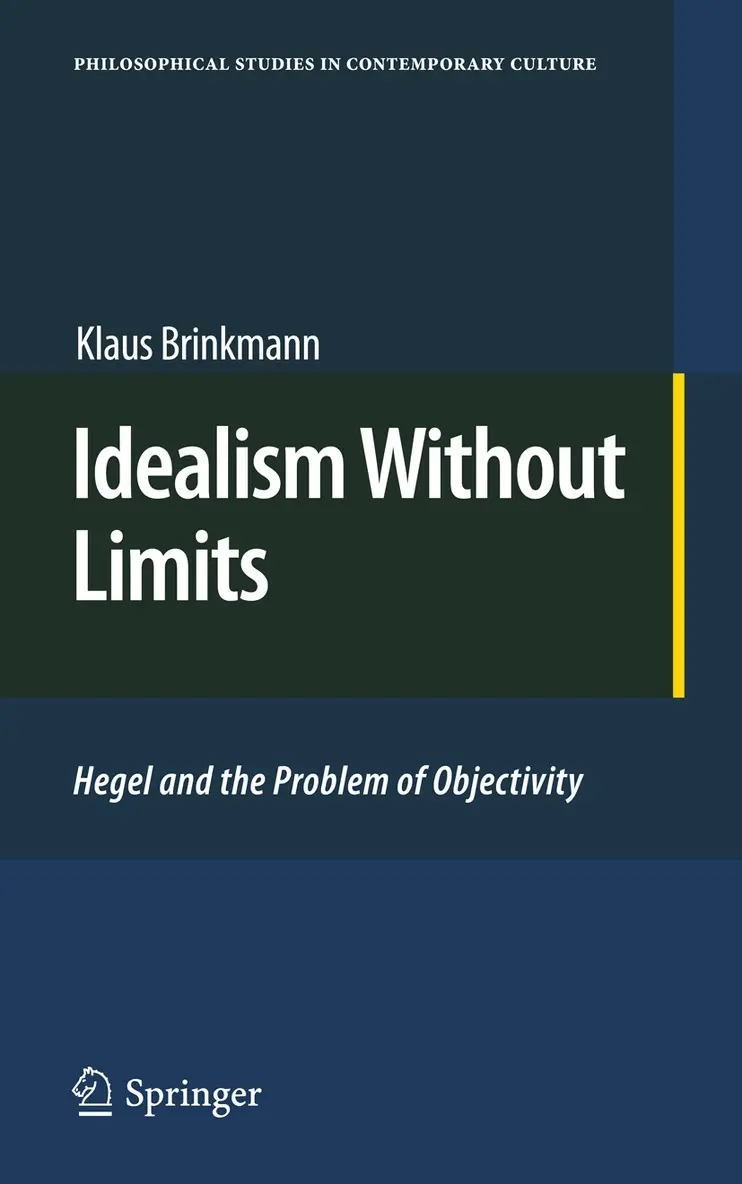
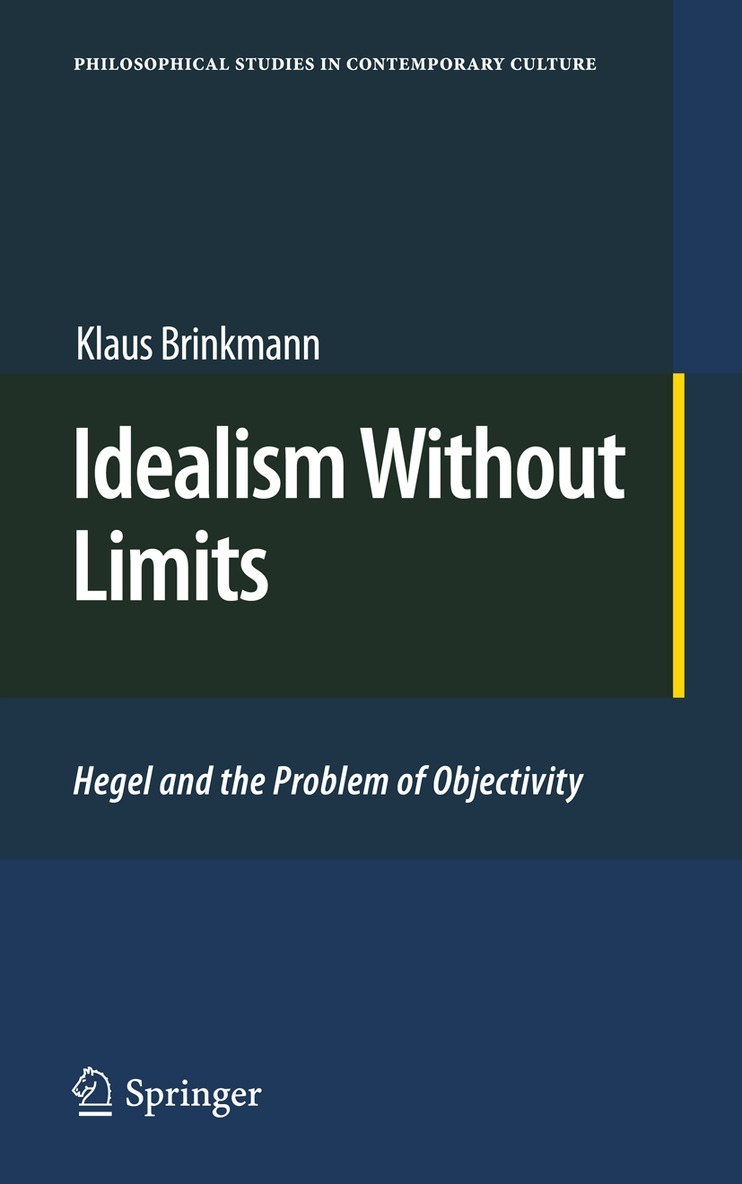
In this study of Hegel's philosophy, Brinkmann undertakes to defend Hegel's claim to objective knowledge by bringing out the transcendental strategy underlying Hegel's argument in the Phenomenology of Spirit and the Logic. Hegel's metaphysical commitments are shown to become moot through this transcendental reading. Starting with a survey of current debates about the possibility of objective knowledge, the book next turns to the original formulation of the transcendental argument in favor of a priori knowledge in Kant's First Critique. Through a close reading of Kant's Transcendental Deduction and Hegel's critique of it, Brinkmann tries to show that Hegel develops an immanent critique of Kant's position that informs his reformulation of the transcendental project in the Introduction to the Phenomenology of Spirit and the formulation of the position of 'objective thought' in the Science of Logic and the Encyclopedia of the Philosophical Sciences. Brinkmann takes the reader through the strategic junctures of the argument of the Phenomenology that establishes the position of objective thinking with which the Logic begins. A critical examination of the Introduction to the Lectures on the History of Philosophy shows that Hegel's metaphysical doctrine of the self-externalization of spirit need not compromise the ontological project of the Logic and thus does not burden the position of objective thought with pre-critical metaphysical claims.Brinkmann's book is a remarkable achievement. He has given us what may be the definitive version of the transcendental, categorial interpretation of Hegel. He does this in a clear approachable style punctuated with a dry wit, and he fearlessly takes on the arguments and texts that are the most problematic for this interpretation. Throughout the book, he situates Hegel firmly in his own context and that of contemporary discussion." -Terry P. Pinkard, University Professor, Georgetown University, Washington, D.C, USA"Klaus Brinkmann’s important Hegel study reads the Phenomenology and the Logic as aspects of a single sustained effort, in turning from categories to concepts, to carry Kant’s Copernican turn beyond the critical philosophy in what constitutes a major challenge to contemporary Cartesianism."- Tom Rockmore, McAnulty College Distinguished Professor, Duquesne University, Pittsburgh, Pennsylvania, USA"In this compelling reconstruction of the theme of objective thought, Klaus Brinkmann takes the reader through Hegel’s dialectic with exceptional philosophical acumen.... Many aspects of this book are striking: the complete mastery of the central tenets of Kant’s and Hegel’s philosophy, the admirable clarity in treating obscure texts and very difficult problems, and how Brinkmann uses his expertise for a discussion of the problems of truth, objectivity and normativity relevant to the contemporary philosophical debate. This will prove to be a very important book, one that every serious student of Kant and Hegel will have to read."- Alfredo Ferrarin, Professor, Department of Philosophy, University of Pisa, Pisa, Italy
1 069 kr
Skickas inom 10-15 vardagar
In this study of Hegel's philosophy, Brinkmann undertakes to defend Hegel's claim to objective knowledge by bringing out the transcendental strategy underlying Hegel's argument in the Phenomenology of Spirit and the Logic. Hegel's metaphysical commitments are shown to become moot through this transcendental reading. Starting with a survey of current debates about the possibility of objective knowledge, the book next turns to the original formulation of the transcendental argument in favor of a priori knowledge in Kant's First Critique. Through a close reading of Kant's Transcendental Deduction and Hegel's critique of it, Brinkmann tries to show that Hegel develops an immanent critique of Kant's position that informs his reformulation of the transcendental project in the Introduction to the Phenomenology of Spirit and the formulation of the position of 'objective thought' in the Science of Logic and the Encyclopedia of the Philosophical Sciences. Brinkmann takes the reader through the strategic junctures of the argument of the Phenomenology that establishes the position of objective thinking with which the Logic begins. A critical examination of the Introduction to the Lectures on the History of Philosophy shows that Hegel's metaphysical doctrine of the self-externalization of spirit need not compromise the ontological project of the Logic and thus does not burden the position of objective thought with pre-critical metaphysical claims.Brinkmann's book is a remarkable achievement. He has given us what may be the definitive version of the transcendental, categorial interpretation of Hegel. He does this in a clear approachable style punctuated with a dry wit, and he fearlessly takes on the arguments and texts that are the most problematic for this interpretation. Throughout the book, he situates Hegel firmly in his own context and that of contemporary discussion." -Terry P. Pinkard, University Professor, Georgetown University, Washington, D.C, USA"Klaus Brinkmann’s important Hegel study reads the Phenomenology and the Logic as aspects of a single sustained effort, in turning from categories to concepts, to carry Kant’s Copernican turn beyond the critical philosophy in what constitutes a major challenge to contemporary Cartesianism."- Tom Rockmore, McAnulty College Distinguished Professor, Duquesne University, Pittsburgh, Pennsylvania, USA"In this compelling reconstruction of the theme of objective thought, Klaus Brinkmann takes the reader through Hegel’s dialectic with exceptional philosophical acumen.... Many aspects of this book are striking: the complete mastery of the central tenets of Kant’s and Hegel’s philosophy, the admirable clarity in treating obscure texts and very difficult problems, and how Brinkmann uses his expertise for a discussion of the problems of truth, objectivity and normativity relevant to the contemporary philosophical debate. This will prove to be a very important book, one that every serious student of Kant and Hegel will have to read."- Alfredo Ferrarin, Professor, Department of Philosophy, University of Pisa, Pisa, Italy