Klaus G. Heumann – författare
Visar alla böcker från författaren Klaus G. Heumann. Handla med fri frakt och snabb leverans.
3 produkter
3 produkter
147 kr
Skickas inom 3-6 vardagar
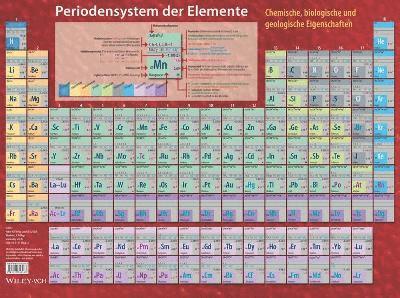
Ob in der Vorlesung, im Labor oder am Schreibtisch, das 'Periodensystem der Elemente' gibt schnelle, kompetente Antwort auf einen Blick. Das handliche, zweiseitig bedruckte und chemikalienfest eingeschweißte Periodensystem ermöglicht Ihnen den sofortigen Zugriff auf mehr als 3000 Elementdaten überall dort, wo Sie sie gerade benötigen.Die sechste Auflage berücksichtigt alle von der IUPAC empfohlenen Änderungen in den Elementdaten bis zum Jahr 2016, einschließlich der neuen Elemente Nihonium, Moscovium, Tennessine und Oganesson. Von Atomradius bis Zerfallsart - auf dem neuen 'Periodensystem' finden Sie unentbehrliche Informationen zu mehr als 20 Elementeigenschaften, darunter:· Elementsymbol, deutscher und englischer Elementname, Ordnungszahl· Relative Atommasse, Massenzahlen, Massenanteil des Elements in der Erdhülle· Anzahl und Häufigkeit natürlicher Isotope, langlebigstes Radioisotop· Radius: Atomradius, Kovalenzradius, Ionenradius, van-der-Waals-Radius· Dichte, Schmelz- oder Siedepunkt· Elektronenkonfiguration, Elektronegativität· Ionisierungsenergie, Reduktionspotential, wichtigste Oxidationszahlen· physiologische Bedeutung
Inbunden, Engelska, 2005
10 038 kr
Skickas
This two-volume handbook, prepared by Editors involved in an EU validation project on speciation, provides comprehensive coverage of the sample preparation methods and analytical techniques utilised for speciation of different elements in environmental, food, and clinical samples.Handbook of Elemental Speciation I - Techniques and Methodology brings together a collection of chapters covering different aspects of procedures for speciation analysis at the different levels starting from sample collection and storage, through sample preparation approaches to render the species chromatographable, principles of separation techniques used in speciation analysis, to the element specific detection. Also covers quality assurance and risk assessment, and speciation-relevant legislation.Handbook of Elemental Speciation II - Species in the Environment, Food, Medicine and Occupational Health provides a comprehensive, cross-disciplinary presentation of the analytical techniques involved in speciation.* Comprehensive coverage of key elements and compounds in situ* Addresses the analysis and impact of these elements and compounds, e.g. arsenic, lead, copper, iron, halogens, etc., in food, the environment, clinical and occupational health* Detailed methodology and data are reported, as well as regulatory limits* Includes general introduction on the impact in these key areas
E-bok
PDF, Engelska, 20082 228 kr
Läs direkt efter köp
Refractory organic substances (ROS) are an essential part of the biogeochemical carbon cycle. Wherever there is life on earth, there will also be ROS in the form of poorly biodegradable leftovers of organisms and as a source for new life. Furthermore, it is now beyond doubt that ROS are closely related to the carbon intensity identified as one of the driving forces in the dynamics of green house gas emission, such that ROS play a key role in sustainable development. ''Refractory Organic Substances in the Environment'' provides the results of six years of top-priority research, funded by the Deutsche Forschungsgemeinschaft (DFG). This research program investigated the structure and function of ROS in different parts of the environment, from a chemical, physical, biological, and soil scientific point of view. It included the first systematic study of a set of reference samples from Central Europe, originating from a bog lake, soil seepage water, groundwater, and from the wastewaters of a brown coal processing plant and a secondary effluent. Thus, this work not only highlights the structural features obtained from the application of advanced analytical tools, but also the function in anthropogenically influenced aquatic systems and soils. Of special interest to students and researchers in life sciences.