Klaus Theweleit – författare
Visar alla böcker från författaren Klaus Theweleit. Handla med fri frakt och snabb leverans.
16 produkter
16 produkter
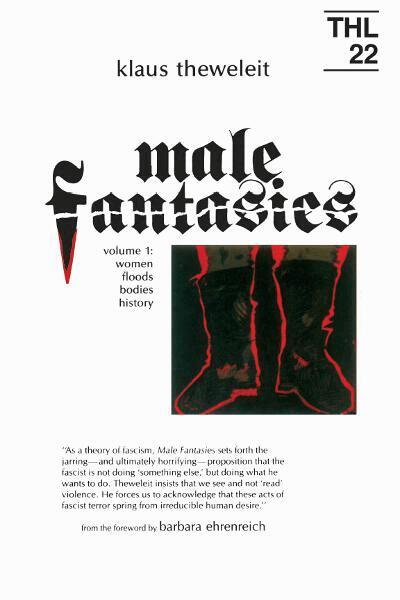
Häftad, Engelska, 1987
341 kr
Skickas
2 volume set about the fantasies of males. V. 1 includes women, floods, bodies, history. V. 2 includes male bodies, psychoanalyzing the white terror.
Häftad, Engelska, 1987
295 kr
Skickas inom 5-8 vardagar
Häftad, Engelska, 1989
295 kr
Skickas inom 5-8 vardagar
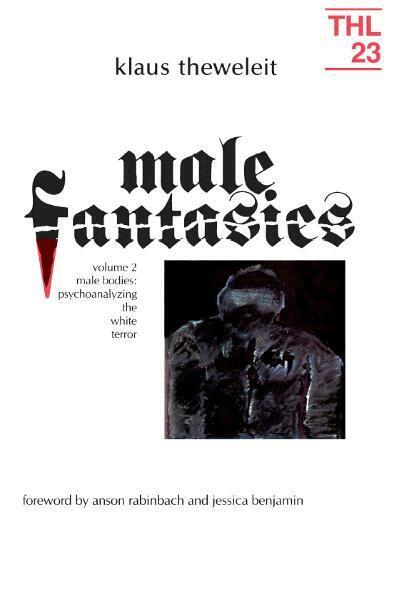
Theweleit's project in Male Fantasies is to discover the emotional core of fascism as it was revealed in the novels and memoirs of the Freikorps, mercenary bands that fought Germany's border disputes and put down worker revolts in the aftermath of World War I. His excavation of Freikorps literary remains (and the writings of some of their protofascist contemporaries) enabled Theweleit to reconstruct the mythical content of the fascist imagination. An integral part of Male Fantasies is Theweleit's choice of illustrations--cartoons, advertisements, engravings, posters--that serve as an ironic commentary on the text and extend its meaning in time and space.In this second volume of the two-volume work Theweleit discovers how the repudiation of one's own body--and of femininity--became a psychic compulsion associating masculinity with hardness, self-denial, and destruction. We are shown how the body becomes a mechanism for eluding the dreaded liquid--the "Red Flood," lava, mud--and the "feminine" emotions associated with it. Armored, organized by mental and physical procedures like the military drill, the male body is transformed into a "man of steel." As Theweleit shows, only in war does this body find redemption from constraint.The first volume of Male Fantasies, also available from the University of Minnesota Press, deals primarily with the image of women in the collective unconscious of the fascist warrior that threatens to engulf the male ego.
Häftad, Engelska, 1989
392 kr
Skickas inom 11-20 vardagar
This is the second volume of Theweleit's extraordinary study of the fantasies of some of the men centrally involved in the rise of Nazism. The author develops his account by focusing on the representation of masculinity and homosexuality and their relation to the preparations for and conduct of war. He offers a psychoanalytic interpretation of the role of warfare as a search for sensation without desire or pleasure, leading to an image of the body which emphasizes hardness, self-discipline and, ultimately, violence. This is much more than a book about culture of warfare: it is about sexuality and power, about gender, representation and violence. It is a document of our times which will be of interest to anyone concerned with modern history, contemporary politics and social, political and literary theory.
Häftad, Engelska, 1994
264 kr
Skickas inom 3-6 vardagar
Whom do we choose when we fall in love? How do we make the love-object into what we want? These are questions which only became important at the end of the nineteenth century, as Freud began to formulate a new discipline which would be called psycholanalysis. Freud argues Klaus Theweleit, was the first theoretician of the new situation: boy versus girl in the world series of love.Theweleit looks at a number of relationships: Alfred Hitchcock and Alma Reville; the triangle of Hannah Arendt, Martin Heidegger and Elfriede Heidegger; Jung and Sabina Spierlrein. But the key figure is Freud himself. Who would, who could Freud choose? As it happened, Freud proposed to Martha Bernays. The 1,500 letters of Freud's courtship became something like the first psychoanalysis; without knowing it, Martha Bernays became an analytic-instance.But Object-Choice is not only a study of the founder of psychoanalysis, it is also an illuminating lexicon of love in the twentieth century. Freud is accompanied here by Jimi Hendrix, the Kinks and the Velvet Underground. Like Theweleits's Male Fantasies, this is a collage book, mixing auto-biography, theory and pop culture, and always haunted by history, above all the history of Nazism.As an epilogue, Theweleit brings Freud back to the scene of his courtship, and the Beatles back to Hamburg, in an exploration of that city's Wandsbek district, once home to an important Jewish community. His comments on the transformations and destruction that Wandsbek has endured form an elegiac tribute to German Jewry, and a powerful conclusion to this remarkable book.
Inbunden, Tyska
279 kr
Skickas inom 3-6 vardagar
E-bok
Tyska, 2015159 kr
Läs direkt efter köp
Vom Lachen der Killer wird in zahlreichen Fällen erzählt, auch die deutschen Wehrmachtssoldaten sollen einander in englischer Kriegsgefangenschaft ihre Gräueltaten mit großer Heiterkeit berichtet haben. Hinter dem Lachen verbirgt sich aber auch die andere Seite der Tötungslust: die kalte Rationalität der Rede, wenn die Täter ihre Taten öffentlich begründen. So kommt Anders Breiviks Verteidigung vor Gericht dem Text eines Statistikseminars über Einwandererzahlen in Norwegen nahe. Theweleits Essay entlarvt die Begründungssprache als Deckmantel der Tötungslust, denn, so die provokante Kritik des Autors, "begründen" lässt sich alles, doch glauben sollte man davon eher nichts.
E-bok
Tyska, 2023237 kr
Läs direkt efter köp
Wer hat es erfunden, das Vokalalphabet? Kam es aus der Donaukultur nach Süden, brachten es die Phönizier auf ihren Handelsrouten mit, oder hat es seine Wurzeln doch in den semitischen Sprachen des Nahen Ostens? War es gar Homer, der es im Alleingang erschuf, als er die Illias und die Odyssee dichtete? Klar ist, dass sich um 800 v. Chr. das Vokalalphabet vom östlichen Mittelmeerraum ausgehend durchsetzt. In vielen Kulturtheorien sind Alphabetisierung und Demokratisierung aufs Engste verknüpft:Die massive Reduktion der nötigen Zeichen bei enormer Ausweitung des mit ihnen Ausdrückbaren stellt in ihnen einen Umschlagpunkt der Geschichte dar. Präzise und angriffslustig zugleich nimmt Klaus Theweleit die Fäden auf. Das Vokalalphabet, so seine spekulative Rekonstruktion, ist eine Erfindung von griechischen Händlern und Piraten, die auf keinen festen Heimathafen mehr zusteuern konnten. Auf stürmischer See trägt der Vokal einfach besser. Die im Versmaß des Hexameters memorierten Epen wurden zum zentralen Mittel der Kommunikation von Zugehörigkeit. »Die Erfindung des Vokalalphabets – auf See« ist eine rasante Reise zu den Ursprüngen der europäischen Kultur.
Del 20 - n.b.k. Diskurs
n.b.k. Diskurs Bd. 20 = Klaus Theweleit: Filmen nach Auschwitz: Claude Lanzmann und Jean Luc Godard
Häftad, Tyska, 2025
225 kr
Skickas inom 3-6 vardagar
E-bok
Tyska, 2019339 kr
Läs direkt efter köp
Vor 40 Jahren erschien mit Männerphantasien Klaus Theweleits große Untersuchung über die sexuelle, psychologische und soziopolitische Vorgeschichte des Nationalsozialismus in der Weimarer Republik. Das Werk, das für viele als Auftakt der Männerforschung in Deutschland gilt, ist längst zu einem Klassiker auch der Gewaltforschung geworden. Angesichts der Rückkehr rechten Straßenterrors und faschistoider Positionen, die viele schon an Weimarer Verhältnisse denken lassen, sowie von Propagandafeldzügen gegen freiere Sexualitäten - Stichwort: "Genderwahn" - sind die Analysen des Buches viel zu brennend, um es im Regal der großen Werke ins Archiv zu stellen. In dieser um ein langes Nachwort des Autors ergänzten Neuausgabe wird Theweleits epochales Werk nun endlich wieder verfügbar und diskutierbar, politisch neu nutzbar.
Inbunden, Tyska, 2019
611 kr
Skickas inom 3-6 vardagar
Inbunden, Tyska, 2020
430 kr
Skickas inom 3-6 vardagar
Inbunden, Tyska, 2020
495 kr
Skickas inom 3-6 vardagar
Inbunden, Tyska, 2020
495 kr
Skickas inom 3-6 vardagar
Inbunden, Tyska, 2020
386 kr
Skickas inom 3-6 vardagar
Häftad, Engelska, 2008
172 kr
Tillfälligt slut