Koichiro Uto – författare
3 165 kr
Skickas inom 5-8 vardagar
2 832 kr
Läs direkt efter köp
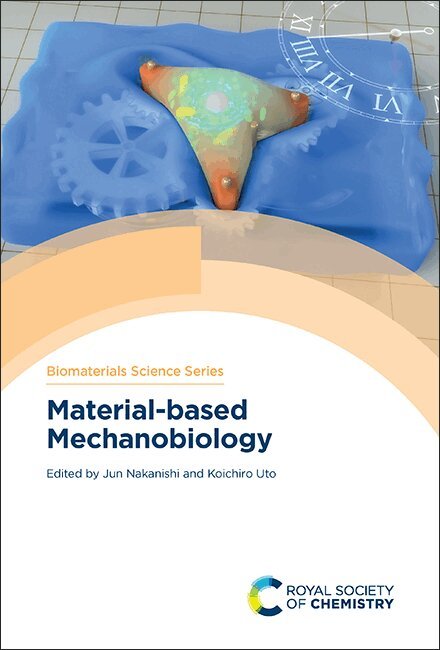
Mechanobiology is a new research field that investigates how the physical forces and changes in mechanical properties of cells and tissues contribute to their development, physiology and disease. One unique feature in the mechanical regulation, distinct from chemical/biochemical one, is that it can directly react with the multi-layered architectures of living systems, ranging from nano-scale proteins, subcellular organelles, cells, tissues, organs to whole bodies; one could term it “mechanoarchitectonics”. Another important aspect is its time-dependent dynamic feature. Not only time evolution in cells and extracellular matrices, but their intrinsic viscoelastic nature makes mechanical interaction dissipative and such feature is critical in cellular mechanical responses.
This book focuses on recent progress in mechanobiology from the materials science perspective, encompassing innovative material designs for force measurements and actuation to resolve dynamic mechanobiology and mechanoarchitectonics, by better mimicking physiologically relevant and time-evolving cellular mechanical environments. It also shows the marriage between cutting-edge materials science which enable spatiotemporal manipulation of material and cell dynamics in multi-dimensions and molecular biological techniques such as genome editing and next generation sequencing for cell fate/motility engineering and disease modelling, with the aim of providing valuable insights into the latest technological advances and discoveries in areas such as stem cell, fibroblast, heart, tumour, and epithelial mechanobiology.
Edited by leaders in the field, this book will be suitable for a broad range of readers, including materials scientists, biomaterial and biomedical engineering researchers and those working in chemical and mechanical engineering to expand possibilities of system designs for the developments of medical technologies based on mechanobiology.
2 733 kr
Läs direkt efter köp
Mechanobiology is a new research field that investigates how the physical forces and changes in mechanical properties of cells and tissues contribute to their development, physiology and disease. One unique feature in the mechanical regulation, distinct from chemical/biochemical one, is that it can directly react with the multi-layered architectures of living systems, ranging from nano-scale proteins, subcellular organelles, cells, tissues, organs to whole bodies; one could term it “mechanoarchitectonics”. Another important aspect is its time-dependent dynamic feature. Not only time evolution in cells and extracellular matrices, but their intrinsic viscoelastic nature makes mechanical interaction dissipative and such feature is critical in cellular mechanical responses.
This book focuses on recent progress in mechanobiology from the materials science perspective, encompassing innovative material designs for force measurements and actuation to resolve dynamic mechanobiology and mechanoarchitectonics, by better mimicking physiologically relevant and time-evolving cellular mechanical environments. It also shows the marriage between cutting-edge materials science which enable spatiotemporal manipulation of material and cell dynamics in multi-dimensions and molecular biological techniques such as genome editing and next generation sequencing for cell fate/motility engineering and disease modelling, with the aim of providing valuable insights into the latest technological advances and discoveries in areas such as stem cell, fibroblast, heart, tumour, and epithelial mechanobiology.
Edited by leaders in the field, this book will be suitable for a broad range of readers, including materials scientists, biomaterial and biomedical engineering researchers and those working in chemical and mechanical engineering to expand possibilities of system designs for the developments of medical technologies based on mechanobiology.
1 338 kr
Skickas inom 10-15 vardagar
1 785 kr
Läs direkt efter köp
This book provides comprehensive coverage of smart biomaterials and their potential applications, a field that is developing at a very rapid pace. Because smart biomaterials are an emerging class of biomaterials that respond to small changes in external stimuli with large discontinuous changes in their physical properties, they have been designed to act as an “on–off” switch for, among others, bio separation, immunoanalysis, drug delivery technologies, gene therapy, diagnostics, bio sensors and artificial muscles. After an introduction to the topic and the history of smart biomaterials, the author gives the reader an in-depth look at the properties, mechanics, and characterization of smart biomaterials including hydrogels, particles, assemblies, surfaces, fibers and conjugates. Information on the wide range of applications for these materials follows, including drug delivery, tissue engineering, diagnostics, biosensors, bio separation and actuators. In addition, recent advances in shape memory biomaterials as active components of medical devices are also presented.