Korneel Rabaey – författare
Visar alla böcker från författaren Korneel Rabaey. Handla med fri frakt och snabb leverans.
2 produkter
2 produkter
1 634 kr
Skickas
Throughout history, the first and foremost role of urban water management has been the protection human health and the local aquatic environment. To this end, the practice of (waste-)water treatment has maintained a central focus on the removal of pollutants through dissipative pathways. Approaches like –in case of wastewater treatment- the activated sludge process, which make ‘hazardous things’ disappear, have benefitted our society tremendously by safeguarding human and environmental health. While conventional (waste-)water treatment is regarded as one of the greatest engineering achievements of the 20th century, these dissipative approaches will not suffice in the 21th century as we enter the era of the circular economy. A key challenge for the future of urban water management is the need to re-envision the role of water infrastructure, still holding paramount the safeguard of human and environmental health while also becoming a more proactive force for sustainable development through the recovery of resources embedded in urban water. This book aims (i) to explain the basic principles governing resource recovery from water (how much is there, really); (ii) to provide comprehensive overview and critical assessment of the established and emerging technologies for resource recovery from water, and (iii) to put resource recovery from water in a legal, economic (including the economy of scale of recovered products), social (consumer’s point of view), and environmental sustainability framework. This book serves as a powerful teaching tool at the graduate entry master level aiming to developing the next generation of engineers and experts and is also highly relevant for seasoned water professionals and practicing engineers.
1 822 kr
Skickas
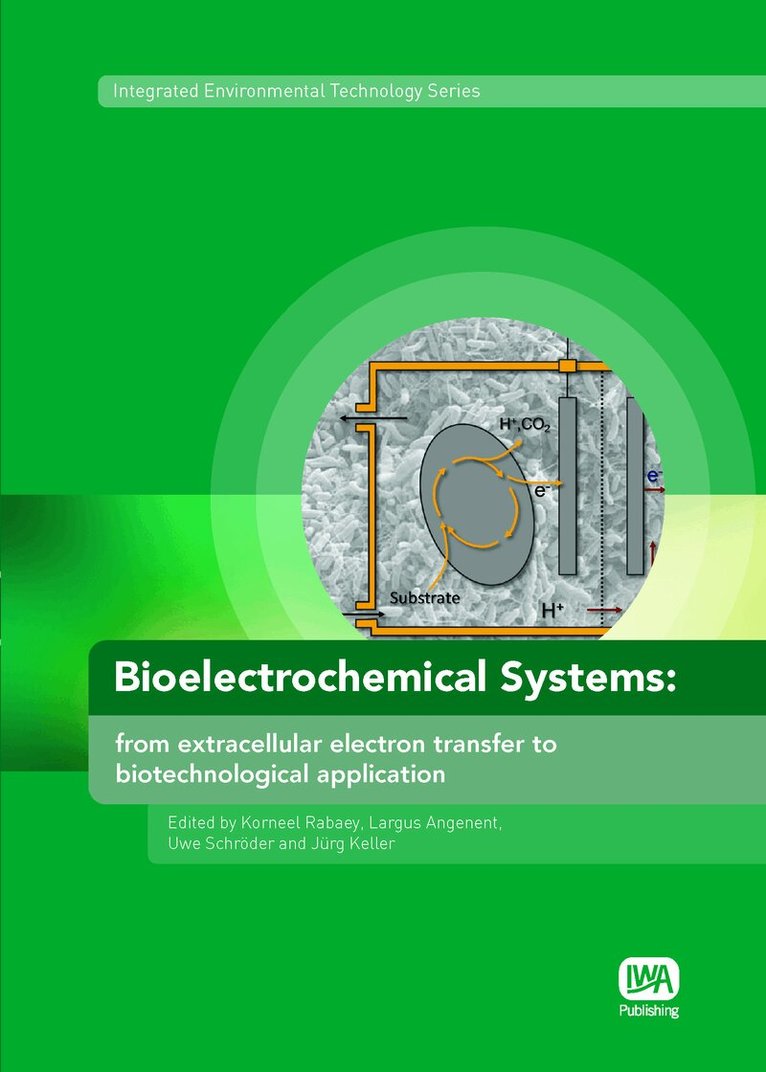
In the context of wastewater treatment, Bioelectrochemical Systems (BESs) have gained considerable interest in the past few years, and several BES processes are on the brink of application to this area. This book, written by a large number of world experts in the different sub-topics, describes the different aspects and processes relevant to their development. Bioelectrochemical Systems (BESs) use micro-organisms to catalyze an oxidation and/or reduction reaction at an anodic and cathodic electrode respectively. Briefly, at an anode oxidation of organic and inorganic electron donors can occur. Prime examples of such electron donors are waste organics and sulfides. At the cathode, an electron acceptor such as oxygen or nitrate can be reduced. The anode and the cathode are connected through an electrical circuit. If electrical power is harvested from this circuit, the system is called a Microbial Fuel Cell; if electrical power is invested, the system is called a Microbial Electrolysis Cell. The overall framework of bio-energy and bio-fuels is discussed. A number of chapters discuss the basics – microbiology, microbial ecology, electrochemistry, technology and materials development. The book continues by highlighting the plurality of processes based on BES technology already in existence, going from wastewater based reactors to sediment based bio-batteries. The integration of BESs into existing water or process lines is discussed. Finally, an outlook is provided of how BES will fit within the emerging biorefinery area.