K.R. Parthasarathy – författare
Visar alla böcker från författaren K.R. Parthasarathy. Handla med fri frakt och snabb leverans.
11 produkter
Probability Measures on Metric Spaces
Häftad, 1967
832 kr
Lägg i varukorg
In this book, the author gives a cohesive account of the theory of probability measures on complete metric spaces (which is viewed as an alternative approach to the general theory of stochastic processes). After a general description of the basics of topology on the set of measures, the author …
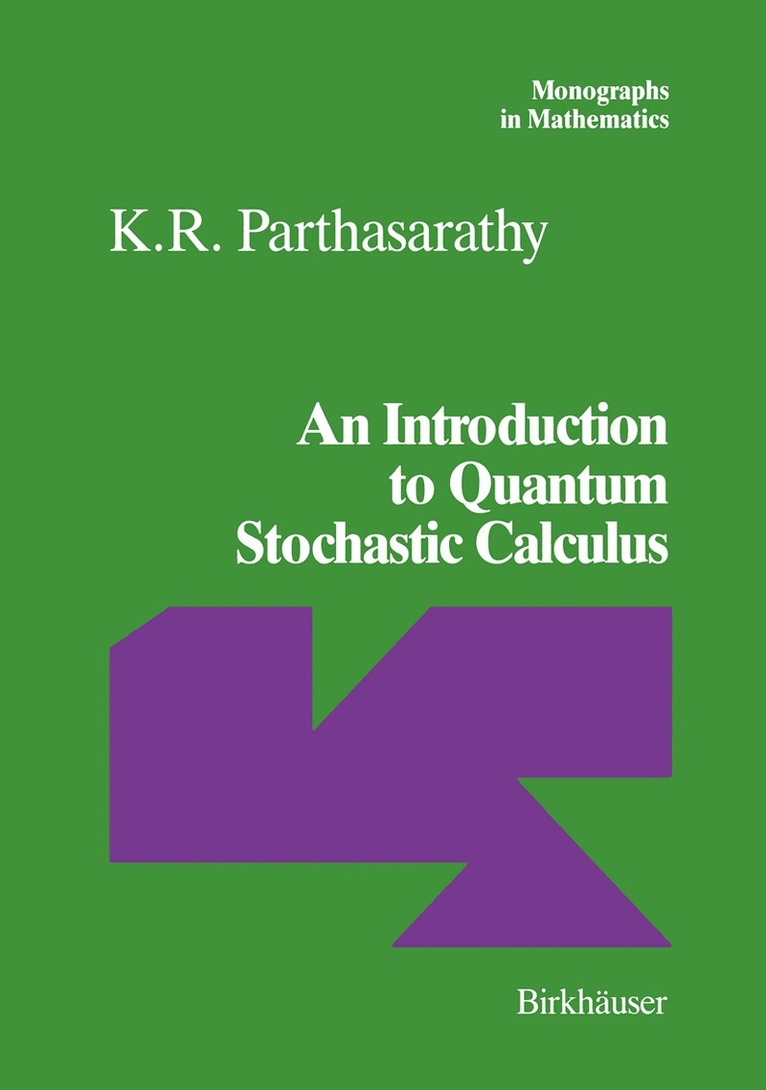
Introduction to Quantum Stochastic Calculus
Häftad, 2012
1096 kr
Lägg i varukorg
An Introduction to Quantum Stochastic Calculus aims to deepen our understanding of the dynamics of systems subject to the laws of chance both from the classical and the quantum points of view and stimulate further research in their unification. This is probably the first systematic attempt to weave …
Introduction to Quantum Stochastic Calculus
E-bok, 2012
1427 kr
Lägg i varukorg
An Introduction to Quantum Stochastic Calculus aims to deepen our understanding of the dynamics of systems subject to the laws of chance both from the classical and the quantum points of view and stimulate further research in their unification. This is probably the first systematic attempt to weave …
Introduction to Quantum Stochastic Calculus
E-bok, 2012
1459 kr
Lägg i varukorg
"Elegantly written, with obvious appreciation for fine points of higher mathematics...most notable is [the] author''s effort to weave classical probability theory into [a] quantum framework." – The American Mathematical Monthly "This is an excellent volume which will be a valuable companion both …
Introduction to Quantum Stochastic Calculus
Häftad, 2012
1093 kr
Lägg i varukorg
"Elegantly written, with obvious appreciation for fine points of higher mathematics...most notable is [the] author's effort to weave classical probability theory into [a] quantum framework." – The American Mathematical Monthly "This is an excellent volume which will be a valuable companion both for …
Collected Papers I
Limit Theorems
Av S.R.S. Varadhan, Rajendra Bhatia m. fl.
Inbunden, 2013
1093 kr
Lägg i varukorg
From the Preface: Srinivasa Varadhan began his research career at the Indian Statistical Institute (ISI), Calcutta, where he started as a graduate student in 1959. His first paper appeared in Sankhyá, the Indian Journal of Statistics in 1962. Together with his fellow students V. S. Varadarajan, R. …
Collected Papers II
PDE, SDE, Diffusions, Random Media
Av S.R.S. Varadhan, Rajendra Bhatia m. fl.
Inbunden, 2013
1093 kr
Lägg i varukorg
From the Preface: Srinivasa Varadhan began his research career at the Indian Statistical Institute (ISI), Calcutta, where he started as a graduate student in 1959. His first paper appeared in Sankhyá, the Indian Journal of Statistics in 1962. Together with his fellow students V. S. Varadarajan, R. …
Collected Papers III
Large Deviations
Av S.R.S. Varadhan, Rajendra Bhatia m. fl.
Inbunden, 2013
1093 kr
Lägg i varukorg
From the Preface: Srinivasa Varadhan began his research career at the Indian Statistical Institute (ISI), Calcutta, where he started as a graduate student in 1959. His first paper appeared in Sankhyá, the Indian Journal of Statistics in 1962. Together with his fellow students V. S. Varadarajan, R. …
Collected Papers IV
Particle Systems and Their Large Deviations
Av S.R.S. Varadhan, Rajendra Bhatia m. fl.
Inbunden, 2013
1093 kr
Lägg i varukorg
From the Preface: Srinivasa Varadhan began his research career at the Indian Statistical Institute (ISI), Calcutta, where he started as a graduate student in 1959. His first paper appeared in Sankhyá, the Indian Journal of Statistics in 1962. Together with his fellow students V. S. Varadarajan, R. …
Introduction to Probability and Measure
Häftad, 2005
456 kr
Lägg i varukorg
According to a remark attributed to Mark Kac 'Probability Theory is a measure theory with a soul'. This book with its choice of proofs, remarks, examples and exercises has been prepared taking both these aesthetic and practical aspects into account.
Coding Theorems of Classical and Quantum Information Theory
Inbunden, 2007
386 kr
Tillfälligt slut
The aim of this little book is to convey three principal developments in the evolution of modern information theory: Shannon's initiation of a revolution in 1948 by his interpretation of Boltzmann entropy as a measure of information yielded by an elementary statistical experiment and basic coding …