Kristina – författare
Visar alla böcker från författaren . Handla med fri frakt och snabb leverans.
2 produkter
2 produkter
E-bok
Engelska, 20202 999 kr
Läs direkt efter köp
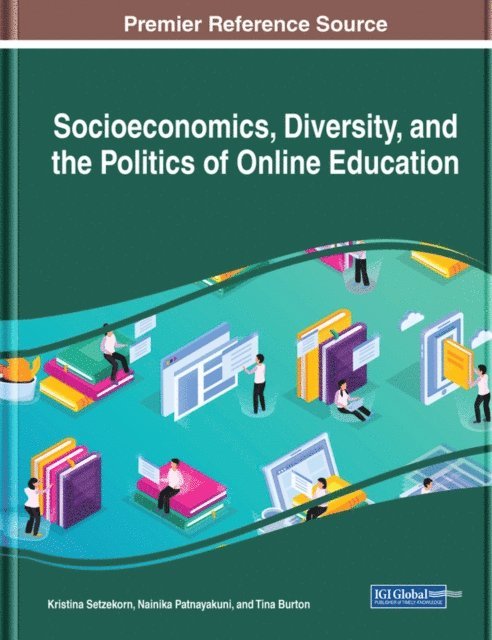
Education has until recently promoted social mobility, broad economic growth, and democracy. However, modern universities direct policy and resources toward criteria that exacerbate income inequality and reduce social mobility. Online education can make education more socially, geographically, temporally, and financially accessible, impacting the higher education industry, governments, economies, communities, and society in general. Thus, education's shift away from scarcity affects the differential earnings and socio-political influence of all concerned, and online education impacts, and is impacted by, such shifting power structures. Socioeconomics, Diversity, and the Politics of Online Education is a cutting-edge research publication that explores online education's optimal design and management so that more students, especially those traditionally underserved, are successful and can contribute to their communities and society. Additionally, it looks at the political/regulatory, diversity, and socioeconomic impacts on online education, especially for online education demographic groups. Featuring a wide range of topics including globalization, accreditation, and socioeconomics, this book is essential for teachers, administrators, government policy writers, educational software developers, MOOC providers, LMS providers, policymakers, academicians, administrators, researchers, and students interested in student retention and diversity and income inequality as well as promoting social mobility and democracy through accessible public education.

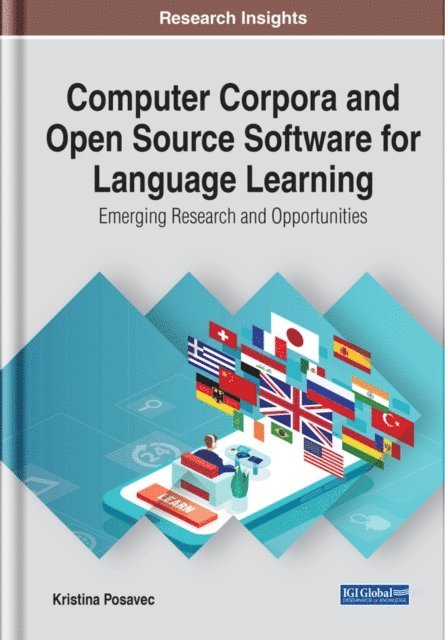
Computer Corpora and Open Source Software for Language Learning: Emerging Research and Opportunities
E-bok
Engelska, 20202 691 kr
Läs direkt efter köp
During the last four decades, a corpus-based approach to language teaching has become very significant. Direct use of corpora in language pedagogy is limited by certain factors: time, the lecturer's knowledge and skills needed to analyze the corpus, access to sources such as computers and appropriate computer tools, or a combination of these factors. The key to a successful corpus-based approach is in the appropriate level of the lecturer's guidance or pedagogical mediation, which depends on student age, experience, and prior knowledge. It is therefore very important that lecturers be equipped with the necessary knowledge and education for using and analyzing corpora on a daily basis. Computer Corpora and Open Source Software for Language Learning: Emerging Research and Opportunities is a cutting-edge research publication that analyzes teacher experiences in implementing computer corpora into their language learning classrooms in order to formulate additional insights as to best strategies for integrating such tools that maximizes language learning efficiency in primary and secondary education. Highlighting topics such as ICT tools, language education, and linguistics, this book is ideal for academicians, educators, computer science teachers, IT professionals, researchers, and students.