Krzysztof Wilmanski - Böcker
Visar alla böcker från författaren Krzysztof Wilmanski. Handla med fri frakt och snabb leverans.
7 produkter
7 produkter
Surface Waves in Geomechanics: Direct and Inverse Modelling for Soils and Rocks
Häftad, Engelska, 2005
1 324 kr
Skickas inom 10-15 vardagar
Theories of surface waves develop since the end of XIX century and many fundamental problems like existence, phase and group velocities, attenuation (quality factor), mode conversion, etc. have been, in part successfully, solved within the framework of such simple models as ideal fluids^ or linear elasticity. However, a sufficiently complete presentation of this subject, particularly for solids, is still missing in the literature. The sole exception is the book of I. A. Viktorov^ which contains an extensive discussion of fundamental properties of surface waves in homogeneous and stratified linear elastic solids with particular emphasis on contributions of Russian scientists. Unfortunately, the book has never been translated to English and its Russian version is also hardly available. Practical applications of surface waves develop intensively since a much shorter period of time than theories even though the motivation of discoverers of surface waves such as Lord Rayleigh stems from their appearance in geophysics and seismology. Nowadays the growing interest in practical applications of surface waves stem from the following two main factors: surface waves are ideal for developing relatively cheap and convenient methods of nondestructive testing of various systems spanning from nanomaterials (e.g.
1 324 kr
Skickas inom 10-15 vardagar
This book is an account on the thermomechanical behaviour of granular and porous materials and deals with experiments, theoretical deduction of macroscale equations by means of averaging from microscale properties, embedding the macroscopic description into a continuum-thermodynamical and statistical context and analysis of solutions of macroscopic models by numerical techniques. It addresses itself to engineers (chemical, civil, mechanical) applied mathematicians and physicists at the advanced student or Ph. D. level at universities, research centres and in industry.
2 115 kr
Skickas inom 10-15 vardagar
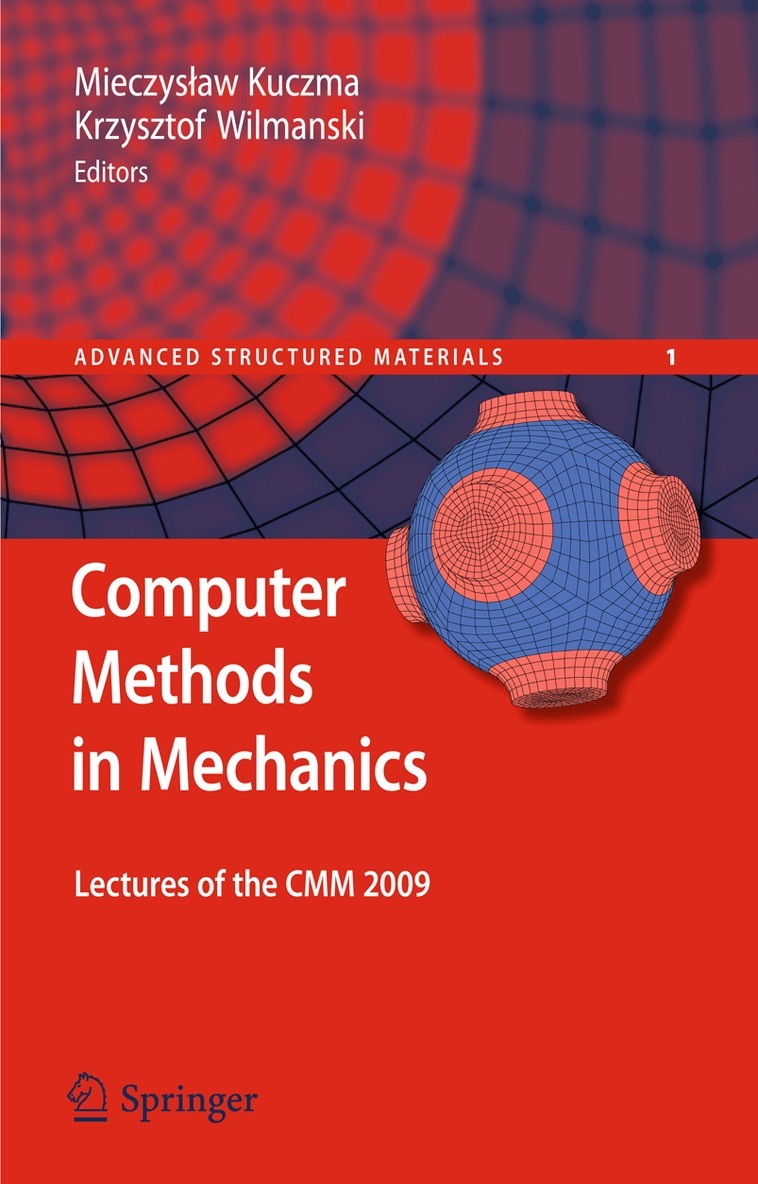
Prominent scientists present the latest achievements in computational methods and mechanics in this book. These lectures were held at the CMM 2009 conference.
2 115 kr
Skickas inom 10-15 vardagar
Prominent scientists present the latest achievements in computational methods and mechanics in this book. These lectures were held at the CMM 2009 conference.
534 kr
Skickas inom 10-15 vardagar
The notion of continuum thermodynamics, adopted in this book, is primarily understood as a strategy for development of continuous models of various physical systems. The examples of such a strategy presented in the book have both the classical character (e. g. thermoelastic materials, viscous fluids, mixtures) and the extended one (ideal gases, Maxwellian fluids, thermoviscoelastic solids etc. ). The latter has been limited intentionally to non-relativistic models; many important relativistic applications of the true extended thermodynamics will not be considered but can be found in the other sources. The notion of extended thermodynamics is also adopted in a less strict sense than suggested by the founders. For instance, in some cases we allow the constitutive dependence not only on the fields themselves but also on some derivatives. In this way, the new thermodynamical models may have some features of the usual nonequilibrium models and some of those of the extended models. This deviation from the strategy of extended thermodynamics is motivated by practical aspects; frequently the technical considerations of extended thermodynamics are so involved that one can no longer see important physical properties of the systems. This book has a different form from that usually found in books on continuum mechanics and continuum thermodynamics. The presentation of the formal structure of continuum thermodynamics is not always as rigorous as a mathematician might anticipate and the choice of physical subjects is too disperse to make a physicist happy.
Del 77 - Series on Advances in Mathematics for Applied Sciences
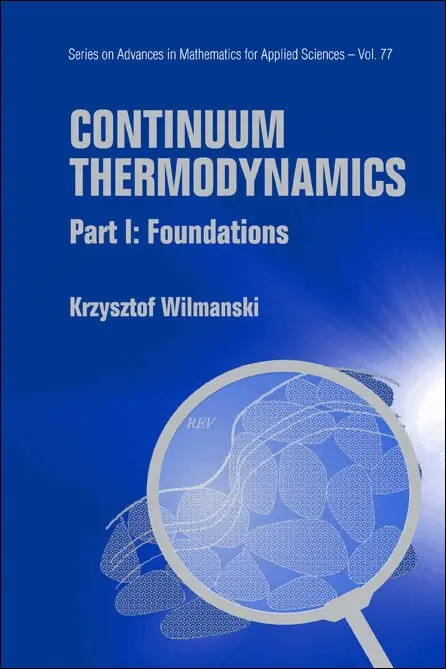
Continuum Thermodynamics - Part I: Foundations
Inbunden, Engelska, 2008
1 774 kr
Tillfälligt slut
This book is a unique presentation of thermodynamic methods of construction of continuous models. It is based on a uniform approach following from the entropy inequality and using Lagrange multipliers as auxiliary quantities in its evaluation. It covers a wide range of models — ideal gases, thermoviscoelastic fluids, thermoelastic and thermoviscoelastic solids, plastic polycrystals, miscible and immiscible mixtures, and many others. The structure of phenomenological thermodynamics is justified by a systematic derivation from the Liouville equation, through the BBGKY-hierarchy-derived Boltzmann equation, to an extended thermodynamics. In order to simplify the reading, an extensive introduction to classical continuum mechanics and thermostatics is included. As a complementary volume to Part II, which will contain applications and examples, and to Part III, which will cover numerical methods, only a few simple examples are presented in this first Part. One exception is an extensive example of a linear poroelastic material because it will not appear in future Parts.The book is the first presentation of continuum thermodynamics in which foundations of continuum mechanics, microscopic foundations and transition to extended thermodynamics, applications of extended thermodynamics beyond ideal gases, and thermodynamic foundations of various material theories are exposed in a uniform and rational way. The book may serve both as a support for advanced courses as well as a desk reference.
Del 85 - Series on Advances in Mathematics for Applied Sciences
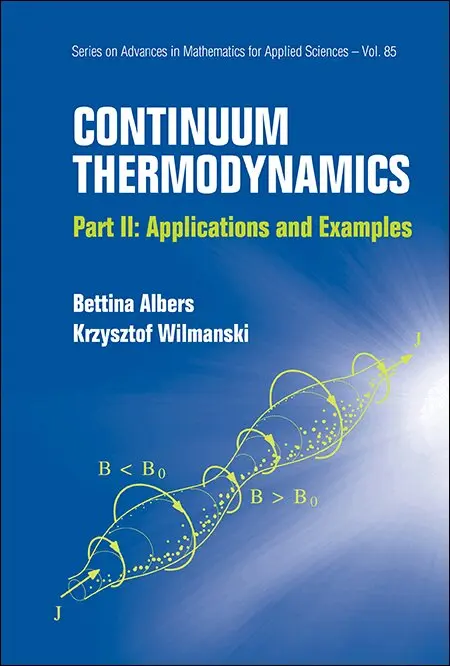
Continuum Thermodynamics - Part Ii: Applications And Examples
Inbunden, Engelska, 2014
2 396 kr
Skickas inom 3-6 vardagar
This second part of Continuum Thermodynamics is designed to match almost one-to-one the chapters of Part I. This is done so that the reader studying thermodynamics will have a deepened understanding of the subjects covered in Part I. The aims of the book are in particular: the illustration of basic features of some simple thermodynamical models such as ideal and viscous fluids, non-Newtonian fluids, nonlinear solids, interactions with electromagnetic fields, and diffusive porous materials. A further aim is the illustration of the above subjects by examples and simple solutions of initial and boundary problems as well as simple exercises to develop skills in the construction of interdisciplinary macroscopic models.