Kunio Murasugi - Böcker
Visar alla böcker från författaren Kunio Murasugi. Handla med fri frakt och snabb leverans.
3 produkter
3 produkter
536 kr
Skickas inom 10-15 vardagar
This work provides a comprehensive exposition of the theory of braids, beginning with the basic mathematical definitions and structures. Among the many topics explained in detail are: the braid group for various surfaces; the solution of the word problem for the braid group; braids in the context of knots and links (Alexander's theorem); Markov's theorem and its use in obtaining braid invariants; the connection between the Platonic solids (regular polyhedra) and braids; and the use of braids in the solution of algebraic equations. Dirac's problem and special types of braids termed Mexican plaits are also discussed. Since the book relies on concepts and techniques from algebra and topology, the author also provide a couple of appendices that cover the necessary material from these two branches of mathematics. Hence, the book is accessible not only to mathematicians but also to anybody who might have an interest in the theory of braids. In particular, as more and more applications of braid theory are found outside the realm of mathematics, this book is aimed at physicists, chemists or biologists who would like to understand the mathematics of braids.With its use of numerous figures to explain clearly the mathematics, and exercises to solidify the understanding, this book may also be used as a textbook for a course on knots and braids, or as a supplementary textbook for a course on topology or algebra.
694 kr
Skickas inom 10-15 vardagar
Knot theory is a concept in algebraic topology that has found applications to a variety of mathematical problems as well as to problems in computer science, biological and medical research, and mathematical physics. This book is directed to a broad audience of researchers, beginning graduate students, and senior undergraduate students in these fields. The book contains most of the fundamental classical facts about the theory, such as knot diagrams, braid representations, Seifert surfaces, tangles, and Alexander polynomials; also included are key newer developments and special topics such as chord diagrams and covering spaces. The work introduces the fascinating study of knots and provides insight into applications to such studies as DNA research and graph theory. In addition, each chapter includes a supplement that consists of interesting historical as well as mathematical comments.The author clearly outlines what is known and what is not known about knots. He has been careful to avoid advanced mathematical terminology or intricate techniques in algebraic topology or group theory. There are numerous diagrams and exercises relating the material. The study of Jones polynomials and the Vassiliev invariants are closely examined."The book ...develops knot theory from an intuitive geometric-combinatorial point of view, avoiding completely more advanced concepts and techniques from algebraic topology...Thus the emphasis is on a lucid and intuitive exposition accessible to a broader audience... The book, written in a stimulating and original style, will serve as a first approach to this interesting field for readers with various backgrounds in mathematics, physics, etc. It is the first text developing recent topics as the Jones polynomial and Vassiliev invariants on a level accessible also for non-specialists in the field." -Zentralblatt Math
536 kr
Skickas inom 10-15 vardagar
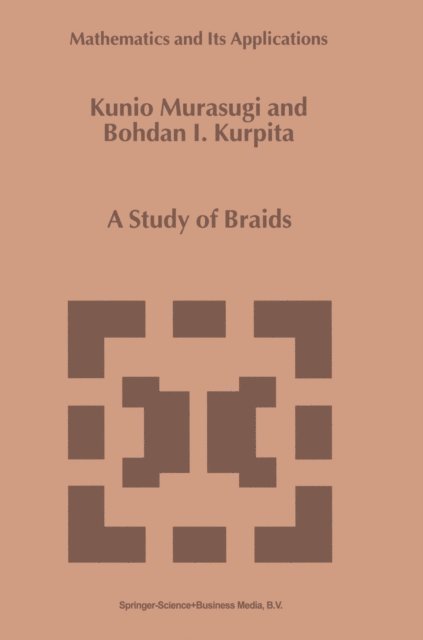
This book provides a comprehensive exposition of the theory of braids, beginning with the basic mathematical definitions and structures. Among the many topics explained in detail are: the braid group for various surfaces; the solution of the word problem for the braid group; braids in the context of knots and links (Alexander's theorem); Markov's theorem and its use in obtaining braid invariants; the connection between the Platonic solids (regular polyhedra) and braids; the use of braids in the solution of algebraic equations. Dirac's problem and special types of braids termed Mexican plaits are also discussed. Audience: Since the book relies on concepts and techniques from algebra and topology, the authors also provide a couple of appendices that cover the necessary material from these two branches of mathematics. Hence, the book is accessible not only to mathematicians but also to anybody who might have an interest in the theory of braids. In particular, as more and more applications of braid theory are found outside the realm of mathematics, this book is ideal for any physicist, chemist or biologist who would like to understand the mathematics of braids.With its use of numerous figures to explain clearly the mathematics, and exercises to solidify the understanding, this book may also be used as a textbook for a course on knots and braids, or as a supplementary textbook for a course on topology or algebra.